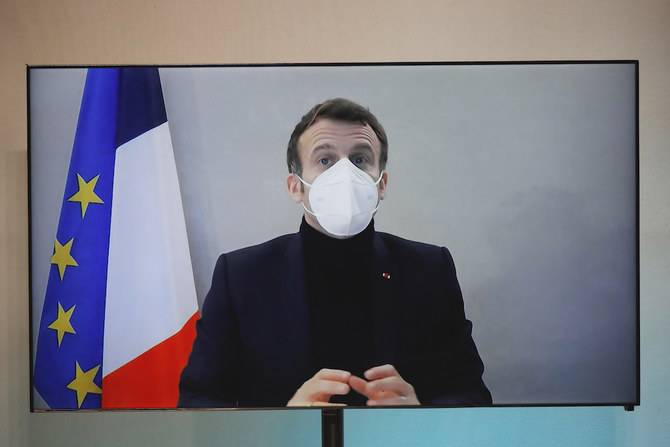
PARIS: Wearing a white medical mask, French President Emmanuel Macron went ahead with a planned speech by videoconference Thursday, hours after testing positive for COVID-19 following a week in which he met with numerous European leaders.
The French and Spanish prime ministers and the EU Council president were among many top officials self-isolating because they had recent contact with him.
Macron took a test “as soon as the first symptoms appeared" on Thursday morning and will self-isolate for seven days, the presidency said in a brief statement. It did not detail what symptoms Macron experienced or what treatment he might be receiving.
The 42-year-old president "will continue to work and take care of his activities at a distance,” the statement added. His wife, Brigitte, 67, tested negative on Thursday. She has no symptoms and will self-isolate as a precaution, her office said.
On Thursday afternoon, Macron took part, as planned, in a roundtable on French aid to the world's poorest countries — but via videoconference instead of attending in person.
Wearing a high-protection, medical grade mask — instead of the fabric versions emblazoned with the French flags he often wears — he showed no apparent sign of being affected by the disease. He did not mention the virus in his speech.
French government spokesman Gabriel Attal said contact tracing efforts were in progress. He said Macron started to feel symptoms overnight and that he will keep working from the Elysee presidential palace.
“The virus has been circulating in France and worldwide for several months and the presidency and government are used to working in these circumstances,” Attal said.
Macron joined a growing list of leaders who have tested positive for the virus, including U.S. President Donald Trump and British Prime Minister Boris Johnson, who wished him a speedy recovery on Twitter.
France has a tradition of keeping strict medical privacy, including for top officials, and Macron once said he would release health information only when justified by the impact it could have on his presidency.
Macron, and people in his entourage, have rarely been seen in public without a mask in recent months. The French president usually only removes it when making a speech or at a press conference when he is at safe distance from others. For several months, masks have been required in all indoor public places in France and everywhere outdoors in big cities.
The French president has had multiple in-person meetings in recent days at home and in Brussels where he attended a European Union summit at the end of last week. The Elysee palace confirmed that a trip to Lebanon scheduled for next week is being canceled.
Some have questioned Macron's many activities as the country is implementing strict anti-virus measures, including a lockdown since October that was only partially lifted on Tuesday and now includes a curfew from 8 p.m. to 6 a.m. All restaurants and bars, tourist sites and many other public places remain closed.
“Zero risk doesn’t exist. We are all equal in the face of this disease,” said Thomas Mesnier, a lawmaker from Macron’s party and emergency doctor by training.
“Anyone can get sick, even if you are scrupulously respecting protective measures and wearing masks” he told news broadcaster France-Info.
EU leaders met in person on Dec 10-11, for the first time since October, as the summit involved key negotiations on the EU's long-term budget and recovery fund and climate-related policies. The media was kept away from the summit venue in Brussels, but television images showed the leaders wearing masks, generally keeping good distancing — preferring elbow bumps to the usual handshakes, kisses and hugs — and occasionally using hand gel dispensers in the room.
“During the European Council of Thursday 10 and Friday 11 December all sanitary measures were observed and we have not been informed of any other participant or staff present during the summit who tested positive," said an EU official, who was not allowed to be identified publicly.
Spain’s government said Prime Minister Pedro Sánchez was found negative after taking a PCR test on Thursday morning following the news that Macron was infected. Sánchez had been with Macron on Monday during an event at the Paris-based Organization for Economic Cooperation and Development (OECD). Sánchez will remain in isolation until Dec. 24.
The prime minister of Portugal, António Costa, who had lunch with Macron on Wednesday, also tested negative for the virus Thursday.
European Council President Charles Michel and several other EU top officials announced that they were placing themselves in self-isolation as a precaution.
German Chancellor Angela Merkel, who had a bilateral meeting with Macron in Brussels, had taken a PCR test a few days after the European Council meeting as a matter of routine and it had been negative, her office said.
Macron's positive test also led several high-profile French politicians and government officials to self-isolate as a precaution.
On Wednesday, Macron held the government's weekly Cabinet meeting and in the evening, he had dinner with several members of his party. A day earlier, he lunched with the heads of political groups at the National Assembly.
French Prime Minister Jean Castex's office said that he tested negative Thursday but would self-isolate for seven days.
Several politicians who attended a lunch or a dinner at the Elysee palace recently described strict sanitary protocols, with guests placed around a very big table and speaking into a microphone to be able to maintain distance between them. Some said they have been informed by the presidency they are not considered as having been in close contact with the president, because they were too far away.
Christophe Castaner, a lawmaker from Macron's party who attended Wednesday's dinner, told reporters that by the nature of Macron’s office he comes in contact with many people, and that “even exemplary behavior” isn’t always enough to protect people from the virus.
Macron has always been an active president who travels frequently. He has scaled down his activities somewhat this year but continued holding in-person meetings in Paris, other French cities and in Brussels as numbers of virus infections were high in the country in recent weeks. He welcomed Egypt's president on a state visit to France earlier this month.
The French president is following national health authorities' recommendations that since September have reduced the self-isolation time from 14 days to seven. Authorities said at the time that this is the period when there is the greatest risk of contagion and that reducing it allows better enforcement of the measure.
The US Centers for Disease Control and Prevention recommends to isolate for at least 10 days after symptoms first appear.


![]()


France’s Macron has tested positive for COVID-19
Short Url
https://arab.news/9zwxg
France’s Macron has tested positive for COVID-19
- The presidency said he would isolate for the next seven days

Carney denies claim he walked back Davos speech in Trump call
- Carney’s speech last week in Davos urged middle powers to break their reliance on US economic influence
- Trump told Carney to watch his words as “Canada lives because of the United States”
TORONTO: Prime Minister Mark Carney on Tuesday denied a claim that he walked back his speech at the World Economic Forum denouncing US global leadership in a subsequent call with President Donald Trump.
Carney’s speech last week in Davos, which captured global attention, said the rules-based international order led by the United States for decades was enduring a “rupture” and urged middle powers to break their reliance on US economic influence, which Washington was partly using as “coercion.”
The speech angered Trump, who told Carney to watch his words as “Canada lives because of the United States.”
Speaking to Fox News on Monday, US Treasury Secretary Scott Bessent said: “I was in the Oval with the president today. He spoke to Prime Minister Carney, who was very aggressively walking back some of the very unfortunate remarks he made at Davos.”
Carney told reporters in Ottawa on Tuesday that Bessent was incorrect.
“To be absolutely clear, and I said this to the president, I meant what I said in Davos,” he said.
Carney reiterated that Canada “was the first country to understand the change in US trade policy that (Trump) had initiated, and we’re responding to that.”
Carney told reporters that Trump initiated the Monday call, which touched on issues ranging from Arctic security, Ukraine and Venezuela.
Carney’s speech last week in Davos, which captured global attention, said the rules-based international order led by the United States for decades was enduring a “rupture” and urged middle powers to break their reliance on US economic influence, which Washington was partly using as “coercion.”
The speech angered Trump, who told Carney to watch his words as “Canada lives because of the United States.”
Speaking to Fox News on Monday, US Treasury Secretary Scott Bessent said: “I was in the Oval with the president today. He spoke to Prime Minister Carney, who was very aggressively walking back some of the very unfortunate remarks he made at Davos.”
Carney told reporters in Ottawa on Tuesday that Bessent was incorrect.
“To be absolutely clear, and I said this to the president, I meant what I said in Davos,” he said.
Carney reiterated that Canada “was the first country to understand the change in US trade policy that (Trump) had initiated, and we’re responding to that.”
Carney told reporters that Trump initiated the Monday call, which touched on issues ranging from Arctic security, Ukraine and Venezuela.
Latest updates


© 2026 SAUDI RESEARCH & PUBLISHING COMPANY, All Rights Reserved And subject to Terms of Use Agreement.