

Lebanese ministers refuse questioning in Beirut blast investigation

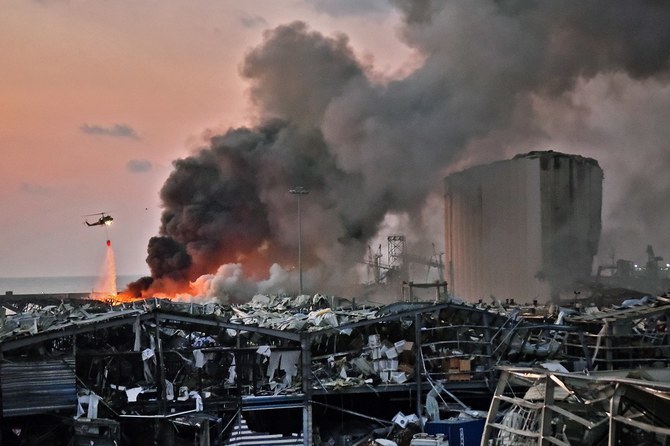
Over 200 people died in the Beirut port explosion in August. (AFP/File)
Short Url
Updated 16 December 2020
Follow

Lebanese ministers refuse questioning in Beirut blast investigation

  • Judge accused of ‘politicizing’ case by Diab allies
  • President Aoun warns ‘money in the treasury is very limited’

BEIRUT: Two former Lebanese ministers, Ghazi Zaiter and Ali Hassan Khalil, have refused to appear before Lebanon’s judicial investigator as part of criminal proceedings following the Beirut explosion.

Judge Fadi Sawan charged the ex-ministers, Prime Minister Hassan Diab and former minister Youssef Fenianos last week with “criminal negligence causing the death and injury of hundreds of people.”

The two former ministers justified their decision by saying that they “did not receive a formal summons.”

The pair also submitted a request to remove Sawan from the case because of “legitimate suspicions” regarding his neutrality.

A judicial source told Arab News that the revelation means “Sawan should stop the investigation with Zaiter and Hassan Khalil until the Court of Cassation decides on the recusal request after he delivers his remarks.”

Sawan said that he “did not intend” to step down and will continue investigating the file, setting Jan. 4 next year as the new date for the two former ministers to appear for questioning.

Lebanon’s investigation into the port explosion has faced political objections. Many have called for ministers and MPs linked to the disaster to stand before the Supreme Council.

The 1989 Taif agreement established the Supreme Council in Lebanon as a formal body to charge and convict presidents and ministers.

The Supreme Council consists of 7 MPs elected by parliament and 8 judges of the highest rank. Supreme Council procedures are only initiated if a two-thirds majority is reached in Lebanon’s parliament.

However, Col. Bechara El-Khoury, head of the Ministry of Defense legal department, said legal texts have “created ambiguity in drawing the boundary between ordinary crimes and violations resulting from breaching the duties incurred by the prime minister and ministers.”

He added: “The jurisprudence has not resolved the difference in views.”

A source in Lebanon’s judiciary said: “Parliamentary immunity is waived from Zaiter and Hassan Khalil when they are accused of murder.

“This is a criminal offense and is within the jurisdiction of the judicial branch, because their breach of duty resulted in murders.”

On Wednesday, Deputy Parliament Speaker Elie Ferzli criticized Sawan in parliament. “The background to Sawan’s accusation against the prime minister and three ministers is political,” he said.

“What has the principle of separation of powers become? We did not find any serious or nonserious suspicion involving all those whose names were mentioned in the letter that Sawan sent to parliament,” he added.

On Wednesday, Sawan listened to the testimony of former Lebanese Army Chief of Staff Maj. Gen. Walid Salman. A judicial source said: “Maj. Gen. Salman is a witness until now, waiting to see and study his testimony.”

Sawan previously charged the Beirut Port Administration and Investment Authority with negligence, possible intent to murder and attempted murder. Hassan Quraitem, the port’s director, was arrested about four months ago.

Director-General of State Security Maj. Gen. Tony Saliba also announced his refusal to appear before Sawan in a session scheduled for Thursday, asking to be invited through the Supreme Council of Defense.

Sawan is expected to question caretaker Prime Minister Hassan Diab on Friday.

Future bloc MP Mohammed Al-Hajjar questioned the Lebanese president’s responsibility for the disaster.

He said: “The president of the republic knew about the ammonium nitrate 15 days before the explosion. He knew more than others the danger of these materials near neighborhoods, and he is a former commander of the army and the head of the Supreme Council of Defense. So who is responsible?”

Meanwhile, Lebanon’s General Labor Union suspended a general strike on Wednesday that was set to protest against the removal of subsidies on basic materials.

Union head Bechara Al-Asmar said: “The union reached an understanding with Prime Minister Hassan Diab and the ministers concerned about not removing the subsidy on wheat, and it was confirmed that medicines for chronic diseases and diesel will still be subsidized.

“There is a keenness to postpone the move because it coincides with the holiday season and the need to move commercial markets, which are on the verge of bankruptcy."”

A delegation from the union visited President Michel Aoun, who said: “The crisis in which the Lebanese are facing is one of the biggest crises, and we are working so that the economic and financial measures that we are taking are consistent with the situation in which we live.

“The big problem that Lebanon suffers from lies in securing the money needed to put solutions into practice.

“The money in the treasury is very limited and we are working to secure it. We are the ones working on that and we are not the ones who spent this money,” he added.

Aoun warned that “rumors are spreading and have caused great damage in terms of building confidence between the Lebanese people and the judiciary, which I renew my absolute support for in the face of pressures.”


Historic decree seeks to end decades of marginalization of Syria’s Kurds

Updated 51 min ago
Follow

Historic decree seeks to end decades of marginalization of Syria’s Kurds

DAMASCUS/RIYADH: A decree issued by President Ahmad Al-Sharaa on Friday marks a historic end to decades of marginalization of Syria’s Kurdish minority and seeks to open a new chapter based on equality and full citizenship in post-liberation Syria.

The presidential action, officially known as Decree No. 13, affirms that Syrian Kurds are an integral part of the national fabric and that their cultural and linguistic identity constitutes an inseparable element of Syria’s inclusive, diverse, and unified national identity.

Al-Sharaa’s move seeks to address the consequences of outdated policies that distorted social bonds and divided citizens.

The decree for ⁠the first time grants Kurdish Syrians rights, including recognition of Kurdish identity as part of Syria’s national fabric. It designates Kurdish as a national language alongside Arabic and allows schools to teach it.

Al-Sharaa’s decree came after fierce clashes that broke out last week in the northern city of Aleppo, leaving at least 23 people dead, according to Syria’s health ministry, and forced more than 150,000 to flee the two Kurdish-run pockets of the city. The clashes ended ⁠after Kurdish fighters withdrew.

The Syrian government and the Kurdish-led Syrian Democratic Forces (SDF), that controls the country’s northeast, have engaged in months of talks last year to integrate Kurdish-run military and civilian bodies into Syrian state institutions by the end of 2025, but there has been little progress.

The end of an era of exclusion

For more than half a century, Kurds in Syria were subjected to systematic discriminatory policies, most notably following the 1962 census in Hasakah Governorate, which stripped thousands of citizens of their nationality and deprived them of their most basic civil and political rights.

These policies intensified after the now-dissolved Baath Party seized power in 1963, particularly following the 1970 coup led by criminal Hafez al-Assad, entrenching a state of legal and cultural exclusion that persisted for 54 years.

With the outbreak of the Syrian revolution in March 2011, Syrian Kurds actively participated alongside other segments of society. However, the ousted regime exploited certain separatist parties, supplying them with weapons and support in an attempt to sow discord and fragment national unity.

Following victory and liberation, the state moved to correct this course by inviting the Kurdish community to fully integrate into state institutions. This approach was reflected in the signing of the “March 10 Agreement,” which marked an initial milestone on the path toward restoring rights and building a new Syria for all its citizens.

Addressing a sensitive issue through a national approach

Decree No. 13 offers a balanced legal and political response to one of the most sensitive issues in modern Syrian history. It not only restores rights long denied, but also redefines the relationship between the state and its Kurdish citizens, transforming it from one rooted in exclusion to one based on citizenship and partnership.

The decree shifts the Kurdish issue from a framework of conflict to a constitutional and legal context that guarantees meaningful participation without undermining the unity or territorial integrity of the state. It affirms that addressing the legitimate demands of certain segments strengthens, rather than weakens, the state by fostering equal citizenship, respecting cultural diversity, and embracing participatory governance within a single, centralized state.

Core provisions that restore dignity

The decree commits the state to protecting cultural and linguistic diversity, guaranteeing Kurdish citizens the right to preserve their heritage, develop their arts, and promote their mother tongue within the framework of national sovereignty. It recognizes the Kurdish language as a national language and permits its teaching in public and private schools in areas with significant Kurdish populations, either as an elective subject or as part of cultural and educational activities.

It also abolishes all laws and exceptional measures resulting from the 1962 Hasakah census, grants Syrian nationality to citizens of Kurdish origin residing in Syria, including those previously unregistered, and guarantees full equality in rights and duties. In recognition of its national symbolism as a celebration of renewal and fraternity, the decree designates Nowruz Day (21 March) as a paid official holiday throughout the Syrian Arab Republic.

A call for unity and participation

In a speech following the issuance of the decree, President Ahmad al-Sharaa addressed the Kurdish community, urging them not to be drawn into narratives of division and calling on them to return safely to full participation in building a single homeland that embraces all its people. He emphasized that Syria’s future will be built through cooperation and solidarity, not through division or isolation.

The decree presents a pioneering national model for engaging with diversity, grounded not in narrow identities but in inclusive citizenship, justice, and coexistence. The decree lays the foundations for a unified and strong Syria that respects all its components and safeguards its unity, sovereignty, and territorial integrity.