Pakistani top officials deny reports of visit, meetings in Israel 

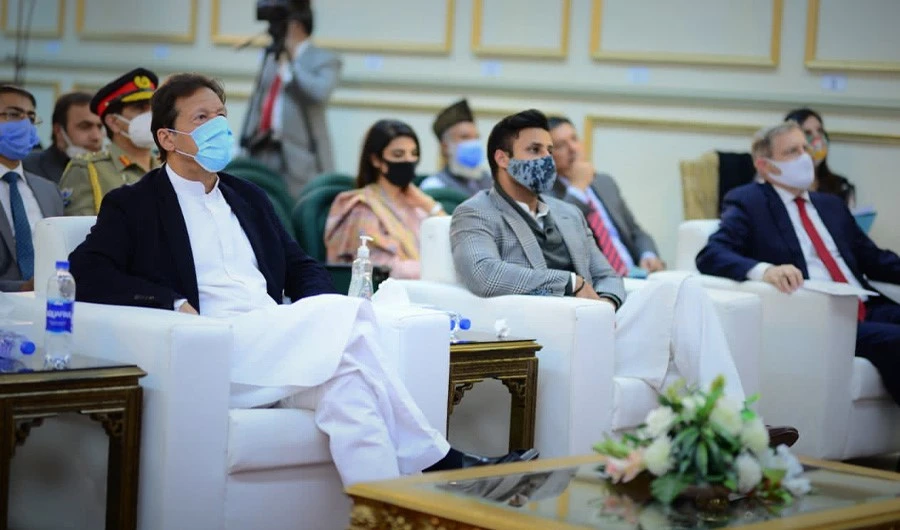
In this photo taken on December 12, 2020, Prime Minister Imran Khan and special adviser to PM on overseas Pakistanis Sayed Zulfiqar Bukhari attended the launching ceremony of Travel Responsibly for Experiencing Ecotourism in Khyber Pakhtunkhwa. (Photo Courtesy: Pakistan's PM Office)
Short Url
Updated 17 December 2020
Follow

Pakistani top officials deny reports of visit, meetings in Israel 

  • Top PM advisers Tahir Ashrafi and Sayed Zulfiqar Bukhari say the reports are “absolutely wrong,” “ridiculous” 
  • Israeli media reported officials from major Muslim country in Asia with no diplomatic ties with Israel visited the Jewish state two weeks ago

ISLAMABAD: Two top officials in Pakistan on Wednesday categorically denied media reports that Pakistani officials had visited Israel or held meetings in the Jewish state, separately terming the reports “absolutely wrong” and “ridiculous.”
The Israel Hayom and other Israeli media outlets reported this week in a veiled reference to Pakistan that a senior adviser to the leader of a large Muslim majority country in Asia that had no diplomatic ties with Israel had visited the Jewish state two weeks ago with a delegation of senior officials to discuss the potential normalization of relations. 
Pakistan currently does not recognize the state of Israel over its thwarting of Palestinians’ aspirations for a state of their own. Israel captured the West Bank and East Jerusalem, the Sinai peninsula and the Gaza Strip and the Golan Heights in the 1967 Middle East war. Palestinians want East Jerusalem as the capital of their future free state, a demand Pakistan has supported for decades. 
“It is an absolutely wrong news,” Tahir Ashrafi, a special adviser on religious harmony and the Middle East, told Arab News when asked to confirm the media reports. “It is an attempt to create chaos, instability in Pakistan and malign us in the Muslim world.”
Ashrafi said Pakistan’s stance regarding establishing relations with Israel was very clear, adding that Islamabad would not recognize Israel until a just solution to the Palestine conflict was found. 
“It is the clear stance of Prime Minister Imran Khan and his cabinet. The state of Pakistan including our people, armed forces, institutions and government, are on the same page regarding this issue,” Ashrafi added. 
Special assistant to the prime minister for overseas Pakistanis, Sayed Zulfiqar Bukhari, called the media reports “ridiculous.”
“It is ridiculous and a pathetic attempt [to malign Pakistan],” Bukhari told Arab News, adding that those spreading these “lies and fairy tales [were] putting lives in danger.”


Pakistan to launch AI screening in January to target fake visas, agent networks

Updated 5 sec ago
Follow

Pakistan to launch AI screening in January to target fake visas, agent networks

  • New system to flag forged-document travelers before boarding and pre-verify eligibility
  • Move comes amid increasing concern over fake visas, fraudulent agents, forged papers

ISLAMABAD: Pakistan will roll out an AI-based immigration screening system in Islamabad from January to detect forged documents and prevent illegal overseas travel, the government said on Thursday. 

The move comes amid increasing concern over fake visas, fraudulent agents and forged papers, with officials warning that such activity has contributed to deportations, human smuggling and reputational damage abroad. Pakistan has also faced scrutiny over irregular migration flows and labor-market vulnerability, particularly in the Gulf region, prompting calls for more reliable pre-departure checks and digital verification.

The reforms include plans to make the protector-stamp system — the clearance required for Pakistani citizens seeking overseas employment — “foolproof”, tighten labor-visa documentation, and cancel the passports of deportees to prevent them from securing visas again. The government has sought final recommendations within seven days, signalling a rapid enforcement timeline.

“To stop illegal immigration, an AI-based app pilot project is being launched in Islamabad from January,” Interior Minister Mohsin Naqvi said following a high-level meeting chaired by him and Minister for Overseas Pakistanis Chaudhry Salik Hussain.

Naqvi said the new screening technology is intended to determine travelers’ eligibility in advance, reducing airport off-loads and closing loopholes exploited by traffickers and unregistered agents.

The interior minister added that Pakistan remains in contact with foreign governments to improve the global perception and ranking of the green passport, while a uniform international driving license will be issued through the National Police Bureau.

The meeting also approved zero-tolerance measures against fraudulent visa brokers, while the Overseas Pakistanis Ministry pledged full cooperation to streamline the emigration workflow. Minister Hussain said transparency in the protector process has become a “basic requirement,” particularly for labor-migration cases.

Pakistan’s current immigration system has long struggled with document fraud, with repeated cases of passengers grounded at airports due to forged papers or agent-facilitated travel. The launch of an AI screening layer, if implemented effectively, could shift the burden from manual counters to pre-flight verification, allowing authorities to identify risk profiles before departure rather than after arrival abroad.

The reforms also come at a moment when labor mobility is tightening globally. Gulf states have begun demanding greater documentation assurance for imported labor, while European and Asian destinations have increased scrutiny following trafficking arrests and irregular-entry routes from South Asia. For Pakistan, preventing fraudulent departures is increasingly linked to protecting genuine workers, reducing deportation cycles and stabilizing the country’s overseas employment footprint.