

Pakistan court asks government about steps taken to extradite Pakistanis jailed in Iran

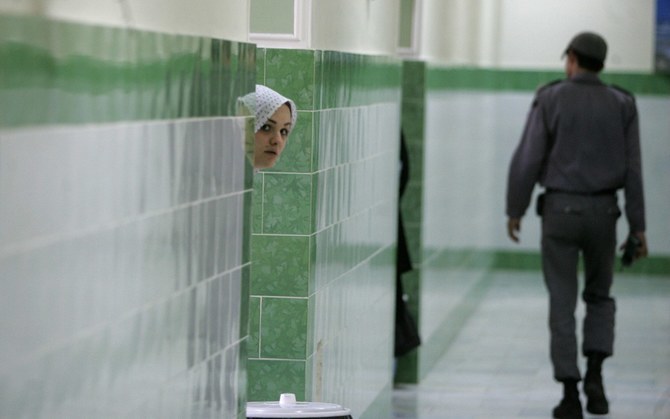
In this 2006 file photo, an Iranian inmate peers from behind a wall as a guard walks by at the female section of the infamous Evin jail. (AFP)
Short Url
Updated 16 December 2020
Follow

Pakistan court asks government about steps taken to extradite Pakistanis jailed in Iran

  • The case has been ongoing since 2018 and concerns the rights of Pakistani citizens imprisoned and facing imminent execution in Iran
  • 65 Pakistani prisoners are eligible to be brought back home under a 2014 prisoner transfer agreement

ISLAMABAD: The Lahore High Court on Wednesday asked the government of Pakistan to clarify and outline what steps it had taken to bring home Pakistanis convicted and jailed in Iran in a case ongoing since 2018 about the rights of Pakistani citizens imprisoned and facing imminent execution in Iran.

At the last hearing, the Ministry of Foreign Affairs appeared before Justice Shahid Waheed and submitted a list of 102 Pakistanis jailed in Iran. The ministry said 14 prisoners were repatriated in July this year under a prisoner transfer agreement signed in 2014. 

Iran had sought a similar list of its citizens jailed in Pakistan but the latter had yet to submit the details, the court observed, prompting Justice Waheed to question how much more time the government needed to bring back Pakistani prisoners. 

“The deputy attorney general should assist this court on the next date of hearing as to what steps have been taken regarding the transfer and extradition of convicted Pakistani prisoners in Iran,” Justice Waheed said in a statement released by Justice Project Pakistan, a prisoner rights group. 

During Tuesday’s hearing, Barrister Sarah Belal argued that of the list of 102 Pakistani nationals currently imprisoned in Iran, 65 had already been convicted and were thus eligible to be brought back home under the 2014 prisoner transfer agreement. She added that the agreement allowed the prisoners to serve the remainder of their sentences in their home country.

Earlier this year, Iranian Deputy Minister for Justice and Human Rights Mahmoud Abbasi had said Iran was ready to repatriate 44 Pakistani prisoners on humanitarian grounds but was awaiting a response from Pakistani authorities. However, despite more than six months having passed, Pakistan had yet to expedite their return, JPP said. 

Iran released thousands of prisoners when the pandemic first struck and is now entering a deadly second wave with a sharp spike in cases since October 15.

Speaking at a small gathering hosted by Justice Project Pakistan last Saturday, Special Adviser to the Prime Minister Zulfikar Bukhari reiterated his commitment to bring back all Pakistanis imprisoned abroad, whether they had committed a crime or not. 

On November 4, 41 Pakistanis imprisoned in Sri Lanka were brought back to Pakistan under a 2004 prisoner transfer agreement.

“Due to the lack of a uniform consular policy, Pakistani citizens imprisoned abroad lack consular support and adequate legal representation, often suffering due process violations such as long periods of detention without charge or trial,” JPP said. “The majority of Pakistani prisoners in foreign jails are arrested for non-lethal crimes such as drug trafficking, theft and violation of immigration laws.”


Pakistan says EU notes progress on rights commitments during GSP+ compliance discussions

Updated 20 December 2025
Follow

Pakistan says EU notes progress on rights commitments during GSP+ compliance discussions

  • The review formed part of a wide-ranging EU-Pakistan Joint Commission meeting held in Brussels
  • The two sides also covered irregular migration, climate cooperation and safe Afghan refugee return

ISLAMABAD: The European Union reviewed Pakistan’s compliance with its preferential GSP+ trade scheme this week and welcomed progress on key human rights commitments, according to a statement on Saturday, as Islamabad seeks to protect access to European markets vital for its export-led growth strategy.

The EU’s Generalized Scheme of Preferences Plus (GSP+) grants duty-free access to most European markets for eligible developing countries in return for their commitment to implement 27 international conventions covering human rights, labor standards, environmental protection and good governance. Pakistan, which has benefited from the scheme since 2014, is one of the biggest beneficiaries, with the EU its second-largest trading partner and a destination for roughly a third of its exports.

Pakistan’s GSP+ status has come under scrutiny in the past after, in April 2021, the European Parliament adopted a resolution calling for an immediate review, citing concerns over violence against religious minorities, curbs on media freedom and broader human rights issues. The move followed widespread anti-France protests in Pakistan over the publication of anti-Islamic caricatures, which EU legislators said raised questions about Islamabad’s commitment to fundamental freedoms.

“Both sides reviewed Pakistan’s progress on the implementation of the 27 international conventions as required under the GSP+ framework,” the foreign office said in a statement circulated in Islamabad. “The EU welcomed progress made in bringing Pakistan’s application of the death penalty in line with international standards and encouraged further steps in this regard.”

“It also recognised important first steps against torture, as well as the creation of a Commission on Minorities,” it added.

IRREGULAR MIGRATION, CLIMATE COOPERATION

The discussions took place during the 15th meeting of the EU–Pakistan Joint Commission, held in Brussels on Dec. 17, where officials also addressed irregular migration, including cooperation on the return and readmission of migrants without legal status, and legal mobility pathways under the bloc’s broader migration framework.

The foreign office statement came just a day after Greek authorities said they rescued more than 500 migrants from a fishing boat in the Mediterranean, adding that the group included several Pakistani nationals, highlighting continued migration pressures despite tighter controls.

Climate cooperation was another focus, with both sides reviewing ongoing collaboration on climate resilience, disaster risk reduction and sustainable development, areas of growing importance for Pakistan after repeated climate-related shocks.

The meeting also touched on the situation of Afghan refugees.

The statement said the EU welcomed the ongoing discussions between Pakistan and the UN refugee agency “to identify and compile a list of vulnerable cases, to ensure their adequate protection.”

“The EU appreciated that Pakistan is hosting millions of Afghan nationals for over four decades,” it continued. “They emphasised that any return must be safe, dignified and in line with international standards.”

The two sides agreed to continue engagement under the EU–Pakistan Strategic Engagement Plan, a framework guiding cooperation on political dialogue, trade, development, security and people-to-people exchanges, with the next joint commission meeting scheduled to be held in Islamabad next year.