

Pakistan court asks government about steps taken to extradite Pakistanis jailed in Iran

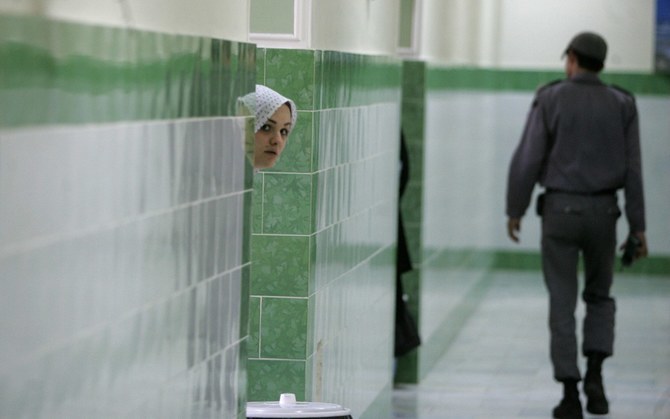
In this 2006 file photo, an Iranian inmate peers from behind a wall as a guard walks by at the female section of the infamous Evin jail. (AFP)
Short Url
Updated 16 December 2020
Follow

Pakistan court asks government about steps taken to extradite Pakistanis jailed in Iran

  • The case has been ongoing since 2018 and concerns the rights of Pakistani citizens imprisoned and facing imminent execution in Iran
  • 65 Pakistani prisoners are eligible to be brought back home under a 2014 prisoner transfer agreement

ISLAMABAD: The Lahore High Court on Wednesday asked the government of Pakistan to clarify and outline what steps it had taken to bring home Pakistanis convicted and jailed in Iran in a case ongoing since 2018 about the rights of Pakistani citizens imprisoned and facing imminent execution in Iran.

At the last hearing, the Ministry of Foreign Affairs appeared before Justice Shahid Waheed and submitted a list of 102 Pakistanis jailed in Iran. The ministry said 14 prisoners were repatriated in July this year under a prisoner transfer agreement signed in 2014. 

Iran had sought a similar list of its citizens jailed in Pakistan but the latter had yet to submit the details, the court observed, prompting Justice Waheed to question how much more time the government needed to bring back Pakistani prisoners. 

“The deputy attorney general should assist this court on the next date of hearing as to what steps have been taken regarding the transfer and extradition of convicted Pakistani prisoners in Iran,” Justice Waheed said in a statement released by Justice Project Pakistan, a prisoner rights group. 

During Tuesday’s hearing, Barrister Sarah Belal argued that of the list of 102 Pakistani nationals currently imprisoned in Iran, 65 had already been convicted and were thus eligible to be brought back home under the 2014 prisoner transfer agreement. She added that the agreement allowed the prisoners to serve the remainder of their sentences in their home country.

Earlier this year, Iranian Deputy Minister for Justice and Human Rights Mahmoud Abbasi had said Iran was ready to repatriate 44 Pakistani prisoners on humanitarian grounds but was awaiting a response from Pakistani authorities. However, despite more than six months having passed, Pakistan had yet to expedite their return, JPP said. 

Iran released thousands of prisoners when the pandemic first struck and is now entering a deadly second wave with a sharp spike in cases since October 15.

Speaking at a small gathering hosted by Justice Project Pakistan last Saturday, Special Adviser to the Prime Minister Zulfikar Bukhari reiterated his commitment to bring back all Pakistanis imprisoned abroad, whether they had committed a crime or not. 

On November 4, 41 Pakistanis imprisoned in Sri Lanka were brought back to Pakistan under a 2004 prisoner transfer agreement.

“Due to the lack of a uniform consular policy, Pakistani citizens imprisoned abroad lack consular support and adequate legal representation, often suffering due process violations such as long periods of detention without charge or trial,” JPP said. “The majority of Pakistani prisoners in foreign jails are arrested for non-lethal crimes such as drug trafficking, theft and violation of immigration laws.”


Pakistan, Qatar leaders discuss Middle East tensions amid Iran crisis

Updated 5 sec ago
Follow

Pakistan, Qatar leaders discuss Middle East tensions amid Iran crisis

  • Iran has warned of retaliation against US military bases in region if Washington intervenes in support of anti-government protests
  • United States on Wednesday withdrew some personnel from Mid East key bases, including Al Udeid Air Base, according to Reuters

ISLAMABAD: Pakistani Prime Minister Shehbaz Sharif spoke by telephone on Wednesday with Qatar’s Emir Sheikh Tamim bin Hamad Al Thani, discussing regional developments as tensions escalated in the Middle East following warnings from Iran over potential US military action.

The phone call comes as Iran warned it would retaliate against US military bases in the region if Washington intervenes in support of anti-government protesters, prompting the United States to withdraw some personnel from key bases, including Al Udeid Air Base, according to Reuters.

For Pakistan, a wider escalation could have economic and security implications, including pressure on energy supplies, shipping routes and regional trade, as well as potential risks to Pakistani workers and businesses across the Gulf. Islamabad has traditionally sought to balance relations with Iran, Gulf Arab states and the United States, and analysts say heightened tensions could complicate that diplomacy at a time when Pakistan remains dependent on external financing, remittances and stable energy imports.

According to a statement from the Prime Minister’s Office, Sharif and Al Thani expressed satisfaction with the trajectory of Pakistan-Qatar relations and reaffirmed their commitment to strengthening bilateral ties. 

“Recent developments in the Middle East were also discussed,” a statement from Sharif’s office said. “The Prime Minister appreciated Qatar’s constructive and proactive role in promoting peace, dialogue, and mediation across the region, and acknowledged its meaningful efforts to defuse tensions through diplomatic solutions.”

Sharif also assured the Qatari leadership that Pakistan would also continue “to play a positive role in maintaining regional peace and stability.”

Tensions are high in the Middle East, with Iranian officials having said Tehran has conveyed messages to regional states, including Saudi Arabia, the United Arab Emirates and Turkiye, warning that US bases in those countries could be attacked if Iran is struck. Direct contacts between Iranian and US officials have reportedly been suspended.

The unrest in Iran, sparked by demonstrations over worsening economic conditions, has escalated into the most violent internal challenge faced by the Islamic Republic since the 1979 revolution, according to Western officials and rights groups. Iranian authorities have accused the United States and Israel of fomenting the protests, which they describe as acts of terrorism.

Human rights organizations have reported thousands of deaths and arrests amid a sweeping crackdown by Iranian security forces, while Western governments say Iran’s leadership remains in control but under unprecedented pressure.

Qatar, which maintains close ties with both Washington and Tehran and has played a mediating role in multiple regional crises, has emerged as a key diplomatic hub as fears grow of a wider regional escalation involving US forces, Iran and its allies.