

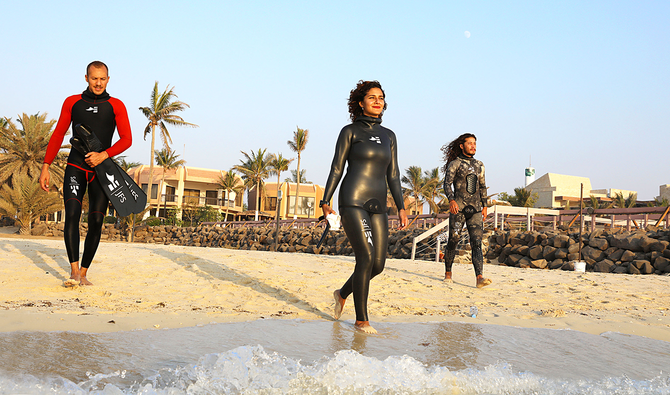


JEDDAH: Three friends with a passion for freediving have taken a leap of faith in launching the Kingdom’s first freediving school earlier this month.
The Jeddah Freediving School (JFS) co-founding trio of Osama Jouhari, Ishaq Farsi and Mariam Shalan grew up living by the sea and have practiced freediving for more than 10 years, breaking local, GCC, and continental records.
“Our main goal is to unify our ideas as a team and as freediving instructors,” the team told Arab News. “We want to share our knowledge and experience among the community of water sports lovers and allow everyone to experience one of the world’s extreme sports.”
The school’s acronym, JFS, is also the initials of the trio: Jouhari, Farsi and Shalan.
Freediving is a form of underwater diving that relies on breath-holding until resurfacing rather than the use of breathing apparatus, such as scuba gear. Pressure and heart rate increases with each meter spent moving deeper underwater.
Each member of the team has achieved their own legacy of records, but they are still hoping for more success to come through their school.
Shalan, an Egyptian female freediver born to a Saudi mother, achieved the deepest Arab dive in Egypt and Africa. Farsi, of Afghan origin, also holds a national record for freediving in his country.
The school offers theoretical and practical training programs for both genders. The main instructors at the school are the three co-founders and a group of freediving experts.
FASTFACTS
• Learning free diving is a slow progress process as breathing techniques need to be acquired.
• To be a level one certified free diver, one needs to dive for 20 meters underwater.
• Pressure and heart rate increases with each meter spent moving deeper underwater.
“All the manuals, programs and courses we provide at JFS are followed by Scuba School International, one of the biggest diving institutions in the world. They are also authorized by the Saudi Sports Federation as well,” the team said.
Changing the concept people have in their minds about the sport is challenging, the team said, adding that they are trying to “reflect it differently.”
The trio said: “Freediving can be a recreational activity or a sports activity. We want to develop this sport in the Kingdom to help Red Sea people break world records.”
JFS is located in North Obhur on Prince Abdulmajeed Street, and is authorized by the Saudi Water Sports and Diving Federation.
Mahmoud Zakariya, a freediving instructor with over 10 years of experience from Jeddah, told Arab News that the serene sport gives people the chance to explore the beauty of the underwater world.
“Freediving is all about holding your breath, diving deep into the sea and carrying only the air in your lungs,” he said.
The sport, he added, is considered the primitive way for humans to deal with and survive deep water. It is also used for pearl fishery.
“Humans are born freedivers by nature, it’s a natural skill that comes within us. However, it requires breath training to reach a level of breath flexibility and control that enables the diver to go deeper with a calm mind,” he said. “It needs patience, self-awareness and strong consciousness.”
As joyful as it can get, the sport requires a lot of preparation, he warned. “Freediving is known as extreme and one of the deadliest types of sports ever; it has no roles, no boundaries and no timeout.”
Accordingly, safety precautions in this sport are essential. The co-founders of JFS said that their safety precautions are taught to students through the SSI freediving course.
“It is basically an introduction to the purest form of diving that explains the proper breathing techniques, to help trainers familiarize themselves with diaphragmatic breathing and take a deep breath like they never have before. This is in addition to the safety equipment, preparations and legal documents,” the team added.
Zakariya said that for divers to stay on the safe side, it is better to always dive with a certified diver so they can “rescue or deal with any shallow water blackout or LMC (loss of motor control) cases that might occur while the inexperienced diver is swimming up to reach the water surface.”
JFS is also a fully equipped diving store that offers all the tools freedivers need from local and international brands, including customized items such as diving suits, fins and shirts.


