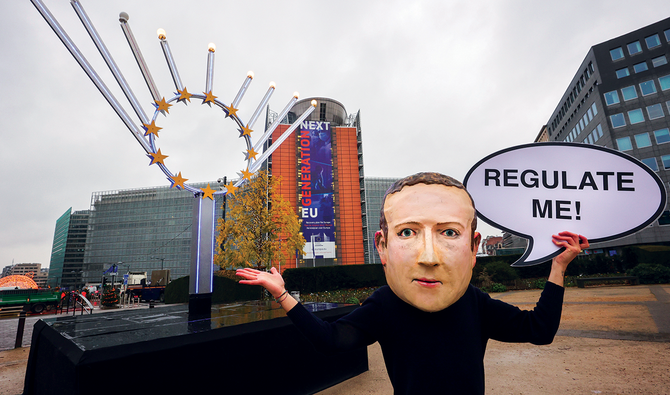
BRUSSELS: The EU on Tuesday unveiled tough draft rules targeting tech giants such as Google, Amazon and Facebook, whose power Brussels sees as a threat to competition and even democracy.
The landmark proposals, which come as Silicon Valley faces increasing global scrutiny, could shake up the way Big Tech does business by menacing some of the world’s biggest firms with mammoth fines or bans from the European market.
EU competition chief Margrethe Vestager said the bloc’s draft laws to regulate the internet aimed to bring “order to chaos” and rein in the online “gatekeepers” that dominate the market.
“The Digital Service Act and Digital Markets Act will create safe and trustworthy services while protecting freedom of expression,” she told a press conference.
The EU says the legislation would see internet behemoths face fines of up to 10 percent of their turnover for breaking some of the most serious competition rules, or even risk being broken up.
It also proposes fining them 6 percent of revenues or temporarily banning them from the EU market “in the event of serious and repeated breaches of law which endanger the security of European citizens.”
The Digital Services Act and its accompanying Digital Markets Act will lay out strict conditions for doing business in the EU’s 27 member countries as authorities aim to curb the spread of disinformation and hate speech online, as well as Big Tech’s business dominance.
A source close to the European Commission said 10 firms face being designated as “gatekeepers” under the competition legislation and subject to specific regulations to limit their power to dominate markets.
The firms that would be subject to stricter regulation are US titans Facebook, Google, Amazon, Apple, Microsoft and SnapChat, China’s Alibaba and Bytedance, South Korea’s Samsung and the Netherlands’ Booking.com.
Search engine Google said it will carefully study the proposals, but complained that they “seem to specifically target a handful of companies.”
The draft laws will go through a long and complex ratification process, with the EU’s 27 states, the European Parliament, and a lobbying frenzy of companies and trade associations influencing the final law.
The Digital Services Act is being touted as a way to give the European Commission sharper teeth in pursuing social media platforms when they allow illegal content online, such as extremist propaganda, hate speech, disinformation and child pornography.
Under the Digital Markets Act, the EU is seeking to give Brussels new powers to enforce competition laws more quickly, and to push for greater transparency in their algorithms and use of personal data.
The rules are designed to update legislation that dates back to 2004, when many of today’s internet giants either did not exist or were in their infancy.
A Facebook spokesperson said the proposed regulations “are on the right track to help preserve what is good about the internet,” and insisted it looks forward “to engaging with EU lawmakers.”
The social network took aim at fellow tech giant Apple, insisting it wants the rules to “set boundaries” for the iPhone maker, with which it has tussled over privacy.
Activist group Avaaz said the legislation could prove a “bold and brave move,” but insisted Brussels must make sure it is fully enforced.
“This is a strong framework and the EU has the heft and democratic values to hold the platforms to account, regulate the reach of disinformation and protect the free speech of the users,” legal director Sarah Andrew said.
European Parliament member David Cormand, who sits on its internal market committee, said the legislation is a “step in the right direction” but lacks the ambition to “regain power over our digital services.”
For the past decade the EU has taken the lead worldwide in trying to grapple with the power of Big Tech, for example slapping billions in antitrust fines on Google, but critics believe the method has been too cumbersome and has done little to change behavior.
The EU has also ordered Apple to pay billions of euros in back taxes to Ireland, but that decision was quashed by the bloc’s highest court.
Tuesday’s moves in Brussels come as regulators around the world have increasingly become concerned about the financial and social power of Big Tech.
US authorities have taken up the call, with several major antitrust cases targeting Google in addition to a legal bid to strip Facebook of its Instagram and WhatsApp products.
Britain’s government was on Tuesday also expected to announce proposed legislation to tackle “online harms” by introducing the threat of fines for internet giants.


![]()

EU unveils new rules to curb tech giants
Short Url
https://arab.news/mtp69
EU unveils new rules to curb tech giants
- The EU outlined its long-awaited sweeping overhaul of digital regulations


Latest updates


© 2026 SAUDI RESEARCH & PUBLISHING COMPANY, All Rights Reserved And subject to Terms of Use Agreement.