

Russia, SDF to set up joint military posts in strategic Syrian town

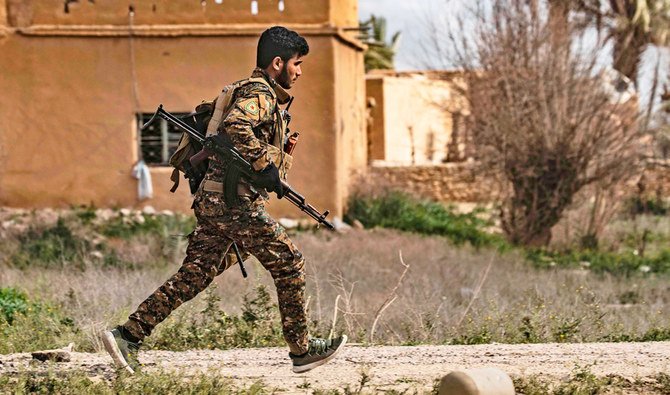
A member of the Syrian Democratic Forces (SDF) runs for cover during shelling on the Islamic State group's last holdout of Baghouz, in the eastern Syrian Deir Ezzor province on March 3, 2019. (AFP)
Short Url
Updated 12 December 2020
Follow

Russia, SDF to set up joint military posts in strategic Syrian town

  • Russia has reportedly asked the SDF to surrender Ain Issa to the Assad regime, but that proposal was rejected by the Syrian Kurds

ANKARA: Russia and the Syrian government have agreed with the Kurdish-led Syrian Democratic Forces (SDF) to establish three joint military observation posts in the town of Ain Issa.

The posts, which will be deployed in the strategically important town linking Aleppo to Al-Hasakah, will monitor the cease-fire and violations of Turkish-governed zones in the region.

Ain Issa is currently under the control of the SDF and is located on the M4 highway that connects northeastern Syria to the western part of the country.

The town has come under regular attack, most recently by Ankara-backed rebel groups against Syrian Kurdish YPG militia positions. In October, Turkish President Recep Tayyip Erdogan warned of a possible new operation into the region.

However, Navvar Saban, a military analyst from the Istanbul-based Omran Center for Strategic Studies, did not anticipate a new Turkish offensive on the scale of its October push to clear SDF fighters away from the towns of Tal Abyad and Ras Al-Ayn, both near Ain Issa.

“This agreement on establishing observation posts is just a public relations activity and nothing will change. It will just reduce the intensity of the tensions at that front but will not end them in the long run because the SDF has been violating the cease-fire agreement by digging tunnels, which Turkey and Ankara-backed groups were destroying,” he told Arab News.

Turkey considers the SDF as an extension of the outlawed Kurdistan Workers’ Party (PKK).

Kyle Orton, a UK-based independent researcher on Syria, told Arab News: “Ain Issa does not affect any of the broader dynamics in Syria, it is just the kind of trouble one would expect along the line of contact between two forces as mutually hostile as Turkey and the PKK.

“The PKK’s Rojava statelet in Syria has always been significantly dependent on the (Syrian President Bashar) Assad and Iran system and as the US draws down or threatens to, the PKK has little choice but to lean ever-more into this other option.”

Russia has reportedly asked the SDF to surrender Ain Issa to the Assad regime, but that proposal was rejected by the Syrian Kurds.

HIGHLIGHT

The posts, which will be deployed in the strategically important town linking Aleppo to Al-Hasakah, will monitor the cease-fire and violations of Turkish-governed zones in the region.

“For Russia, having the Assad regime directly take Ain Issa would have allowed them to make progress on restoring Assad’s writ across the whole country, an important part of the effort to rehabilitate the regime internationally by presenting its victory as a fait accompli, and simultaneously to gain goodwill from Turkey by claiming to have removed the PKK from territory,” Orton said.

He pointed out that the present option worked too. “The Turks are much less concerned about Russia being the custodian of the PKK rather than the US partnering with the PKK, which is seen as something much more threatening.”

Orton added that the developments in Ain Issa would not threaten the Russo-Turkish understanding over Syria, manifested in the Astana process.

Halid Abdurrahman, a researcher and analyst on the Middle East and North Africa, told Arab News that control over Ain Issa was of strategic importance for gaining the control of the key M4 highway.

“Turkey wanted to establish a military base in Ain Issa’s Saida village in order to increase its supremacy in the region, but the Russians didn’t lean toward this offer. Then, Turkish army and Ankara-backed rebel groups began attacking YPG targets intermittently,” he said.

He noted that if Turkey blocked the passage of Ain Issa, it would be able to cut supply lines between the towns of Kobane and Manbij towns, while interrupting their contacts with the Jazira canton – something that would facilitate any potential Turkish military operation into the region in the future.

“However, Russia is uneasy with Turkey’s moves about Ain Issa, and would rather prefer giving the town to the Syrian regime forces in order to prevent any military move to the region by Ankara. Establishing observation posts with SDF and following an active military strategy with Syrian Kurds is just a short-term strategy to extend this challenge over time,” Abdurrahman said.

Russia and YPG militia have reportedly conducted some informal joint drills and recently held technical meetings about regional challenges.

“Turkey and Russia have not been on good terms with each other for a while. They have a tense relationship about their moves in Idlib, while Russia’s joint operations with Kurdish-led SDF would not please Ankara apparently,” Abdurrahman added.


Arab Coalition announces ‘limited’ airstrike targeting two ships that smuggled weapons to Yemen

Updated 48 min 26 sec ago
Follow

Arab Coalition announces ‘limited’ airstrike targeting two ships that smuggled weapons to Yemen

  • Coalition urges evacuation of the Port of Mukalla, signaling that a major military operation to force an STC withdrawal could be imminent
  • Spokesman says the two ships transported weapons from the UAE port of Fujairah to Mukalla without getting permission from Coalition command

RIYADH: The Coalition to Support Legitimacy in Yemen on Tuesday said it conducted a “limited” airstrike targeting two ships that smuggled weapons and other military hardware into Mukalla in southern Yemen.

In a statement carried by the Saudi Press Agency (SPA), the Coalition Forces spokesman, Major General Turki Al-Maliki, said that two ships coming from the port of Fujairah in the United Arab Emirates entered the Port of Mukalla in Hadramaut without obtaining official permits from the Joint Forces Command of the Coalition. 

“The crews of the two ships disabled the tracking systems of the two ships and unloaded a large quantity of weapons and combat vehicles to support the Southern Transitional Council forces in the eastern governorates of Yemen (Hadramawt, Al-Mahra) with the aim of fueling the conflict. This is a clear violation of imposing a truce and reaching a peaceful solution, as well as a violation of UN Security Council Resolution No. (2216) of 2015 AD,” said the spokesman.

The coalition urged civilians and fishermen to evacuate the Port of Mukalla, signaling that a major military operation to force an STC withdrawal could be imminent.

Google map showing the location of Mukalla in southern Yemen

Al-Maliki said the Coalition Forces acted on a request by Rashad Al-Alimi, the president of the Yemeni Presidential Leadership Council, “to take all necessary military measures to protect civilians in the governorates of Hadramawt and Al-Mahra.”

Al-Alimi, the president of the Yemeni Presidential Leadership Council, warned last week that unilateral actions by the STC were pushing the country toward a dangerous tipping point.

“Given the danger and escalation posed by these weapons, which threaten security and stability, the Coalition Air Forces conducted a limited military operation this morning targeting weapons and combat vehicles unloaded from the two ships at the port of Al-Mukalla. This was done after documenting the unloading, and the military operation was carried out in accordance with international humanitarian law and its customary rules, ensuring no collateral damage occurred,”  spokesman Al-Maliki said on Tuesday.


READ MORE: Analysis: The risks of carving up Yemen


He affirmed the Coalition’s "continued commitment to de-escalation and enforcing calm in the governorates of Hadramawt and Al-Mahra, and to prevent any military support from any country to any Yemeni faction without coordination with the legitimate Yemeni government and the Coalition. This is aimed at ensuring the success of the Kingdom and the Coalition’s efforts to achieve security and stability and prevent the conflict from spreading.”

Disregarding previous agreements with the Coalition, the group calling itself Southern Transitional Council, or STC, launched a sweeping military campaign early in December, seizing the governorates of Hadramaut along the Saudi border and the eastern governorate of Al-Mahra in Yemen’s border with Oman.

The UAE-backed STC forces captured the city of Seiyun, including its international airport and the presidential palace. They also took control of the strategic PetroMasila oilfields, which account for a massive portion of Yemen’s remaining oil wealth.

CaptioYemenis members of the Sabahiha tribes of Lahj, who live along the strip between the south and north of the country, gather during a rally in the coastal port city of Aden on December 14, 2025, to show their support for the UAE-backed Southern Transitional Council (STC), which wants to revive an independent South Yemen. (AFP)

This prompted Saudi Arabia to issue a firm demand for the STC to withdraw and hand over the seized areas to the National Shield Forces, a Saudi-backed unit.

The coalition warned that any military movements undermining de-escalation efforts would be dealt with immediately to protect civilians, according to the Saudi Press Agency.

On Dec. 26, the UAE issued a statement welcoming Saudi Arabia’s efforts to support security and stability in Yemen.

The statement carried by state news agency WAM praised Saudi Arabia’s constructive role in advancing the interests of the Yemeni people and supporting their legitimate aspirations for stability and prosperity.