Bilawal says time for political dialogue with government long gone

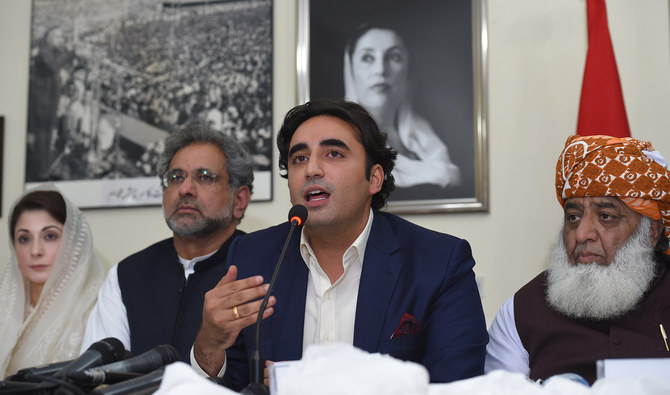
Pakistani opposition party leaders, Bilawal Bhutto-Zardari (2R) speaks along with former premier Shahid Khaqan Abbasi (2L) and Maryam Nawaz (L) and Jamiat Ulema-e Islam-F (JUI-F) leader Maulana Fazlur Rehman (R) attend a press conference in Islamabad on May 19, 2019. (AFP/File)
Short Url
Updated 12 December 2020
Follow

Bilawal says time for political dialogue with government long gone

  • The PPP chairman shows willingness to sacrifice Sindh administration if it can bring down government in the country
  • The PML-N vice president claims sitting government ministers have been striving to establish contacts with the PDM leadership

ISLAMABAD: Pakistan People Party (PPP) Chairman Bilawal Bhutto Zardari said on Friday that the time for political dialogue with the government was over.
His statement came only a few days after Prime Minister Imran Khan announced that the government was always open to national dialogue since such political conversations were essential to democracy.
The PPP chairman also denied that there were any differences within the opposition Pakistan Democratic Movement (PDM) alliance.
"The PDM has decided that leaders of its constituent parties will receive resignations [of their lawmakers in the national and provincial assemblies] by 31st December," he said. "The Pakistan Peoples Party is also part of that decision. I have been receiving resignations one after another, and I will have all of them in my pocket before the deadline."
Bilawal criticized those who thought that PDM factions would stop questioning the establishment's role in politics, saying such individuals were wrong in making that assumption.
He said that the establishment would not only have to stop propping up the current political administration but also end curbing dissenting voices.
"As long as this does not happen, no PDM faction will abandon this cause," he added.
The PPP chairman made these statements during a media interaction after his meeting in Lahore with Pakistan Muslim League-Nawaz (PML-N) Vice President Maryam Sharif.
Analysts have speculated that the PPP would not resign from national and provincial assemblies since its administration runs the province of Sindh.
"I am taking the case to the party's central executive committee that we should sacrifice our Sindh government and National Assembly seats if it can send this government and its facilitators home," he said in response to a question about how far his party was willing to go with the PDM's resignation initiative.
Addressing the media, the PML-N vice president claimed that the government was doing its best to reach out to the PDM leadership.
"Their sitting ministers are trying to establish contacts with us," she said. "However, I don't attribute much significance to such efforts or feel obliged to respond."
Federal Minister for Information and Broadcasting Shibli Faraz said during a media briefing in Islamabad that the opposition was in a state of "panic" since it knew it had entered a "dead-end street."
He maintained that the PDM was forcing people to resign, adding that it would not succeed in putting the government under pressure.


Pakistan to issue four RFPs for Panda, dollar bond sale

Updated 11 sec ago
Follow

Pakistan to issue four RFPs for Panda, dollar bond sale

  • Government may seek to raise up to $1.25 billion from global markets
  • Authorities also eye FX-linked instruments to tap local dollar liquidity

KARACHI: Pakistan’s government plans to issue four Requests for Proposal (RFPs) to major international investment banks as it moves toward launching Panda and dollar bonds, seeking to raise up to $1.25 billion from global markets, a senior finance ministry official told Arab News this week. 

RFPs are formal invitations sent to banks asking them to submit bids to underwrite bond issuances, a step that signals the government is entering the execution phase of its borrowing plans. Panda bonds are yuan-denominated bonds issued in China, while dollar bonds are sold in international markets to global investors.

Pakistan has recently boosted the State Bank of Pakistan’s foreign exchange reserves to around $16 billion, supported by a $7 billion International Monetary Fund (IMF) program but continues to seek diversified sources of foreign funding. The country has also relied on financial support from friendly nations such as China, Saudi Arabia and the United Arab Emirates to manage balance-of-payments pressures.

The plans for the RFPs were discussed at a meeting of the finance ministry’s Debt Management Office (DMO) with financial market participants held on Jan. 12 at the Pakistan Stock Exchange, the finance ministry official said, requesting anonymity.

“The Debt Management Office of ministry of finance held a meeting... to communicate their strategy and debt management plan through various new initiatives under pipeline,” the official said.

Providing details of the DMO meeting, Shankar Talreja, head of research at Topline Securities Ltd., who attended the session, said the government was now moving decisively toward global bond issuance.

“The government is expected to issue four RFPs to engage big international investment banks like JP Morgans etc., who will submit their proposals on underwriting the bonds Pakistan is seeking to float,” Talreja told Arab News.

“They are rolling out both the Chinese and US bonds simultaneously,” he said, adding that the government may target raising about $1.25 billion.

Talreja said the IMF, in its latest country report, had asked Pakistan to raise $250 million through Panda bonds this year and another $1 billion through dollar bonds next year.

“That $1 billion can be a mix of both or only dollar bonds,” he said.

Alongside external borrowing, the government is also considering issuing foreign exchange-linked notes or bonds aimed at attracting dollar liquidity already held within Pakistan.

Talreja said the DMO was working on exchange rate-linked instruments for local investors, particularly individuals holding dollars in bank accounts or seeking returns linked to the US dollar.

According to State Bank of Pakistan data, commercial banks held $5.14 billion in foreign currency deposits as of January 2.

“The government borrows huge amount of dollars at as much as 8-7 or 10 percent markup rates from its foreign lenders. Why not to borrow from local investors at a reasonable rate of return,” Talreja said.

“The $5.1 billion Pakistan’s commercial banks are currently holding in deposits can be easily targeted,” he added.

Pakistan also faces near-term external repayment obligations, including a $1.3 billion Eurobond maturing on April 8.

The country repaid $500 million of Eurobond debt in September 2025 without market disruption, which Talreja described as a “nonevent” due to sufficient financial resources, citing DMO officials.

Separately, Talreja said in a note to clients that yields on 10-year Chinese government bonds were currently below 2 percent, while US bonds of similar maturity were yielding between 4 and 4.5 percent.

“The government expects rate on new issuance well within existing secondary market yields of Pakistan bonds, while Panda bonds are likely to be further competitive,” he said.

To attract global investors, Pakistani authorities have conducted roadshows and finalized a list of more than 100 international investors as part of their outreach efforts, he added.