

Sporting racism spotlight falls on Turkey

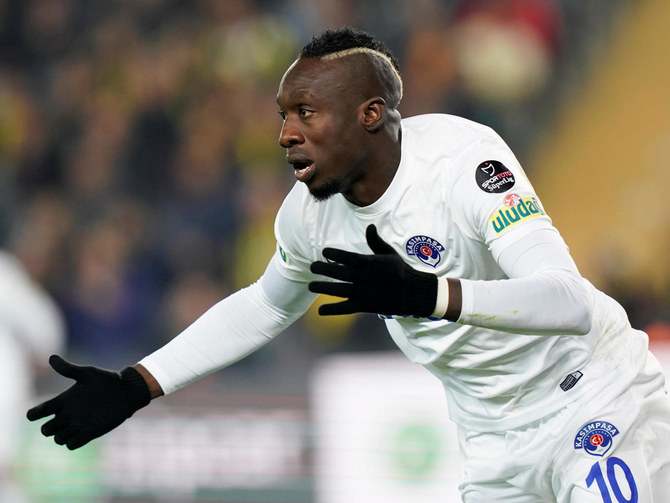
Galatasaray’s Senegalese striker Mbaye Diagne. (Reuters)
Short Url
Updated 11 December 2020
Follow

Sporting racism spotlight falls on Turkey

  • Football commentator Emre Bol told pro-government channel A TV that Galatasaray’s Senegalese star Mbaye Diagne “was eating crocodile in Senegal, then came here and became a footballer”
  • The football team of Kurdish-majority Diyarbakir city has increasingly become the focus of nationalist hostility, with the club accused of being linked to the outlawed PKK

ANKARA: Controversy surrounding an official’s alleged racism during a Champions League match between Paris Saint-Germain and Istanbul Basaksehir has not only fueled the simmering row between Ankara and Paris but also stirred debate in Turkey about the country’s own sporting culture.

Turkish President Recep Tayyip Erdogan, who has close ties with the owners of the Basaksehir club, said after the match: “This incident is the result of recent racist discourse in France. France has regrettably become a hotspot for racism.”

During the game on Tuesday, Basaksehir’s assistant coach, Pierre Webo, was shown a red card for protesting against a refereeing decision. A Romanian fourth official then allegedly pointed to the Cameroonian and used a racist description.

The match was suspended in the 13th minute after both teams left the pitch and was replayed the following day.

European football’s governing body UEFA is expected to launch an investigation into incident.

“Racism, and discrimination in all its forms, has no place in football,” UEFA said in a statement.

The MHP, Turkey’s ultra-nationalist party and a coalition partner of the ruling government, tweeted “No to Racism” photos in protest at the incident.

However, for many Turks, ethnic tensions and racism in sports remain a source of concern.

Mert Yasar, a lawyer specializing in sports law, said racist incidents involving managers, competitors and fans have been a familiar problem over the years, with many of those responsible enjoying complete impunity since federations and prosecutors fail to hand down fines or launch investigations.

“Our record in this area is getting worse,” he told Arab News.

The football team of Kurdish-majority Diyarbakir city has increasingly become the focus of nationalist hostility, with the club accused of being linked to the outlawed Kurdistan Workers’ Party (PKK).

Players are exposed to almost daily harassment by rival fans, especially after the club’s rebranding as Amedspor in 2014, for using the Kurdish name for Diyarbakir.

Turkish nationalists generally shout “Kurds out; this is Turkey, not Kurdistan,” while the team’s Kurdish supporters are occasionally banned from attending matches.

In 2014, Deniz Naki, an Amedspor player with a Kurdish background, was the target of a racist attack in Ankara. Two years later, he was banned for 12 games over a Facebook post described as “ideological propaganda.”

Two years later, Amedspor executives were assaulted after attending a match in the capital.

The same year, Amedspor players carried a giant banner on to the pitch calling for an “end to violence in the region that kills children who should instead attend the matches.” The players were accused of “terror propaganda.”

Last week, football commentator Emre Bol told pro-government channel A TV that Galatasaray’s Senegalese star Mbaye Diagne “was eating crocodile in Senegal, then came here and became a footballer.” Galatasaray immediately took legal action against Bol.

In 1999, a UK-born striker, Kevin Campbell, left Trabzonspor club after its chairman, Mehmet Ali Yilmaz, called him a “cannibal.”

Campbell said that it was the “biggest insult” he had ever received.

“No apology can heal my injury,” he said after Yilmaz told Turkish journalists: “We bought a cannibal who calls himself a striker.”

Fans waving bananas during matches routinely make headlines, with no stern warnings or sanctions in return.

Racism is sometimes rewarded in sports.

Riza Kayaalp, a well-known Turkish wrestler, made headlines for racist remarks against Armenians and Greeks in August 2013 following the anti-government Gezi Park protests.

The Olympic medalist was suspended for six months by a FILA judge, but the decision was later overturned. Kayaalp was recently appointed undersecretary in the Youth and Sports Ministry.

According to Mert Yasar, Turkey’s campaign against racism is a state responsibility.

“All international conventions and constitutions oblige Turkey to initiate anti-discriminatory measures in sport. The sports ministry as well as the sporting federations and committees should combat the racist attacks in this area,” he said.

“Several international federations have the right to halt the membership of members that don’t fight racism effectively or which fail to conduct thorough investigations. They can even ban participation of these Turkish federations in international events if racism still enjoys impunity.”


New Zealand mosque shooter seeks to discard his guilty pleas, saying prison made him irrational

Updated 2 sec ago
Follow

New Zealand mosque shooter seeks to discard his guilty pleas, saying prison made him irrational

WELLINGTON: The man who killed 51 Muslim worshipers at two mosques in New Zealand’s deadliest mass shooting told an appeals court Monday that he felt forced to admit to the crimes because of “irrationality” due to harsh prison conditions, as he sought to have his guilty pleas discarded.
A panel of three judges at the Court of Appeal in Wellington will hear five days of evidence about Brenton Tarrant’s claim that he was not fit to plead to the terrorism, murder and attempted murder charges he faced after the 2019 attack in the city of Christchurch. If his bid is successful, his case would return to court for a trial, which was averted in March 2020 when he admitted to the hate-fueled shooting.
He is also seeking to appeal his sentence of life without the chance of parole, which had never been imposed in New Zealand before. Tarrant’s evidence Monday about his mental state when he pleaded guilty was the first time he had spoken substantively in a public setting since he livestreamed the 2019 massacre on Facebook.
Shooter says he suffered “nervous exhaustion”
The Australian man, a self-declared white supremacist, migrated to New Zealand with a view to committing the massacre, which he planned in detail. He amassed a cache of semiautomatic weapons, took steps to avoid detection and wrote a lengthy manifesto before he drove from Dunedin to Christchurch in March 2019 and opened fire at two mosques.
Along with 51 people killed, the youngest a 3-year-old boy, dozens of others were severely wounded. The attack was considered one of New Zealand’s darkest days and institutions have sought to curb the spread of Tarrant’s message through legal orders and a ban on possession of his manifesto or video of the attack.
Monday’s hearing took place under tight security constraints that severely limited who could view Tarrant’s evidence, which included some reporters and those hurt or bereaved in the massacre. Tarrant, who wore a white button-down shirt and black-rimmed glasses and had a shaved head, spoke on video from a white-walled room at Auckland Prison.
Answering questions from a Crown lawyer and from lawyers representing him, Tarrant, 35, said his mental health had deteriorated due to conditions in prison, where he was held in solitary confinement with limited reading material or contact with other prisoners.
By the time he pleaded guilty, Tarrant said he was suffering from “nervous exhaustion” and uncertainty about his identity and beliefs. He had admitted to the crimes a few months before his trial was due to begin because there was “little else I could do,” he told the court.
Crown lawyers say no evidence of serious mental illness
Crown lawyer Barnaby Hawes suggested to Tarrant during questioning that the Australian man had other options. He could have requested a delay in his trial date on mental health grounds or could have proceeded to trial and defended himself, Hawes said.
Hawes also put to Tarrant that there was little evidence in the documentation of his behavior by mental health experts and prison staff that he was in any kind of serious mental crisis. Tarrant suggested that signs of mental illness he displayed hadn’t been recorded and that at times he had sought to mask them.
“I was definitely doing everything possible to come across as confident, assured, mentally well,” he told the court. Tarrant’s behavior “reflected the political movement I’m a part of,” he added. “So I always wanted to put on the best front possible.”
He agreed that he had had access to legal advice throughout the court process. Tarrant’s current lawyers have been granted name suppression because they feared representing him would make them unsafe.
The appeal outcome is due later
Bids to appeal convictions or sentences in New Zealand must be made within 20 working days. Tarrant was about two years late in seeking an appeal, filing documents with the court in September 2022.
He told the court Monday that his bid had been late because he hadn’t had access to the information required to make it.
The hearing is due to run for the rest of the week but the judges are expected to release their decision at a later date. If they reject Tarrant’s attempt to have his guilty pleas discarded, a later hearing will focus on his bid to appeal his sentence.