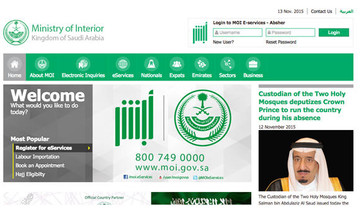
JEDDAH: Absher, the interactive online platform provided by the Saudi Interior Ministry, served 18.3 million users in the past year, according to ministry statistics.
Since its launch in 2009/2010 it has answered 1.2 billion queries from registered users, at a rate of 120 million queries a year, the figures reveal. It was also used to perform 300 million transactions, approximately 30 million a year.
The online Absher service was introduced to increase productivity and promote more efficient work practices within government departments, while raising customer satisfaction levels. A smartphone app was added in 2015.
The platform provides access to 280 services provided by the Ministry of Interior to users in three categories: Individuals, business and government. It can be used to apply for jobs and Hajj permits, update passport information, make appointments, renew IDs and drivers’ licenses, register vehicles and pay traffic fines, among many other things. The services its provides are available to residents as well as
citizens; they can use it to renew residency permits and apply for visas, for example.
Absher is credited with improving life in Saudi Arabia by making it much easier for citizens and residents to interact with government departments to obtain information and complete required procedures and paperwork from the comfort of their own homes.
It has also made it easier for people to resolve potentially serious and costly problems.
For example, father-of-five Abdul Aziz Hazmi, was in the UK for a work assignment three years ago while two of his daughters remained in Jeddah. They were due to visit him when a problem cropped up at the airport.
“Back then they needed my permission on the app to travel back and forth, and without Absher they wouldn’t have been able to come and visit us,” he said. “I thought I’d already set those travel options for them when I did it for their siblings, but one of my daughters called me before boarding the plane panicking about not being allowed on.”
Hazmi told his daughter not to worry and reassured her that he would sort the problem out through the Absher app. Sure enough, four minutes later the girls were able to board the flight.
“Though they don’t need that service anymore, Absher still saves a lot of time and energy,” said Hazmi. “Renewing our national IDs and passports is the best feature. I used to dread the crowds at the application centers. I’d have to excuse myself for an entire day from work just to get my passport renewed.”
Waad Baleegh, a 24-year-old from Jeddah, also likes the fact that Absher streamlines and speeds up the provision of services such as the renewal of ID cards.
“I book my appointments through the app and print everything beforehand, and when I go to receive my new ID card there’s very little communication,” she said. “It gets things done so swiftly and easily.”
The Interior Ministry is participating this week in GITEX Technology Week in Dubai, where they are showcasing Absher, which was the first e-government platform in the Kingdom.
The ministry’s plans include the further development of e-government services into a “smart government” system that uses the power of artificial intelligence to help achieve the goals of Saudi Vision 2030.


![]()

18m used Saudi Arabia’s Absher services last year

Short Url
https://arab.news/83fw2
18m used Saudi Arabia’s Absher services last year
- The platform provides access to 280 services provided by the Ministry of Interior

Latest updates


Recommended


© 2026 SAUDI RESEARCH & PUBLISHING COMPANY, All Rights Reserved And subject to Terms of Use Agreement.