

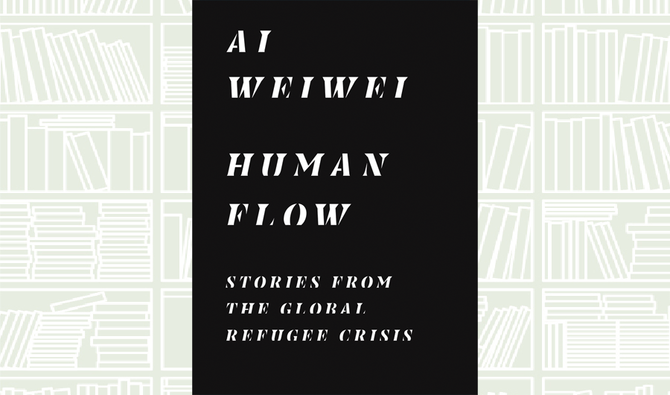
What We Are Reading Today: Human Flow; Stories from the Global Refugee Crisis by Ai Weiwei

Short Url
Updated 08 December 2020
Follow

What We Are Reading Today: Human Flow; Stories from the Global Refugee Crisis by Ai Weiwei

In the course of making Human Flow, his epic feature documentary about the global refugee crisis, the artist Ai Weiwei and his collaborators interviewed more than 600 refugees, aid workers, politicians, activists, doctors, and local authorities in 23 countries around the world. 

A handful of those interviews were included in the film. This book presents one hundred of these conversations in their entirety, providing compelling first-person stories of the lives of those affected by the crisis and those on the front lines of working to address its immense challenges. Speaking in their own words, refugees give voice to their experiences of migrating across borders, living in refugee camps, and struggling to rebuild their lives in unfamiliar and uncertain surroundings. They talk about the dire circumstances that drove them to migrate, whether war, famine, or persecution, and their hopes and fears for the future. 

A wide range of related voices provides context for the historical evolution of this crisis, the challenges for regions and states, and the options for moving forward.
What We Are Reading Today: The Power of Hope by Carol Graham

Updated 25 February 2026
Follow

What We Are Reading Today: The Power of Hope by Carol Graham

In a society marked by extreme inequality of income and opportunity, why should economists care about how people feel? The truth is that feelings of well-being are critical metrics that predict future life outcomes.

In this timely and innovative account, economist Carol Graham argues for the importance of hope—little studied in economics at present—as an independent dimension of well-being.

Given America’s current mental health crisis, thrown into stark relief by COVID, hope may be the most important measure of well-being, and researchers are tracking trends in hope as a key factor in understanding the rising numbers of “deaths of despair” and premature mortality.

Graham, an authority on the study of well-being, points to empirical evidence demonstrating that hope can improve people’s life outcomes and that despair can destroy them. These findings, she argues, merit deeper exploration.