What We Are Reading Today: ‘If Cats Disappeared from the World’

Photo/Supplied
Short Url
Updated 18 May 2024
Follow

What We Are Reading Today: ‘If Cats Disappeared from the World’

  • Beautifully written and emotionally moving, it is also a testament to the power of storytelling and reminds people of the deep impact of making personal choices and connections

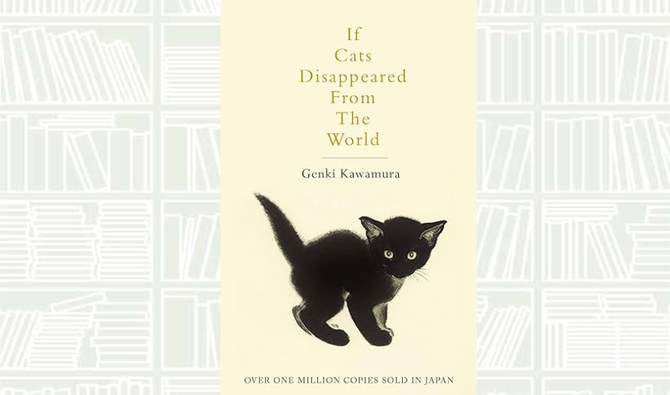
Author: Genki Kawamura

“If Cats Disappeared from the World” is a novel written by Japanese author Genki Kawamura. The book was published in 2012 and was rated 4/5 by over 75,000 readers worldwide.

Kawamura is a worldwide bestselling author. “If Cats Disappeared from the World” was his first novel, which sold over 1 million copies in Japan and was translated into over 14 languages.

In this novel, Kawamura tells the story of a postman who is diagnosed with an uncurable illness. However, when he accepts his destiny, the Devil appears to him with an unusual proposal. The postman must choose one thing to eliminate from this world for him to live one more day. During his journey, the postman then starts examining the true value of everything he owns.

Kawamura’s writing style is simple yet evocative, inviting readers to dive deep into the layers of their own emotional journey with every page. The narrative provides a delicate balance between moments of happiness and sorrow, using cats as a symbol of companionship and joy.

Moreover, the book allows readers to reflect on the value of relationships and experiences. It raises questions regarding the decisions people make, the legacies they leave behind, and the core meaning of everyday moments, which eventually shape people’s characters and how they think.

The novel encourages people to take a deep breath and reflect on the blessings people have, yet neglect, due to their busy lives.

With Kawamura’s thoughtful message and memorable characters, this novel is a compelling exploration of the human experience, providing comfort and inspiration, and a new appreciation for the beauty and brevity of life.

Beautifully written and emotionally moving, it is also a testament to the power of storytelling and reminds people of the deep impact of making personal choices and connections.


‘Maghras’ carries Al-Ahsa’s experimental farm from oasis to page

Updated 19 February 2026
Follow

‘Maghras’ carries Al-Ahsa’s experimental farm from oasis to page

AL-AHSA: Beneath a full moon and swaying palm trees, “Maghras: A Farm for Experimentation” was launched this month in Al-Ahsa, drawing a full crowd to Al-Sbakh Farm — the very landscape that inspired it.

Al-Ahsa, in Saudi Arabia’s Eastern Province, is home to 2.5 million date palms and is officially the largest palm oasis in the world, according to the Guinness Book of Records.

That agricultural abundance forms the foundation of Maghras, a project founded in 2024 by longtime friends Lulu Almana and Sara Al-Omran, who both grew up in the Eastern Province. Conceived as a space for experimentation, research and dialogue, Maghras centers on Al-Ahsa’s agricultural and cultural heritage.

The farm that hosts the project, Al-Sbakh, was established by the late Noura Al-Mousa, who worked alongside farmers and craftspeople for decades. Today, it is managed by her son’s Abdulmohsen Al-Rashed Humanitarian Foundation, alongside Dar Noura Al-Mousa for Culture and Arts, housed in her former home.

Earlier this year, Maghras traveled beyond the oasis. Curated by Almana and Al-Omran with US-based creative director Alejandro Stein, the project was presented at the Triennale di Milano from May 13 to Nov. 9, 2025 — marking the Kingdom’s inaugural participation. Commissioned by the Architecture and Design Commission under the Ministry of Culture, the pavilion took the form of a transplanted maghras, a traditional land unit defined by four palm trees.

The newly launched book, edited by Almana and Al-Omran alongside longtime collaborator Latifa Al-Khayat, extends that journey. Divided into five chapters — Water, Land, Infrastructure, Proximities and Lineages — it weaves imagery and text to document the farm’s evolving agro-ecosystems and seasonal harvest.

Featuring illustrations by Nada Al-Mulla and maps by Hayes Buchanan, and printed by Grafiche Mariano, Italy, and published by Kaph Books, the bilingual volume can be read in English or Arabic with identical wording.

Prince Nawaf bin Ayyaf, CEO of the Architecture and Design Commission, delivered opening remarks at the launch and is featured throughout the publication and the project’s journey.

The book is not a catalogue of the Milan activation. Instead, it captures the spirit of the experimental farm, including commissioned works by Leen Ajlan, Sawtasura (Tara Al-Dughaither), and Mohammad Al-Faraj. Developed through research and workshops circling the central maghras, the publication brings together insights, origin stories and first-person essays.

With attendees crossing from neighboring Bahrain and generations of Hasawi elders and emerging voices gathered under the palms, the launch underscored Maghras’s central premise: rooted in Al-Ahsa, yet reaching far beyond it.