

Egypt prepares to transport royal mummies to Fustat Museum

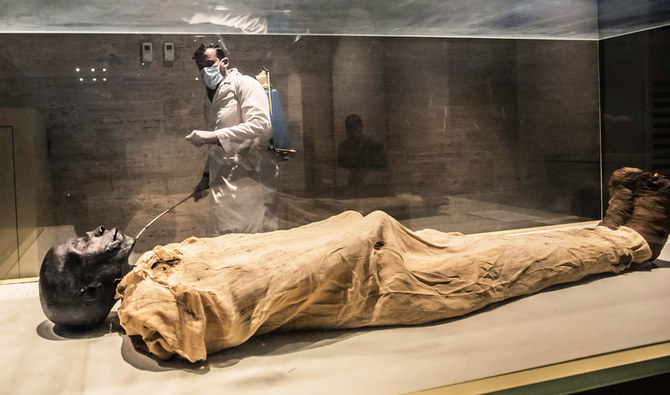
A worker disinfects the Royal Mummies Hall at the Egyptian Museum in Cairo's landmark Tahrir Square amid the coronavirus COVID-19 pandemic, on March 23, 2020. (AFP)
Short Url
Updated 07 December 2020
Follow

Egypt prepares to transport royal mummies to Fustat Museum

  • They are accompanied by 17 royal coffins and the procession will move from Tahrir Square to the Nile Corniche

CAIRO: Egypt is preparing for a royal procession of mummies from the Egyptian Museum in Tahrir Square to the National Museum of Egyptian Civilization in Fustat.

The procession features 22 mummies, 18 of which are mummies of kings and four are of queens.

Head of the Museums’ Sector at Egypt's Supreme Council of Antiquities, Moamen Othman, said the transfer was being carried out in line with specific procedures and international safety measures.

The artifacts were placed in sterilization units equipped with the latest scientific equipment and loaded onto carts that were specially designed and equipped for the purpose, he explained. The aim was to preserve the integrity of the mummies and ensure that the celebration was carried out in line with the greatness of ancient Egyptian civilization.

The Minister of Tourism and Antiquities Khaled Al-Anani and top museum officials have been discussing the final preparations for receiving the royal mummies.

The royal mummies being transferred are: King Ramses II, Ramses III, Ramses IV, Ramses V, Ramses VI, Ramses IX, Thutmose II, Thutmose I, Thutmose III, Thutmose IV, Seqnen Ra, Hatshepsut Amenhotep the First, Amenhotep II, Amenhotep the Third, Ahmose Nefertari, Merit Amon, Siptah, Merenptah, Queen T, Seti I, Seti II.

They are accompanied by 17 royal coffins and the procession will move from Tahrir Square to the Nile Corniche.

The Cairo governorate declared a state of emergency to determine the path of royal mummies and the area being developed in the vicinity of the Museum of Civilizations in Ain Sira, which will receive the royal mummies.

The area directly in front of the museum was converted into a tourist attraction project linked to the museum, and there are several roads serving the area and linking it to main roads.

The event is scheduled to start with the opening of the Egyptian Museum’s door for the mummies’ exit, in the presence of international ambassadors and the media.

The mummies will move from the Egyptian Museum on 22 old Egyptian-style cars, with musical instruments playing and horses.

Sources said the event had been rehearsed for more than two weeks to finalize it and that tests were being carried out on lighting, decorations and equipment.

The sources added that work in the Egyptian Museum was taking place around the clock, with an exchange between archaeologists and inspectors.

It is expected that the National Museum of Egyptian Civilization will be one of the most important tourist attractions in the country.

It is located near the Babylon Fortress and overlooks Ain Al Sira in the heart of the historic city of Fustat.

The foundation stone for the museum was laid in 2002.

It will be one of the most important and largest archeology museums in the world and also the first to be dedicated to the entirety of Egyptian civilization, with more than 50,000 artifacts from the earliest times until the modern era.


Israel confirms ban on 37 NGOs in Gaza

A Palestinian woman carries wood for fire in the Nuseirat refugee camp in the central Gaza Strip on December 31, 2025. (AFP)
Updated 01 January 2026
Follow

Israel confirms ban on 37 NGOs in Gaza

  • UN has warned that this will exacerbate the humanitarian crisis in the war-ravaged Palestinian territory
  • Several NGOS have said the requirements contravene international humanitarian law or endanger their independence

JERUSALEM: Israel on Thursday said 37 humanitarian agencies supplying aid in Gaza had not met a deadline to meet “security and transparency standards,” and would be banned from the territory, despite an international outcry.
The international NGOs, which had been ordered to disclose detailed information on their Palestinian staff, will now be required to cease operations by March 1.
The United Nations has warned that this will exacerbate the humanitarian crisis in the war-ravaged Palestinian territory.
“Organizations that have failed to meet required security and transparency standards will have their licenses suspended,” Israel’s Ministry of Diaspora Affairs and Combating Antisemitism said in a statement.
Several NGOS have said the requirements contravene international humanitarian law or endanger their independence.
Israel says the new regulation aims to prevent bodies it accuses of supporting terrorism from operating in the Palestinian territories.
Prominent humanitarian organizations hit by the ban include Doctors Without Borders (MSF), the Norwegian Refugee Council (NRC), World Vision International and Oxfam, according to a ministry list.
In MSF’s case, Israel accused it of having two employees who were members of Palestinian militant groups Islamic Jihad and Hamas.
MSF said this week the request to share a list of its staff “may be in violation of Israel’s obligations under international humanitarian law” and said it “would never knowingly employ people engaging in military activity.”
‘Critical requirement’ 
NRC spokesperson Shaina Low told AFP its local staff are “exhausted” and international staff “bring them an extra layer of help and security. Their presence is a protection.”
Submitting the names of local staff is “not negotiable,” she said. “We offered alternatives, they refused,” hse said, of the Israeli regulators.
The ministry said Thursday: “The primary failure identified was the refusal to provide complete and verifiable information regarding their employees, a critical requirement designed to prevent the infiltration of terrorist operatives into humanitarian structures.”
In March, Israel gave NGOs 10 months to comply with the new rules, which demand the “full disclosure of personnel, funding sources, and operational structures.”
The deadline expired on Wednesday.
The 37 NGOs “were formally notified that their licenses would be revoked as of January 1, 2026, and that they must complete the cessation of their activities by March 1, 2026,” the ministry said Thursday.
A ministry spokesperson told AFP that following the revocation of their licenses, aid groups could no longer bring assistance into Gaza from Thursday.
However, they could have their licenses reinstated if they submitted the required documents before March 1.
Minister of Diaspora Affairs and Combating Antisemitism Amichai Chikli said “the message is clear: humanitarian assistance is welcome — the exploitation of humanitarian frameworks for terrorism is not.”
‘Weaponization of bureaucracy’
On Thursday, 18 Israel-based left-wing NGOs denounced the decision to ban their international peers, saying “the new registration framework violates core humanitarian principles of independence and neutrality.”
“This weaponization of bureaucracy institutionalizes barriers to aid and forces vital organizations to suspend operations,” they said.
UN Palestinian refugee agency chief Philippe Lazzarini had said the move sets a “dangerous precedent.”
“Failing to push back against attempts to control the work of aid organizations will further undermine the basic humanitarian principles of neutrality, independence, impartiality and humanity underpinning aid work across the world,” he said on X.
On Tuesday, the foreign ministers of 10 countries, including France and Britain, urged Israel to “guarantee access” to aid in the Gaza Strip, where they said the humanitarian situation remains “catastrophic.”
A fragile ceasefire has been in place since October, following a deadly war waged by Israel in response to Hamas’s unprecedented October 7, 2023 attack on Israel.
Nearly 80 percent of buildings in Gaza have been destroyed or damaged by the war, according to UN data.
About 1.5 million of Gaza’s more than two million residents have lost their homes, said Amjad Al-Shawa, director of the Palestinian NGO Network in Gaza.