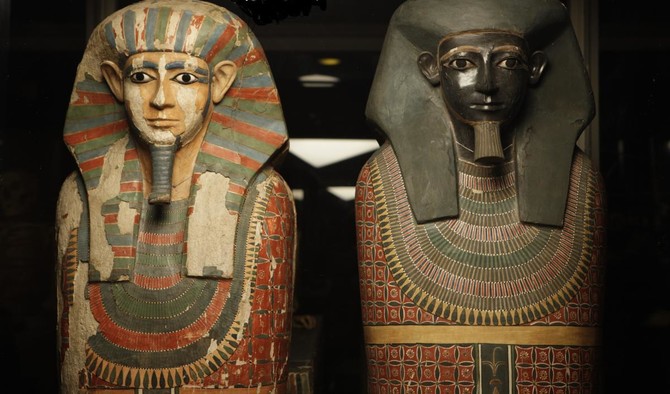
MANCHESTER: Using “next generation” DNA sequencing scientists from the University of Manchester have found that the famous “Two Brothers” mummies of the Manchester Museum actually had different fathers so are, in fact, half-brothers, according to a release from the university.
The Two Brothers are the Museum’s oldest mummies and among the best-known human remains in its Egyptology collection. They are the mummies of two elite men — Khnum-nakht and Nakht-ankh – dating to around 1800BC.
However, since their discovery in 1907 there has been debate among Egyptologists whether they were related at all. Therefore, back in 2015, “ancient DNA” was extracted from the teeth of the pair to solve the mystery.
But how did the mystery start? According to the release from Manchester University, the pair’s joint burial site, later dubbed The Tomb of The Two Brothers, was discovered at Deir Rifeh, a village 250 miles south of Cairo. They were found by Egyptian workmen directed by early 20th century Egyptologists, Flinders Petrie and Ernest Mackay. Hieroglyphic inscriptions on the coffins indicated that both men were the sons of an unnamed local governor and had mothers with the same name, Khnum-aa. It was then the men became known as the Two Brothers.
The release goes on: “When the complete contents of the tomb were shipped to Manchester in 1908 and the mummies of both men were unwrapped by the UK’s first professional female Egyptologist, Dr. Margaret Murray. Her team concluded that the skeletal morphologies were quite different, suggesting an absence of family relationship. Based on contemporary inscriptional evidence, it was proposed that one of the Brothers was adopted.”
Analysis showed that both Nakht-Ankh and Khnum-Nakht belonged to mitochondrial haplotype M1a1, suggesting a maternal relationship. The Y chromosome sequences were less complete but showed variations between the two mummies, indicating that Nakht-Ankh and Khnum-Nakht had different fathers, and were thus very likely to have been half-brothers.
Dr. Konstantina Drosou of the university’s School of Earth and Environmental Sciences who conducted the DNA sequencing, said: “It was a long and exhausting journey to the results but we are finally here. I am very grateful we were able to add a small but very important piece to the big history puzzle and I am sure the brothers would be very proud of us. These moments are what make us believe in ancient DNA.”

Ancient DNA results end 'daddy' mystery of Egyptian mummies in Manchester
Arts festival’s decision to exclude Palestinian author spurs boycott
- A Macquarie University academic who researches Islamophobia and Palestine, Abdel-Fattah responded saying it was “a blatant and shameless act of anti-Palestinian racism and censorship,” with her lawyers issuing a letter to the festival
SYDENY: A top Australian arts festival has seen the withdrawal of dozens of writers in a backlash against its decision to bar an Australian Palestinian author after the Bondi Beach mass shooting, as moves to curb antisemitism spur free speech concerns.
The shooting which killed 15 people at a Jewish Hanukkah celebration at Sydney’s Bondi Beach on Dec. 14 sparked nationwide calls to tackle antisemitism. Police say the alleged gunmen were inspired by Daesh.
The Adelaide Festival board said last Thursday it would disinvite Randa Abdel-Fattah from February’s Writers Week in the state of South Australia because “it would not be culturally sensitive to continue to program her at this unprecedented time so soon after Bondi.”
FASTFACTS
• Abdel-Fattah responded, saying it was ‘a blatant and shameless act of anti-Palestinian racism and censorship.’
• Around 50 authors have since withdrawn from the festival in protest, leaving it in doubt, local media reported.
A Macquarie University academic who researches Islamophobia and Palestine, Abdel-Fattah responded saying it was “a blatant and shameless act of anti-Palestinian racism and censorship,” with her lawyers issuing a letter to the festival.
Around 50 authors have since withdrawn from the festival in protest, leaving it in doubt, local media reported.
Among the boycotting authors, Kathy Lette wrote on social media the decision to bar Abdel-Fattah “sends a divisive and plainly discriminatory message that platforming Australian Palestinians is ‘culturally insensitive.'”
The Adelaide Festival said in a statement on Monday that three board members and the chairperson had resigned. The festival’s executive director, Julian Hobba, said the arts body was “navigating a complex moment.”
a complex and unprecedented moment” after the “significant community response” to the board decision.
In the days after the Bondi Beach attack, Jewish community groups and the Israeli government criticized Prime Minister Anthony Albanese for failing to act on a rise in antisemitic attacks and criticized protest marches against Israel’s war in Gaza held since 2023.
Albanese said last week a Royal Commission will consider the events of the shooting as well as antisemitism and social cohesion in Australia. Albanese said on Monday he would recall parliament next week to pass tougher hate speech laws.
On Monday, New South Wales state premier Chris Minns announced new rules that would allow local councils to cut off power and water to illegally operating prayer halls.
Minns said the new rules were prompted by the difficulty in closing a prayer hall in Sydney linked to a cleric found by a court to have made statements intimidating Jewish Australians.
The mayor of the western Sydney suburb of Fairfield said the rules were ill-considered and councils should not be responsible for determining hate speech.
“Freedom of speech is something that should always be allowed, as long as it is done in a peaceful way,” Mayor Frank Carbone told Reuters.