

Pakistan International Airlines to cut special salaries, allowances of engineers by 50%

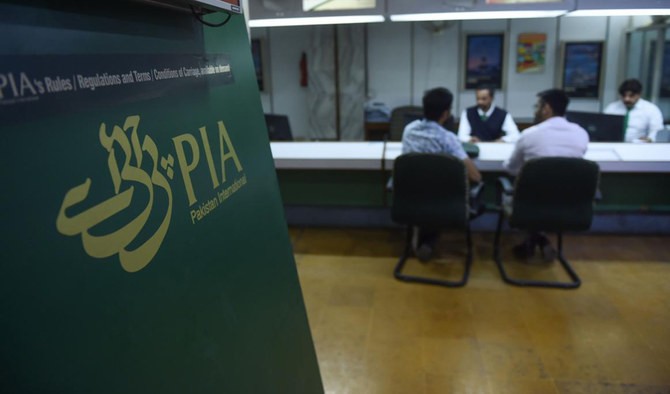
In this file photo, staff of Pakistan International Airlines (PIA) talk with passengers at a PIA office in Karachi on Feb. 27, 2019. (AFP)
Short Url
Updated 15 December 2020
Follow

Pakistan International Airlines to cut special salaries, allowances of engineers by 50%

  • PIA has incurred billions of rupees of losses for the last several years
  • Government has approved bailout packages to keep it financially afloat

ISLAMABAD: Pakistan International Airlines (PIA) has announced it will cut special salaries, allowances and perks of its aircraft engineers by 50 percent from next year, the national carrier’s spokesperson said on Monday.

“The special salaries and allowances of the aircraft engineers will be reduced by 50 percent from January 2021. This has been done to rationalize the resources and allowances of our engineering staff,” PIA spokesman Abdullah Hafeez Khan told Arab News. 

He said the allowances had been rationalized to more realistic levels based on current qualification and licensing.

“A lot of PIA engineers were getting the allowances for the equipment that is not part of our fleet now such as Boeing 747 and few airbuses. This move will not save much finances to the organization but it will bring a realistic and just allowance structure.”

Moreover, the pilots of the national carrier will be paid 50 hours guarantee allowance instead of 75 hours, Khan said: “Pilots were getting flying allowances with minimum guarantee of 75 hours which have also been rationalized and now they will get benefit after flying for 50 hours.”

He said the organization was going through a lot of changes to improve its performance and viability.

“We have just introduced a Voluntary Separation Scheme (VSS) through which we expect 2500 people to benefit from it. It is in the pipeline as all the preparations have been finalized and notification has been issued today. The persons who will avail scheme will leave PIA on 31st December 2020,” Khan said.

The Economic Coordination Committee (ECC) of the Cabinet last month approved the Aviation Division’s summary regarding cash support to implement the voluntary separation scheme. The ECC approved Rs12.87 billion as the cost of VSS to be paid in about two and a half years time.

PIA is a state-run entity that has incurred billions of rupees of losses for the last several years. In recent years, the government has tried several measures to cut down PIA’s annual losses and approved bailout packages to keep it financially afloat.


Pakistan graft survey echoes IMF warning on weak governance, public dissatisfaction

Updated 5 sec ago
Follow

Pakistan graft survey echoes IMF warning on weak governance, public dissatisfaction

  • Most Pakistanis say they were not compelled to pay bribes, but distrust remains high in anti-corruption efforts
  • PM Shahbaz Sharif calls report a recognition of his government’s efforts to fight corruption, promote transparency

ISLAMABAD: Governance weaknesses flagged by the International Monetary Fund (IMF) appeared to align with findings from Pakistan’s latest corruption perception survey, analysts said on Tuesday, as Transparency International Pakistan (TI-Pakistan) reported widespread public dissatisfaction with the state’s accountability mechanisms.

TI-Pakistan’s National Corruption Perception Survey (NCPS) 2025 found that 58 percent of respondents fully or partly agreed that the IMF program and Pakistan’s removal from the Financial Action Task Force’s grey list had helped stabilize the economy.

“Encouragingly, a majority of Pakistanis (66 percent) nationwide reported that they did not experience a situation where they felt compelled to offer a bribe to access any public service,” said the survey. “Sindh recorded the highest proportion of respondents paying a bribe to access public service (46 percent), followed by Punjab (39 percent), Balochistan (31 percent) and Khyber Pakhtunkhwa (20 percent).”

In this context, 77 percent said they were unhappy with the government’s anti-corruption performance.

However, Prime Minister Muhammad Shehbaz Sharif expressed satisfaction over the report in a statement, saying “a large majority of citizens said they did not face corruption during our government’s tenure” which is “recognition of our efforts to fight corruption and promote transparency.”

“It is highly encouraging that most citizens considered the government’s measures for economic recovery to be successful,” he said.

“We worked on a priority basis to establish a system grounded in merit and transparency across all sectors of government, and we are continuing to build on these efforts,” he added.

Economist and former finance ministry adviser Dr. Khaqan Najeeb said the survey highlighted the same structural weaknesses identified by the IMF’s Governance and Corruption Diagnostic, published on Nov. 20 at the international lender’s request, which said Pakistan suffers from “persistent and widespread corruption vulnerabilities” rooted in a state-dominated economy, weak regulatory capacity, and inconsistent enforcement.

“Transparency International Pakistan’s National Corruption Perception Survey does suggest progress in reducing low-level, day-to-day bribery, but it does not contradict the IMF’s governance findings,” he told Arab News. “Instead, it highlights that Pakistan’s real challenge lies in deeper, systemic weaknesses in transparency, oversight and institutional accountability.”

“While public perception has improved, it does not mean the underlying governance issues identified by the IMF have been resolved,” he argued, adding that addressing those will require sustained reforms, stronger institutions and consistent enforcement.

Political analyst Mazhar Abbas said the report was going to be used by the government to bolster its economic narrative.

“Survey reports have usually been tilted in favor of the government, and this report is no different,” he told Arab News. “The government will certainly use it to support its narrative of an improved economy, as the report states that a majority of respondents partially or fully agree that the government has successfully stabilized the economy through the IMF agreement and by exiting the FATF grey list.”

Abbas added it was difficult to either challenge or endorse the findings of the report without knowing who was interviewed and who the respondents were.

“The police have consistently been at the top of Transparency International’s corruption perception reports, whereas there may be other organizations where the frequency and volume of corruption are even higher,” he continued, adding that since the police are a public-dealing organization and consistently top the corruption perception index, it suggested that most respondents are from the general public, who may either lack access to or knowledge of corrupt practices in other organizations.

Islamabad-based social-sector development consultant Muhammad Qasim Jan said the survey should be seen as a barometer of public sentiment rather than an empirical measure of corruption.

“The National Corruption Perception Survey 2025 offers a sobering snapshot of how Pakistanis view corruption and accountability,” he told Arab News. “At the same time, the absence of basic methodological detail means the results should be interpreted with caution, especially when citing national percentages or making population-wide claims.”