

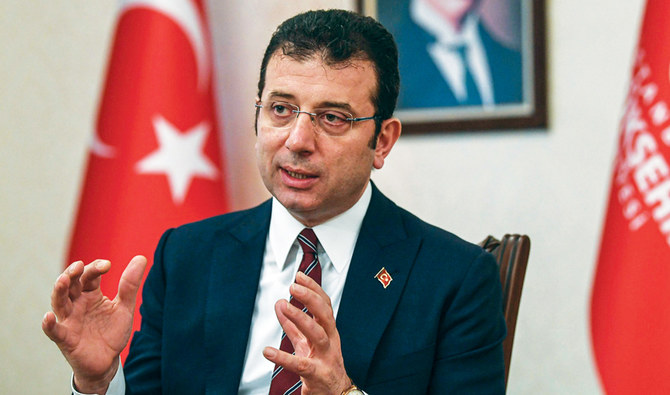

ANKARA: The refusal of Turkey’s state-run banks to extend loans to Istanbul is forcing the municipality to seek loans from abroad.
At a press conference in Istanbul on Wednesday, Ekrem Imamoglu, the mayor of Istanbul, announced that the municipality issued its first eurobond to international capital markets to fund its new infrastructure projects.
The municipality secured $580 million of financing with this eurobond for four landmark subway projects in the city.
“Our relationship with foreign financing sources will continue. This could be either another bond issue, project financing or another instrument,” Imamoglu said.
Imamoglu declared he will focus on metro projects in 2021 following the repeated calls of Istanboulites to ease the traffic jams in the second most congested city in the world.
Imamoglu emerged a powerful challenger to the authority of Turkish President Recep Tayyip Erdogan’s ruling Justice and Development Party (AKP) since he won two local elections last year in March, then in June to be elected the mayor of 16 million people.
The local projects he has implemented so far attracted various segments of the society as they touched on their daily needs. Imamoglu is also expected to challenge Erdogan in the next presidential elections in 2023.
Turkish state banks closed their doors to the municipality after they had supported AKP-affiliated municipalities for the past 25 years.
“It is no secret that Erdogan felt threatened by the loss of İstanbul to the opposition. He refused to accept the loss initially and demanded a rerun of the election, which – embarrassingly – Imamoglu won even more decisively. Now Imamoglu has emerged as a serious contender for 2023 and therefore has a target on his back,” said Paul T. Levin, director of the Stockholm University Institute for Turkish Studies.
“It is unsurprising that the AKP uses its sway over state banks to make governing difficult for the opposition mayor, but it is the citizens of the city who will ultimately pay for it,” he told Arab News.
Given Istanbul’s importance to the country’s economy, Levin warns that trying to punish Imamoglu may backfire and end up hurting Turkey’s rulers, especially Erdogan.
FASTFACT
The Istanbul mayor emerged a powerful challenger to the authority of Turkish President Recep Tayyip Erdogan’s ruling Justice and Development Party (AKP) since he won two local elections last year in March, then in June to be elected the mayor of 16 million people.
Separately, the government has not abandoned the controversial Kanal Istanbul, The $9 billion project, dubbed as Erdogan’s “crazy project,” aims to connect Black Sea and Marmara Sea through an artificial waterway. It has drawn harsh criticism from Imamoglu who has been a vocal opponent of the project on environmental and financial grounds along with the fear that it might trigger earthquakes.
The security around Istanbul mayor was recently increased following serious claims of Daesh-linked assassination plot.
According to Berk Esen, a political analyst from Sabanci University in Istanbul, the state banks' decision to not offer loans to opposition-controlled municipalities is another sign of the increasingly authoritarian regime in Turkey.
“The AKP government has turned the state bureaucracy into its partisan machine, using public resources to favor the party base and punishing opposition voters,” he said.
“This is a deliberate move by the government to leave mayors from opposition parties without sufficient funds to service the municipality debt and undertake large-scale public projects simultaneously,” he said.
Similarly, a senior official at the Ankara municipality confirmed that public banks are refraining from extending loans to the capital as well.
In March 2019 elections, the opposition candidate, Mansur Yavas, ended 25 years of rule by the mayors affiliated to the AKP who benefited continually from the loans of state banks for strange and unpopular urban projects such as dinosar parks.
According to Esen, the AKP elites calculate that these projects could help opposition mayors draw votes from their base, thereby undermining the AKP's political hegemony.
“State banks are a convenient tool to use for this strategy. Under the AKP rule, the state banks instead turned into cash machines for pro-government businesses who openly side with Erdogan,” he said.


