


Kuwait parliamentary race kicks off under shadow of pandemic

1 / 3
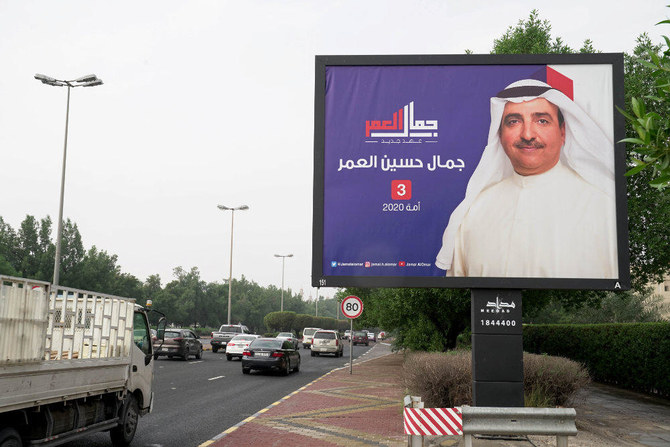
A billboard advertising a parliamentary candidate on a main street ahead of parliamentary elections in Kuwait city on December 3, 2020. (REUTERS/Stephanie McGehee)
2 / 3
A bus with a parliamentary candidate advertisement is seen in a parking lot near a polling station, ahead of parliamentary elections in Kuwait city on December 3, 2020. (REUTERS/Stephanie McGehee)
3 / 3
A worker cleans desks at a polling station ahead of parliamentary elections in Abdullah Salem, Kuwait, on December 3, 2020. (REUTERS/Stephanie McGehee)
Short Url
Updated 05 December 2020
Follow

Kuwait parliamentary race kicks off under shadow of pandemic

  • More than 567,000 voters will be eligible to choose among the 326 candidates contesting the vote
  • Kuwait has a lively political life with a parliament elected for four-year terms

KUWAIT CITY: Kuwait is holding parliamentary elections Saturday under the shadow of Covid-19, with facilities laid on for citizens infected with the disease to vote in special polling stations.
The oil-rich country has enforced some of the strictest regulations in the Gulf to combat the spread of the coronavirus, imposing a months-long nationwide lockdown earlier this year.
But while some curbs have eased, over-the-top election events that traditionally draw thousands for lavish banquets are out, masks remain mandatory and temperature checks are routine when venturing outdoors.
Infected people or those under mandatory quarantine are usually confined to home, with electronic wristbands monitoring their movements.
But in an effort to include all constituents, authorities have designated five schools — one in each electoral district — where they can vote, among the 102 polling stations across the country.
Election officials are expected to be in full personal protective equipment.
Kuwait has a lively political life with a parliament elected for four-year terms that enjoys wide legislative powers.
Political disputes are often fought out in the open.
Parties are neither banned nor recognized, but many groups — including Islamists — operate freely as de facto parties.
But with more than 143,917 coronavirus cases to date, including 886 deaths, the election campaign has been toned down this year.
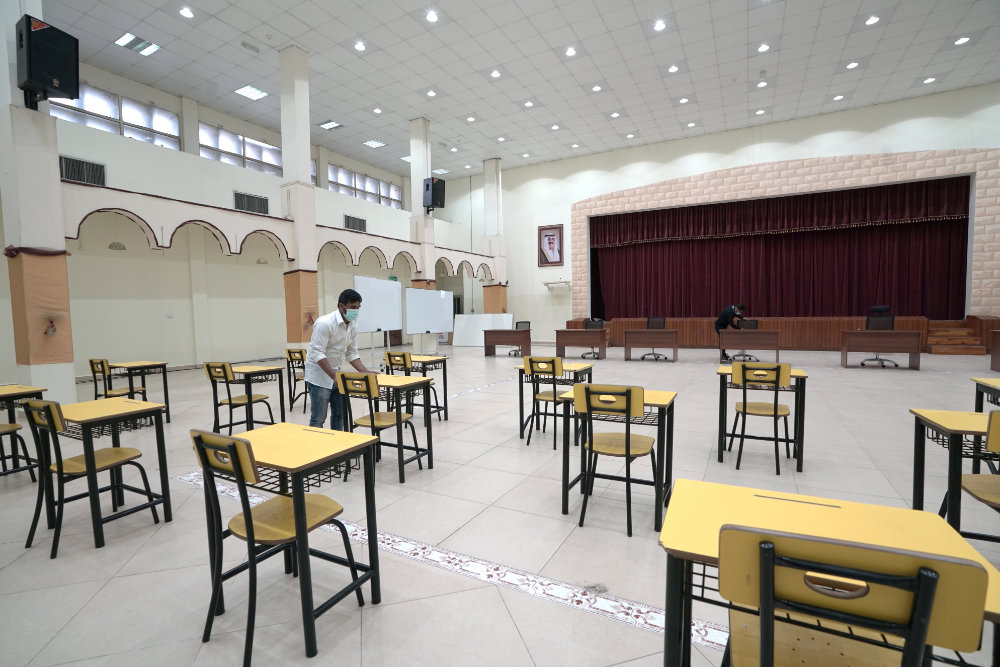


A worker cleans desks at a polling station ahead of parliamentary elections in Abdullah Salem, Kuwait, on December 3, 2020. (REUTERS/Stephanie McGehee)

The polls, which open at 8:00 a.m. (0500 GMT), will be the first since the new emir, Sheikh Nawaf Al-Ahmad Al-Sabah, took office in September following the death of his half-brother, 91-year-old Sheikh Sabah Al-Ahmad Al-Sabah.
But with the opposition weakened in recent years, no major political shifts are expected.
A few electoral banners dotted through the streets have been the only reminder of the nation’s political calendar.
Instead, this year’s campaign has mainly been fought on social networks and in the media.
More than 567,000 Kuwaiti voters will be eligible to choose among the 326 candidates contesting the vote, including 29 women.
Ahmad Deyain, secretary general of the opposition group Kuwaiti Progressive Movement, said he expected a lower voter turnout than previous years after the dulled-down campaign.
The usual themes are a constant though, from promises to fight corruption and plans to address youth employment, to freedom of expression, housing, education and the thorny issue of the “bidoon,” Kuwait’s stateless minority.
From 2009 to 2013, and especially after the Arab Spring revolts of 2011, the country went through a period of political turmoil, with parliament and cabinets dissolved several times after disputes between lawmakers and the ruling family-led government.
“Kuwait is still undergoing a political crisis since 2011, and that page has not yet turned,” Deyain told AFP.
“There are still disputes over the electoral system and mismanagement of state funds.
Deyain said he expected some parliamentarians in the new National Assembly to be “more dynamic” in trying to resolve some issues.
Kuwait was the first Gulf Arab state to adopt a parliamentary system in 1962, and women in 2005 won the right to vote and to stand for election.


Palestinian NGO condemns Israeli act of ‘revenge’ after prisoner abuse video

Updated 58 min 14 sec ago
Follow

Palestinian NGO condemns Israeli act of ‘revenge’ after prisoner abuse video

  • A Palestinian NGO has denounced what it called an Israeli act of revenge after a video showed far-right National Security Minister Itamar Ben Gvir overseeing the abuse of detainees in a military priso

RAMALLAH: A Palestinian NGO has denounced what it called an Israeli act of revenge after a video showed far-right National Security Minister Itamar Ben Gvir overseeing the abuse of detainees in a military prison.
Just days before the start of the Muslim holy month of Ramadan, Ben Gvir held a tour of Ofer Prison in the occupied West Bank, Israel’s Channel 7 reported.
In footage filmed on Friday and broadcast by the channel, around 20 police officers are seen storming a hallway leading to prison cells, brandishing their weapons and firing stun grenades.
They then pull five detainees from their cells, their hands tied behind their backs, forcing them face-down onto the floor.
The operation took place as a bill proposing the death penalty for Palestinian prisoners convicted of terrorism awaited a final vote in the Israeli parliament.
“This is all part of ongoing displays meant to take revenge on Palestinian detainees,” Abdallah al?Zaghari, head of the Palestinian Prisoners’ Club, told AFP on Saturday.
“Everything Ben Gvir and the far?right government are doing affects not only the Palestinian people and prisoners in detention camps — it also impacts the global legal and human rights system,” he added.
Ben Gvir, known for his inflammatory rhetoric, is considered one of the most hard-line members of Prime Minister Benjamin Netanyahu’s ruling coalition.
“It is simply a source of pride — arriving at a prison like this, a prison for terrorists, the vilest of the vile, seeing them like this,” Ben Gvir said in the video.
“I want one more thing: to execute them — the death penalty for terrorists,” he added.
Palestinian Islamist movement Hamas on Saturday said the remarks were “a new war crime and a blatant challenge to international humanitarian law regarding prisoners.”
International rights groups have repeatedly warned of alleged abuse and mistreatment inflicted in Israeli prisons since Hamas’s October 7, 2023, attack on Israel.
While the death penalty exists for a small number of crimes in Israel, it has become a de facto abolitionist country, with the Nazi Holocaust perpetrator Adolf Eichmann the last person to be executed in 1962.