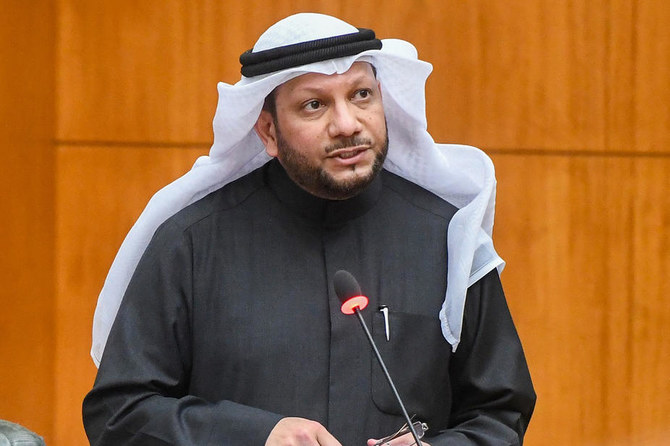
KUWAIT: Kuwait’s finance minister on Monday appointed new senior ministry officials after the ministry undersecretary and five other officials resigned last week.
Aseel Al-Saad Al-Munifi was given the role of undersecretary alongside her current position as assistant undersecretary for budgetary affairs, a statement on the ministry’s Twitter account said.
The six ministry employees wrote in a letter on Wednesday they were resigning in protest at a staff reshuffle at the ministry this year and policy differences. The finance minister accepted the resignations.
One of the most pressing issues facing Kuwait’s new Emir Sheikh Nawaf Al-Ahmad Al-Sabah, who took power following the death of the country’s ruler in September, is the task of overcoming gridlock on debt legislation to tackle a liquidity crisis.
Low oil prices and COVID-19 have strained state finances and led to the rapid depletion of available cash reserves.
Parliament has repeatedly blocked the bill that would allow Kuwait to tap international debt markets.
Kuwait is due to hold parliamentary elections on Dec. 5.
The Gulf state, which has an outspoken parliament, sees frequent clashes between cabinet and parliament, leading to government reshuffles and dissolutions of parliament that hinder investment and reform efforts.

Kuwait finance ministry appoints new senior officials after resignations
https://arab.news/js3yn
Kuwait finance ministry appoints new senior officials after resignations
- Aseel Al-Saad Al-Munifi was given the role of undersecretary
- Several officials resigned last week
UN’s development chief says living conditions in Gaza are worst he has ever seen
- Alexander De Croo urges Israeli authorities to allow more access for removal of debris, provision of temporary housing, and efforts to restart the private sector
- 90 percent of territory’s population living amid rubble in ‘extremely painful’ and dangerous circumstances, he says after 3-day visit to Gaza
NEW YORK CITY: The head of the UN Development Programme said on Tuesday that living conditions in Gaza are the worst he has witnessed in his career, as he urged Israeli authorities to grant more access for the removal of debris, the provision of temporary housing, and private-sector recovery efforts.
Speaking in East Jerusalem after a three-day visit to Gaza, Alexander De Croo said 90 percent of the territory’s population was living amid rubble in “extremely painful” and dangerous circumstances.
“I have been minister of development for six years in the past; this is the worst living conditions that I have ever seen,” he said.
Teams from his agency are focusing their recovery efforts in Gaza on three main areas, he explained: the removal of rubble and other solid waste, temporary housing, and restarting parts of the private sector.
UNDP has removed about 5 percent of the rubble from the war-ravaged enclave so far, De Croo said, but at the current pace clearing it all will take seven years.
“90 percent of the people of Gaza today live in the middle of that rubble, which is extremely dangerous,” he warned, adding that unexploded ordnance and other health risks pose additional ongoing dangers to residents.
Regarding housing, he said most people were living in what he described as very rudimentary tents. UNDP has built 500 “recovery housing” units and has a further 4,000 ready to go, but he estimated that between 100,000 and 203,000 units were needed to provide even the most basic improvements to shelter.
“This is definitely not reconstruction,” he said. “But it’s an improvement on what is available for the moment.”
His agency’s third area of focus is restoration of the private sector, which he said has been “in hibernation.” It aims to help businesses resume operations and provide income for residents through limited investments and cash-for-work programs, including the processing of food.
The main request his agency is making to Israeli authorities is greater access for the delivery of materials and equipment, De Croo said, including heavy machinery for the removal of debris, and components for temporary housing.
“We understand the security concerns of the Israeli authorities,” he said. “But that would not be a reason to not provide organizations such as UNDP, other UN organizations and international (nongovernmental organizations) the more access that is definitely needed to be able to help more people.”
Asked about Israel’s objections to the deployment of large bulldozers and the provision of additional housing units, De Croo said discussions with Israeli officials often centered on “dual-use” concerns over materials that could potentially have military as well as civilian applications.
“We are in continuous discussions with the Israeli authorities on what are the right conditions to have more access,” he said, adding that UNDP takes steps to ensure all materials are used solely for humanitarian purposes.
He reiterated his call for expanded access to enable support for humanitarian and recovery efforts, and said such assistance is an obligation on every state.
“We really have only one ask: Please provide organizations such as UNDP and the others the necessary access to be able to provide the humanitarian and recovery support,” he added.


