Pakistani opposition on same page with government: Says 'no' to recognizing Israel

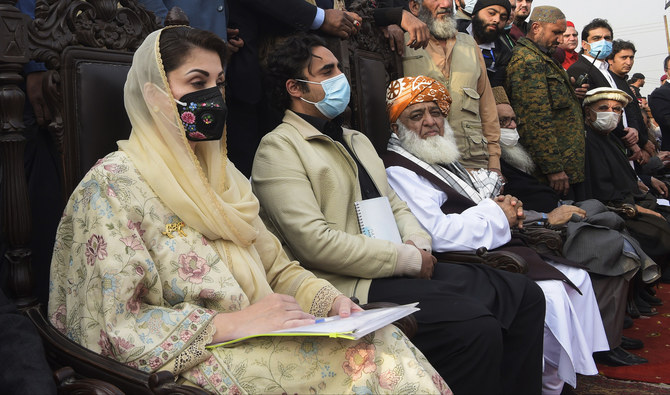
Maryam Nawaz, left, Bilawal Bhutto Zardari, second left, and President of the Jamiat Ulema-e-Islam Maulana Fazlur Rehman, third left, sit on the stage during a political rally in Peshawar on Nov. 22, 2020. (AFP/File)
Short Url
Updated 04 December 2020
Follow

Pakistani opposition on same page with government: Says 'no' to recognizing Israel

  • In recent weeks, there has been speculation about foreign pressure on Pakistan to recognize Israel
  • Opposition leaders say recognizing Israel is 'unthinkable' and against Pakistan's foundations

ISLAMABAD: Pakistani opposition parties on Thursday echoed the government's position of not recognizing Israel, saying that normalizing ties with Tel Aviv would be against Pakistan's ideological foundations.
In recent weeks, there has been speculation about foreign pressure on Pakistan to recognize Israel, although the Pakistani prime minister and foreign office have categorically rejected the reports.
“Pakistani people are strongly against accepting Israel as it is against the ideology of our founder Quaid-i-Azam,” Pakistan Muslim League-Nawaz (PML-N) senior leader Raja Zafar Ul Haq told Arab News, referring to Muhammad Ali Jinnah, the founder of Pakistan.
“Israel has not been recognized as the government knew that they will face a very strong public reaction against it. We strongly support the Palestinian people for their right of an independent and sovereign state,” he said.

Fazlur Rehman, chief of Jamiat Ulema-e-Islam-Fazl (JUI-F) and the head of the multi-party opposition alliance Pakistan Democratic Movement, said the whole Muslim world should talk about recognizing Palestine rather than Israel.
“It is totally unthinkable to recognize Israel. We should talk about independence of Palestine with Al-Quds Al-Sharif as its capital,” he said. “Why the Muslim world is under so much pressure that on one side we are handing over Kashmir to Indians and on the other side, are handing over Palestine to Israel?”
Liaqat Baloch, leader of the opposition Jamaat-e-Islami, told Arab News that Pakistan's stance on Israel is that of Quaid-i-Azam, "that it is an illegal state and the dagger has been stabbed in the chest of the entire Ummah." 
"If we will take decision by conceding to the pressure then we will have no stand on Kashmir. Therefore, it is the stance of Jamaat-e-Islami that we should not recognize Israel. Palestine belongs to Palestinians. We should stand by our principle stand for the independence of Palestine and freedom of Al-Quds Al-Sharif."


Pakistan does not recognize Israel and has been a staunch supporter of demands for a Palestinian state.
Farhat Ullah Babar, senior leader of the opposition Pakistan People’s Party (PPP) said Pakistan should not recognize Israel until the rights of Palestinians are granted to them.

“It is a cornerstone of our foreign policy that any settlement in the Middle East must be based on the acceptance of the inalienable rights of the Palestinian people,” he told Arab News.
Foreign office spokesman Zahid Hafeez Chaudhari reiterated the government's stance during a media briefing on Thursday.
“For just and lasting peace, it is imperative to have a two-state solution in accordance with the relevant United Nations and OIC (Organization of Islamic Cooperation) resolutions, with the pre-1967 borders, and Al-Quds Al-Sharif as the capital of a viable, independent and contiguous Palestinian State,” he told reporters.



Pakistan says defense pact with Saudi Arabia elevated brotherly ties to ‘new heights’

Updated 6 sec ago
Follow

Pakistan says defense pact with Saudi Arabia elevated brotherly ties to ‘new heights’

  • Pakistan, Saudi Arabia signed strategic defense pact last year pledging aggression against one will be treated as attack on both
  • Deputy PM Ishaq Dar says enduring bonds with Islamic and Arab nations form vital pillar of Pakistan’s foreign policy 

ISLAMABAD: Deputy Prime Minister Ishaq Dar said on Wednesday that Pakistan’s defense pact with Saudi Arabia elevated its brotherly ties with the Kingdom to “new heights,” stressing that close ties with Arab and Islamic nations form a key pillar of Islamabad’s foreign policy. 

Pakistan and Saudi Arabia signed a Strategic Mutual Defense Agreement on Sept. 17 last year, pledging that aggression against one country would be treated as an attack on both, enhancing joint deterrence and formalizing decades of military and security cooperation.

Both nations agreed in October 2025 to launch an economic cooperation framework to strengthen trade and investment ties. 

“In the Middle East, our landmark Strategic Mutual Defense Agreement with Saudi Arabia has elevated our brotherly ties to new heights,” Dar said while speaking at the Pakistan Governance Forum 2026 event in Islamabad. 

The Pakistani deputy prime minister was speaking on the topic “Navigating International Relations Amidst Changing Geo-Politics.”

Dar noted that Pakistan has reinforced partnerships with other Middle Eastern nations such as the UAE, Qatar, Jordan, Oman, Egypt and Bahrain. He said these partnerships have yielded “concrete agreements” in investment, agriculture, infrastructure, and energy sectors. 

“Our enduring bonds with Islamic and Arab nations form a vital pillar of our foreign policy, and we will continue to expand our partnerships across Asia, Latin America, and Africa,” he said. 

Dar pointed out that the presidents of Kazakhstan, Uzbekistan and Kyrgyzstan have undertaken visits to Pakistan in recent months, reflecting Central Asian nations’ desire to boost cooperation with Islamabad.

On South Asia, the Pakistani deputy PM said Pakistan has successfully transformed its fraternal ties with Bangladesh into “a substantive partnership.”

“Similarly, the trilateral mechanism involving China, Pakistan, and Bangladesh has been launched with a view to expanding and deepening regional cooperation and synergy,” the Pakistani minister said. 

He said Islamabad has strengthened its “all-weather” partnership with China via the second phase of the multi-billion-dollar China-Pakistan Economic Corridor agreement and “unwavering support” from both sides for each other’s core interests. 

Dar said Pakistan had also reinvigorated its partnership with the US, advancing cooperation in trade, technology, investment, and regional stability. 

“This calibrated approach has enhanced our ability to navigate complexity with skill and confidence, ensuring that our national interests are served without compromising our core foreign policy principles,” he said.