

'Golden hand': Meet the Pakistani artist who has spent a lifetime painting UAE royals

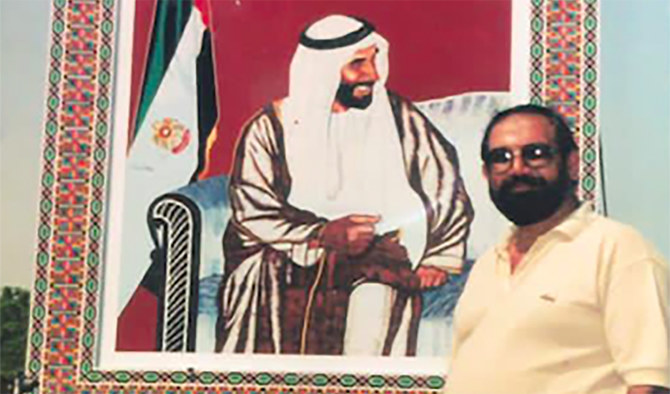
An undated photo of Liaquat Ali Khan, a Pakistani artist, seen posing in front of a portrait he made of UAE's founding father and then ruler, Sheikh Zayed bin Sultan Al Nahyan (Photo courtesy Liaquat Ali Khan)
Short Url
Updated 04 December 2020
Follow

'Golden hand': Meet the Pakistani artist who has spent a lifetime painting UAE royals

  • Liaquat Ali Khan went to the United Arab Emirates as a daily wage laborer but acquired the reputation of a skillful artist
  • He has now returned to Pakistan and set up an art academy in his hometown of Kohat

KOHAT: Four decades ago, a man traveled from Kohat in northwestern Pakistan to the United Arab Emirates in search of a better life. He was part of a group of daily wage laborers, all of them from poor families and looking for better prospects.

But one thing set Liaquat Ali Khan apart: his passion for art, which would go on to change the course of his life.

“I went to watch a Pashto film in Abu Dhabi,” Khan, now 70, told Arab News at his office in Kohat, recalling his time in the UAE in the early eighties. “On stepping out of the cinema, I saw a man who was struggling to paint a billboard. I walked up to him and volunteered to help.”

As Khan painted, another man, a bank executive, observed him for a while and then walked up to him and struck a conversation. The man wanted to know if the painter could draw portraits. He said yes. A few days later, the banker took Khan to see his boss, who commissioned a portrait of UAE’s founding father and then ruler, Sheikh Zayed bin Sultan Al Nahyan, to be unveiled on UAE’s national day. 
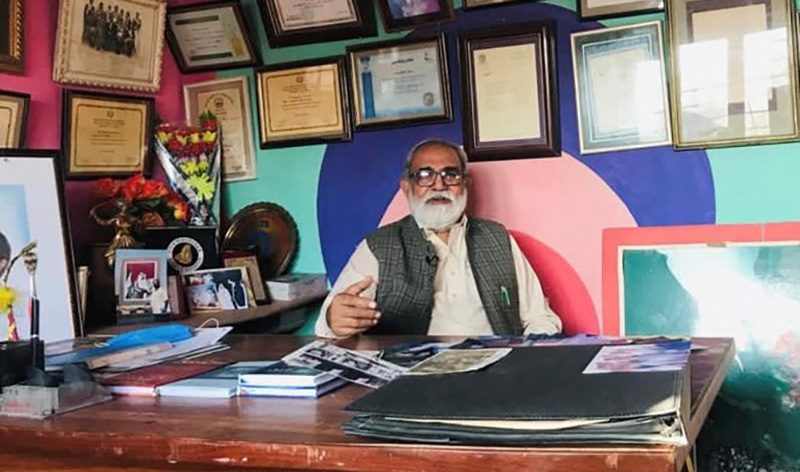


Liaquat Ali Khan, a Pakistani artist, speaks to Arab News at his office in Kohat, Pakistan, on Dec. 1, 2020. (AN photo)

That moment marked a new beginning for Khan, who had a degree in fine arts from the University of Peshawar but never thought he could have a career as an artist. But his first portrait landed him a job with the Abu Dhabi Municipality where he went on to work for 29 years.

“I adorned my canvas with UAE royals and painted over a thousand portraits,” said Khan whose work has been displayed in public parks and along major thoroughfares in Abu Dhabi ahead of the UAE national day, celebrated each year on December 2.

Emirati officials also bestowed on him the title of “golden hand” as his reputation as an artist spread.


Liaquat Ali Khan, a Pakistani artist, writes an Urdu inscription at his office in Kohat, Pakistan on December 1, 2020. (AN Photo)

“Over a period of time, officials and locals began to recognize me through my work and started calling me the golden hand,“Khan said. “But it was a huge portrait of Sheikh Zayed that captured the attention of the royal family.”

In 1999, he was invited to meet the UAE ruler himself. 

“He was clearly interested in the world of art and knew a lot about it,” Khan said. 

Ten years after his meeting with Al Nahyan, Khan returned to Pakistan — not an ‘easy decision,’ he said — where he began teaching art at Kohat University. He also set up an art academy in his native town, where 17 students, both boys and girls, are currently studying.


Students of Liaquat Ali Khan, a Pakistani artist, seen practicing calligraphy at his art academy in Kohat, Pakistan, on December 1, 2020. (AN Photo)

“Creativity and art have brought me closer to nature and I am focused more on them than ever before,” said Omar Shahid, a second-year medical student who took up drawing as a hobby and joined the academy about a year ago.

Today, Khan says he is proud of his journey. The walls of his office in the art academy are decorated with photographs and shields. Some of the photos capture his interactions with high-profile Pakistani personalities such as former military ruler General Pervez Musharraf and ex-prime minister Benazir Bhutto.

The artist said he had also completed a 500-piece portrait of Pakistan’s founding father, Muhammad Ali Jinnah, and requested Musharraf to display it at Jinnah’s mausoleum. He smiled as he said he had no idea where that work had disappeared.

“He [Musharraf] agreed and instructed officials [to display the Jinnah portrait at his tomb],” Khan said. “But the painting has disappeared. It’s probably gathering dust in some government storage facility.”


Pakistan’s Lahore marks Basant festival after government lifts decades-old ban on kite flying

Updated 5 sec ago
Follow

Pakistan’s Lahore marks Basant festival after government lifts decades-old ban on kite flying

  • Pakistan’s Punjab province outlawed Basant in 2000s after authorities linked metal-coated kite strings and celebratory gunfire to multiple deaths and injuries
  • The three-day festivities began after midnight on Thursday as residents gathered on brightly lit rooftops to fly colorful kites to welcome the cultural festival

ISLAMABAD: The eastern Pakistani city of Lahore on Friday welcomed the return of Basant spring festival after the government this year lifted a more than two-decade-old ban on kite flying for a period three days, with Punjab Chief Minister Maryam Nawaz urging masses to follow precautions.

Provincial officials, including Punjab Information Minister Azma Bokhari, were seen flying kites in videos widely shared online. Meanwhile, the prices of air tickets from various Pakistani cities to Lahore have skyrocketed during the three days of the festival as more and more people try to join the celebrations after over a 20-year-hiatus.

Basant, once a vibrant tradition signaling the arrival of spring with colorful kites and rooftop festivities, was outlawed in Pakistan’s Punjab province in the 2000s after authorities linked metal-coated kite strings and celebratory gunfire to multiple deaths and injuries.

The government of CM Nawaz this year allowed Basant festivities in the provincial capital of Lahore, Pakistan’s cultural heart, on Feb. 6-8, but issued an extensive safety plan regarding kite materials and motorcyclists and pedestrians to avoid any untoward incident.

Commuters ride past a large model of a kite celebrating the Basant festival in Lahore on February 3, 2026. (AFP)

The three-day festivities began after midnight on Thursday as residents of Lahore gathered on their brightly lit rooftops along with family, friends and guests visiting from other cities and abroad to fly colorful kites to welcome the return of Basant.

“Kites return to the skies of Lahore as Basant comes alive again after 25 years,” CM Nawaz said on X. “A celebration of culture, color, and community! Let’s enjoy the festivities together responsibly, follow all safety SOPs (standard operating procedures), and make this Basant safe for everyone.”

The Pakistan Meteorological Department (PMD) this week forecast favorable weather conditions for kite flying in Lahore on Feb. 6-8, marked by light westerly winds blowing at speeds of 10–15 kilometers an hour.

Authorities have distributed 1 million safety rods among motorcyclists through designated safety points across Lahore, with spending on the initiative crossing Rs110 million ($392,000), according to local media reports. To enforce regulations and manage traffic flow, around 100 road safety camps have been set up in the city, staffed by teams from the district administration, traffic police and rescue services.

In addition, the Punjab government has launched a free shuttle service to reduce traffic congestion and promote safer travel via 695 buses deployed across Lahore.