

Pakistan to start coronavirus vaccination drive in 2021 — health official 

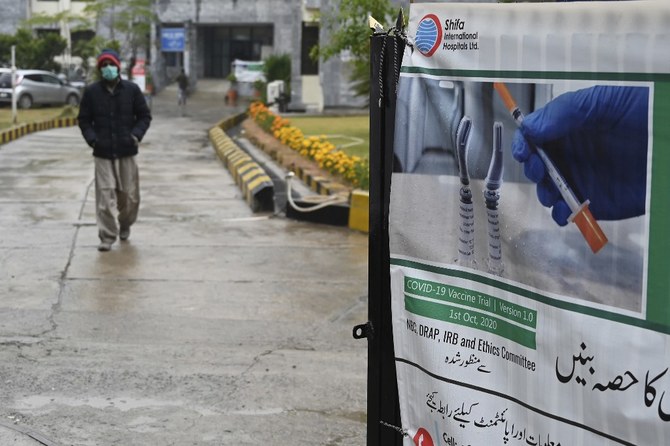
In this picture taken on November 25, 2020 a volunteer leaves a hospital in Islamabad after being administered a new vaccine for the COVID-19 coronavirus during a Phase 3 clinical trial in Pakistan. (AFP/File)
Short Url
Updated 03 December 2020
Follow

Pakistan to start coronavirus vaccination drive in 2021 — health official 

  • Parliamentary secretary on health says all citizens to be vaccinated free of charge, talks underway with three manufacturers 
  • Initially priority to be given to health care workers, law enforcement agencies, exposed persons 

ISLAMABAD: Nausheen Hamid, Pakistani parliamentary secretary on Health, has said the government will launch a free COVID-19 vaccination drive in the second quarter of 2021.

Hamid’s announcement comes a day after the federal cabinet approved the allocation of $150 million to procure a coronavirus vaccine by the first quarter of next year.

Government data released on Wednesday showed Pakistan had recorded 75 COVID-19 deaths in the last 24 hours, the highest in over five months, as the nationwide tally of fatalities jumped to 8,205 and infections reached 406,810.

“Government will provide the coronavirus vaccine free of cost to the people,” Hamid said in a tweet. “Government will start the vaccination from the second quarter of 2021.”

An official at the health ministry told the Dawn newspaper all vaccines under routine immunization programs, including the polio vaccine, were already provided free of cost in Pakistan. 

“The government has allocated an amount of $150 million for the Covid-19 vaccine and it will be provided free of cost,” he said. “However, different segments of society will be prioritized for the vaccination and initially it will be given to health care workers, officials of law enforcement agencies, most exposed persons, etc.”

Speaking to a private TV channel, Hamid said phase 3 clinical trials of a Chinese vaccine were ongoing in Pakistan and she hoped it would be available to the public “once its efficacy was proved.”

She said the government would consider multiple factors before procuring a vaccine, including the type of vaccine, efficacy, safety and side effects, storage requirements, cost, production capacity of the manufacturer and whether Pakistan had access to procure it.

Hamid said Pakistan had signed up for the UN’s Covax Facility, a global initiative aimed at equitable access to safe and effective COVID-19 vaccines worldwide, adding that Pakistan would buy from the Covax platforms on cheap rates. 

“The Covax platform will provide a vaccine to twenty percent of the country’s population,” she said, adding that talks were underway with three companies for the purchase of the vaccine.


Traders say Karachi plaza fire caused $54 million losses as death toll climbs to 71

Updated 23 January 2026
Follow

Traders say Karachi plaza fire caused $54 million losses as death toll climbs to 71

  • Rescuers work through unstable debris as identification continues, compensation announced
  • Rising death toll underscores scale of the disaster and the challenges now facing forensic teams

ISLAMABAD: A deadly fire at a major shopping plaza in Pakistan’s largest city of Karachi has killed at least 71 people and caused estimated losses of up to Rs15 billion ($53.6 million), traders and officials said on Friday, as recovery teams continue searching unstable debris and families await identification of victims.

The fire broke out on Jan. 17 at Gul Plaza, a densely packed commercial complex in the heart of Karachi that housed more than 1,200 shops. The blaze burned for over 24 hours before being brought under control, trapping workers and shoppers inside and leaving large sections of the building structurally unsafe.

Deadly fires are a recurring problem in Karachi, a city of more than 20 million people, where overcrowded markets, aging infrastructure, illegal construction and weak enforcement of safety regulations frequently contribute to disasters. Officials say a blaze of this scale is rare.

“We have processed 71 sets of remains, of which 20 have been identified,” chief police surgeon Dr. Summaiya Syed said on Friday, underscoring the scale of the disaster and the challenges facing forensic teams.

Identification has been significantly slowed by the condition of the remains recovered from the site, Syed said, noting that many bodies were found in fragments, complicating DNA analysis and prolonging the process for families waiting for confirmation.

Tanveer Pasta, president of the Gul Plaza Market Association, said all shops in the plaza were destroyed, estimating total losses at up to Rs15 billion ($53.6 million).

“There were big importers sitting here,” he told Arab News on Thursday. “Just three days before this fire, 31 [shipping] containers were unloaded.”

Relatives of dozens of missing persons have remained near the destroyed plaza and at hospitals even after submitting DNA samples, with some families expressing frustration over the pace of recovery and identification.

Karachi Mayor Murtaza Wahab said the city administration remained focused on rescue operations and on returning victims’ remains to their families as quickly as possible. His remarks came after he visited the homes of several victims, according to a statement from his office.

“Rescue personnel of the Karachi Metropolitan Corporation are still engaged in the rescue operation, while the administration is making every effort to hand over [remains] of the victims, loved ones to their families at the earliest,” Wahab was quoted as saying.

Earlier this week, the Sindh provincial government announced compensation of Rs10 million ($35,720) for the family of each person killed in the blaze and said affected shopkeepers would also receive financial assistance.

Authorities have not yet confirmed the cause of the fire. Police have said preliminary indications point to a possible electrical short circuit, though officials stress conclusions will only be drawn after investigations are completed.