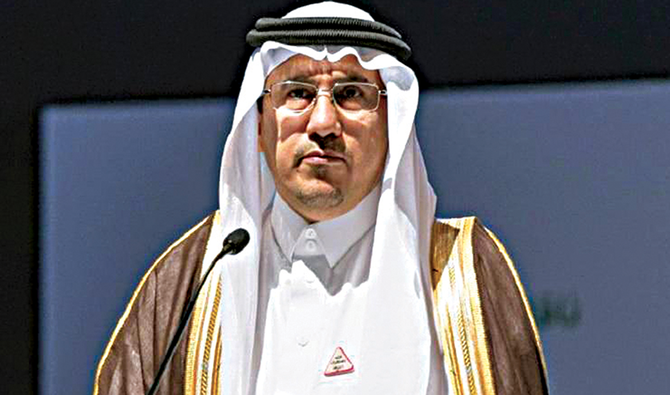

RIYADH: The governor of the Saudi Central Bank on Wednesday revealed measures taken by the Kingdom to combat the “risks and threats” posed by financial crimes during the coronavirus pandemic.
Speaking at the opening session of the 12th Annual Forum for Compliance and Combating Money Laundering, Ahmed Abdulkarim Al-Kholifey said that Saudi Arabia had acted on a number of cases of money laundering, corruption and financial fraud.
“You know about the extent of the impact of the outbreak of the COVID-19 pandemic on health, social, and economic aspects, including the impact on the economies of the entire world. Among the negative impacts that affected the countries of the world are the emergence of new risks and threats,” he told delegates.
Al-Kholifey, who is also chairman of the Anti-Money Laundering Permanent Committee, added: “Among the most prominent of those risks and threats that have been observed during the pandemic period are the increase in financial fraud cases, namely, emergence of individuals claiming to invest in digital currencies or claiming to provide investment services in some major companies.
“(There has also been an) increase in cybersecurity crimes such as hacking into individuals’ smart devices, obtaining their banking information, and exploiting the pandemic period to carry out fake financial donation campaigns for those affected by the coronavirus pandemic by announcing on social networks that they will collect donations for international aid organizations or provide aid to poor countries.”
During his forum address, he noted that his team had observed cases of corruption where officials had exploited support provided by the government to reduce the effects of the health crisis, and engaged in fake or exaggerated deals in an attempt to take advantage of the backing.
Al-Kholifey also pointed out that there had been “cases associated with fraud in medical supplies.”
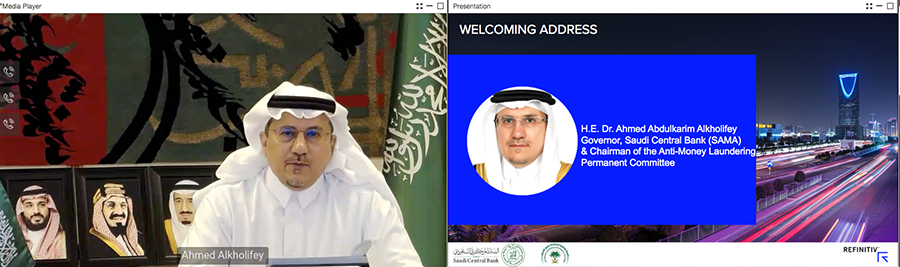
Dr. Ahmed bin Abdul Karim Al-Kholifey, Governor of the Saudi Central Bank (SAMA) and Chairman of the Anti-Money Laundering Permanent Committee. (Refinitiv)
To combat these issues, Saudi authorities, including the central bank, had introduced numerous procedures and measures to manage the risks, he said. This was done by adopting procedures and international standards for combating money laundering and terrorist financing that had been developed by the Financial Action Task Force (FATF) in Paris.
Despite the challenges posed by COVID-19, Saudi officials had managed to maintain communication with the private sector and encourage financial institutions to continue providing financial services, by enhancing electronic and digital payment options, Al-Kholifey added.
This year’s virtual conference was organized by the Anti-Money Laundering Permanent Committee in cooperation with the Saudi Central Bank and global financial solutions company Refinitiv.
David Craig, CEO of Refinitiv, spoke about Saudi Arabia’s leadership in fighting financial crime and the Kingdom’s critical role in the modern global financial system. He also noted that financial criminals were becoming more sophisticated in their tactics.
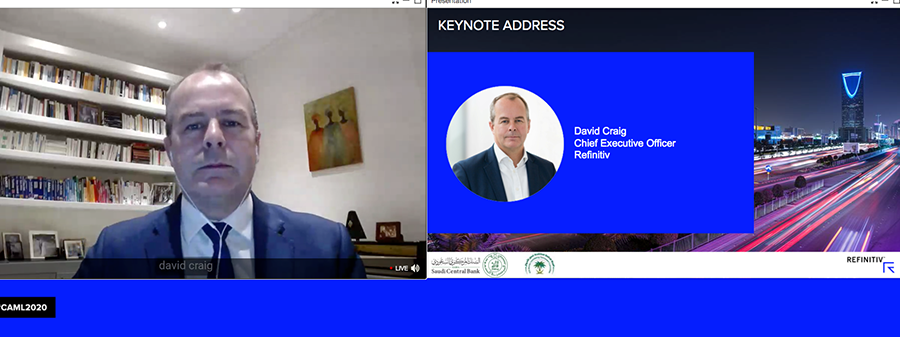
David Craig, CEO, Refinitiv. (Refinitiv)
He said: “In the Middle East — as elsewhere — we are witnessing a major increase in identity-related fraud as organizations digitally onboard customers. Not surprisingly, this has become a significant focus of Refinitiv’s recent work and investments.
“We’re seeing financial criminals move into human trafficking, wildlife smuggling, and other green crimes like the logging of pristine forest — all of which have devastating impacts on people, society, and the biodiversity of our planet. Financial crime is never a victimless crime,” Craig added.
Speaking at the same event, Ali Al-Qahtani, deputy chief compliance officer and head of financial crime compliance at the Saudi British Bank, said that criminal cyber activity had significantly increased around the globe.
“The collective campaign, led by the Saudi Central Bank, helped local banks address these emerging challenges. In line with the local regulations, we kicked off a high-level engagement and set up a crisis management committee. We also had effective planning in place to address staff safety and rolled out precautionary measures outlined by the Ministry of Health.
“Awareness is a key component in promoting a sound compliance culture and that is why I believe that ongoing communication is a necessity,” Al-Qahtani added.