Germany bans far-right, pro-Nazi group, police raid homes

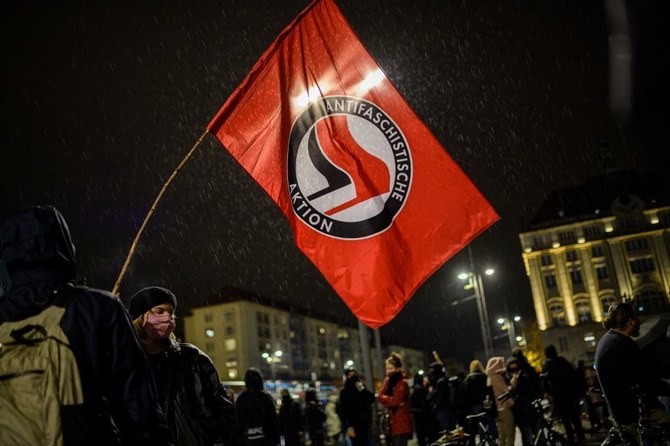
Anti-facists protest against a rally of the anti-immigrant Pegida movement (Patriotic Europeans Against the Islamisation of the Occident) on October 26, 2020, marking the 6th anniversary of their founding, in Dresden, eastern Germany. (File/AFP)
Short Url
Updated 01 December 2020
Follow

Germany bans far-right, pro-Nazi group, police raid homes

  • The homes of 13 members of the far-right group Wolfbrigade 44 were searched in Hesse
  • The group’s goal is to re-establish a Nazi dictatorship, according to security officials

BERLIN: Police raided homes in three German states early Tuesday after the German government banned a far-right group, a spokesman for the interior ministry said.
The homes of 13 members of the far-right group Wolfbrigade 44 were searched in Hesse, Mecklenburg West-Pomerania and North Rhine-Westphalia to confiscate the group’s funds and far-right propaganda material, the German news agency dpa reported.
“Whoever fights against the basic values of our free society will get to feel the resolute reaction of our government,” Interior Minister Horst Seehofer said, according to his spokesman, Steve Alter.
The group’s goal is to re-establish a Nazi dictatorship, according to security officials. The 44 in their name stands for the fourth letter in the alphabet, DD, and is an abbreviation for Division Dirlewanger. Oskar Dirlewanger was a known Nazi war criminal and commander of a Nazi SS special unit.
The far-right group was founded in 2016. It is known for possessing illegal weapons and members have participated in far-right protests.
Earlier this year, the German government banned other far-right groups including the Combat 18 and the Nordadler, dpa reported.


Philippines convicts journalist on terror charge called ‘absurd’

Updated 2 sec ago
Follow

Philippines convicts journalist on terror charge called ‘absurd’

  • Community journalist and radio broadcaster Frenchie Cumpio is the first Filipino journalist to be prosecuted under the terror financing laws
TACLOBAN, Philippines: A young Philippine journalist who spent nearly six years in a crowded provincial prison was found guilty of terror financing on Thursday in a case rights groups and a UN expert labelled a “travesty of justice.”
Community journalist and radio broadcaster Frenchie Cumpio, 26, is the first Filipino journalist to be prosecuted under the terror financing laws, which defense lawyer Julianne Agpalo said have become the government’s “weapon of choice” for silencing dissent.
Cumpio and former roommate Marielle Domequil broke down in tears and hugged each other as the guilty verdict was read and they were sentenced to up to 18 years in prison by judge Georgina Uy Perez of the Tacloban regional court.
The duo, who were both acquitted on a lesser weapons charge, will be eligible for parole in about 12 and a half years.
In a copy of the decision seen by AFP, the court said it was convinced by the testimony of former rebels who said the pair had provided the New People’s Army (NPA), a designated terrorist group, with cash, arms and fabric for clothing.
The Samar-Leyte region that is home to Tacloban is one of the last remaining operating areas of the Maoist insurgency.
Both Cumpio and her advocates have insisted she was a victim of “red-tagging,” in which the government links its critics to the communist forces to silence them.
Speaking outside the courthouse, lawyer Norberto Robel said his team would file an appeal.
“Despite this (ruling), there is still a legal remedy and pending application for bail,” he said.
The case has been closely monitored by human rights groups including Amal Clooney’s Clooney Foundation for Justice, which in October questioned the lengthy detainment, citing “repeated postponements and slow progress.”
UN Special Rapporteur Irene Khan had previously said the charges against Cumpio appeared to be “in retaliation for her work as a journalist.”
Cumpio and Domequil were arrested in February 2020 on weapons charges, accused of possessing a handgun and a grenade.
More than a year later, the terror financing charge, which carried a potential 40-year jail sentence, was added.
‘Absurd verdict’
On Thursday, Beh Lih Yi, Asia-Pacific director of the Committee to Protect Journalists (CPJ), condemned the court’s decision.
“This absurd verdict shows that the various pledges made by President Ferdinand Marcos Jr. to uphold press freedom are nothing but empty talk,” she said, adding it was the first time a journalist had been charged with financing terrorism in the Philippines.
“The ruling underscores the lengths that Philippine authorities are willing to go to silence critical reporting.”
Aleksandra Bielakowska, advocacy manager for Reporters Without Borders, said the verdict demonstrated a “blatant disregard for press freedom.”
“The Philippines should serve as an international example of protecting media freedom — not a perpetrator that red-tags, prosecutes and imprisons journalists simply for doing their work,” she said.
Prosecutors declined to speak with AFP outside the courthouse.
In September, more than 250 journalists and media groups called on President Marcos to release Cumpio, calling the charges “trumped up.”
Following an evening mass on Wednesday, Cumpio’s mother, Lala, told AFP that she visited her daughter in prison once each month, bringing her groceries, medication and chicken from Jollibee.
Bringing in the gravy and soft drinks that accompanied the fast food meals was prohibited by guards, she added.
“Of course, I’m worried,” Lala said of the looming decision. “My youngest keeps asking when his big sister will come home.”
She broke down in tears alongside her two sons outside the courthouse as the verdict was announced.