



PARIS: Tareq Oubrou is a theologian and the imam of Bordeaux. He is known for his openness and the flexibility of his approach to the problems surrounding Islam in France. He is also the author of many books including Call for Reconciliation (Appel à la réconciliation) and The Feminist and the Imam (La Féministe et l’Imam), co-written with Marie-Françoise Colombani.
Oubrou is keenly aware of a growing schism in French society, which he believes is the product of ignorance rather than any intrinsic fault. With learning and a willingness to understand one another, conflict need not be inevitable.
“We must educate Muslims who often ignore their own religion, and we must also explain to non-Muslims that Islamism is a very complex phenomenon and that not every Muslim is a terrorist,” Oubrou told Arab News, reflecting on the latent cultural tensions and recent spate of terrorist attacks afflicting France.
On Oct. 29, three people were killed in a stabbing attack near the Notre-Dame basilica in the southern French city of Nice. It followed the beheading on Oct. 16 near Paris of a French school teacher who had used caricatures of Islam’s Prophet Muhammad in a lesson about freedom of expression.
Oubrou’s comments echo the findings of a survey conducted by British polling agency YouGov on behalf of Arab News, which indicates a majority of French citizens of Arab origin respect French values and secularism. But according to the same poll, these same French citizens do not feel accepted and even feel stigmatized.
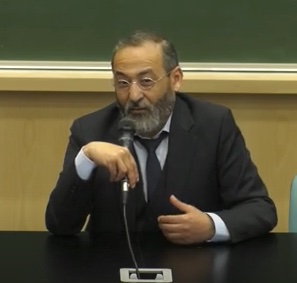
Tareq Oubrou, the renowned imam of Bordeaux, participating in a panel discussion organized by the Université Bordeaux Montaigne. (Still image from a YouTube video)
Q: What is your interpretation of the bloody October attacks outside Nice Cathedral?
A: This is a new level of terrorism, which has no doctrine, no law and no faith. It is an individual act of terrorism committed by people who have tipped over the edge. This very tense period we are going through, characterized by rhetoric of victimization and tension, makes a number of young Muslims move from hatred to revenge and action. It is a form of terrorism that has neither structure nor organization. It is chaotic and dreadful in its psychological effect because it is unpredictable and requires few resources. It can hit anyone at any time without having specific targets. It kills innocent people while we know nothing about its claims.
Q: How did the Muslim community of Bordeaux respond to these attacks?
A: Like all other Muslims they are appalled because no one is beyond the reach of this kind of terrorism. Our own mosque is protected. Yesterday it was a teacher, then it was Catholics, and tomorrow maybe it will be an imam or a mosque.
Terrorism is primarily prevalent in the Muslim world, and Muslims are its main victims, because this kind of terrorism aims to cause an implosion of Islam.
Q: The reaction to the Nice attack was very violent and the rhetoric used evoked images of France entering a war. Does that worry you?
A: These are simple words, because the Islamism we want to fight is a ghost. Against whom and against what are we going to declare war? Fighting this type of phenomenon is very complex because it is not an external enemy, but something that bursts into French society through people who have switched for many reasons, namely psychiatric and ideological. A standard profile of these terrorists was sought, but this proved impossible. What we know about these people is that they have failed in their lives and are having problems.
But often people are more papist than the pope on these issues and forget that we let it happen for a very long time, that we turned a blind eye to immigration without limit and without selection . . . Politicians must take their share of responsibility, because for 30 years things have been allowed to evolve in an anarchic way.
Q: Do you appreciate the fact that many non-Muslim French people feel their way of life, their values and their identity have been targeted?
A: But of course, French society discovered overnight a massive presence of Muslims that have not only their own religion but also their own cultures and social conditions to which is added delinquency that falls on Islam. Because, overnight, this offender can become a Salafist and take action. This is, of course, worrying, but we must not succumb to panic.
We must arm our fellow citizens mentally to resist this trend, especially since the aim of terrorists is to sow division between Muslims and society, and between Muslims and Catholics, Catholicism being the first religion in France. We must therefore be careful and deal with things in depth without panic on the basis of a common program to be adopted in the long term, since it is not a goal that can be achieved overnight.
Q: What are you doing to combat radicalization and the amalgamation of Islam and terrorism?
A: The fight is mostly intellectual. You have to inform people, because information is power, and the person who owns it also has power. So we must inform Muslims of the very essence of their religion, and I have devoted several sermons on the theology of freedom to believe or not, relying on texts of the holy Qur’an and hadiths.
It is therefore necessary to inform Muslims who often ignore their religion, and we must also explain to non-Muslims that Islamism is a very complex phenomenon and that not every Muslim is a terrorist. It is necessary to tell them that one must be a theologian to differentiate between Islam and Islamism, and at what point a theology becomes an ideology. This explanation is of great importance in order to avoid fighting Islam under the pretext of fighting Islamism.
Q: Do you think this pedagogical approach can still be effective, and that it is not too late?
A: Hope guides me in my action, and I believe that we should not yield to these interpretations. By saying that we are heading for a civil war, it is as if we are preparing it. No, we must not succumb to this, knowing that the risk of war is there. Nothing tells us, for example, that there will not be a war between the United States and China tomorrow.
You know, we are living in a world open to all risks. We must not dramatize. We must face problems with serenity and intelligence.
Q: What do you think of the anti-France protests and calls to boycott French products?
A: As a Frenchman, I can only defend France and its interests. It is normal, I am a citizen, and the fact of belonging to the world Muslim community does not mean that this affiliation must be at the expense of my belonging to French society. I am not a “fifth column” in France. The Muslim community is loyal to the Republic, and the interests of the Republic are the interests of Muslims.
There is a great misunderstanding, because the Muslim world, which thinks that caricatures are the will of the government, does not know freedom of expression or the separation of powers. They do not know that media power is not at the behest of political power and that people are free. They consider that since Emmanuel Macron defends freedom of expression, he defends the caricatures of the prophet. There is no reason to resort to violence when one can respond to offense with intelligence.


