Rockets target Eritrea capital after Ethiopia declares victory in Tigray

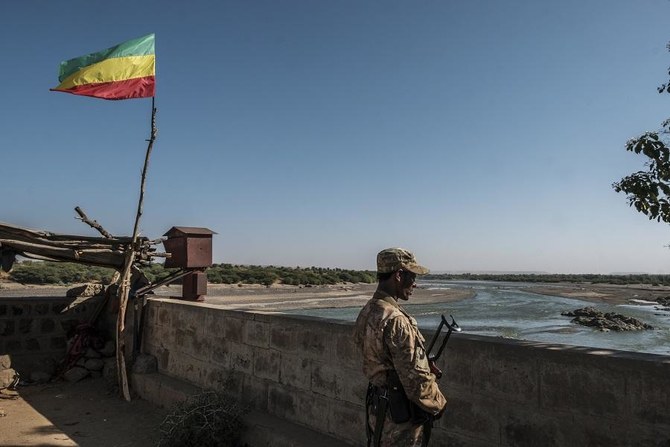
Two Addis Ababa-based diplomats told AFP multiple rockets appeared to have targeted Asmara’s airport and military installations. (File/AFP)
Updated 29 November 2020
Follow

Rockets target Eritrea capital after Ethiopia declares victory in Tigray

ADDIS ABABA: Rockets launched from Ethiopia’s northern Tigray region targeted the capital of Eritrea several hours after Ethiopian Prime Minister Abiy Ahmed declared military operations in the region were over, diplomats told AFP Sunday.
It remained impossible to independently verify whether the regional capital Mekele was completely under federal government control, though a military spokesman told AFP operations were proceeding “very well.”
The US embassy in the Eritrean capital Asmara reported early Sunday “six explosions” had occurred in the city “at about 10:13 pm” Saturday.
Two Addis Ababa-based diplomats told AFP multiple rockets appeared to have targeted Asmara’s airport and military installations.
It marked the third time Asmara has come under fire from Tigray since Abiy ordered military operations against leaders of the region’s ruling party, the Tigray People’s Liberation Front (TPLF).
The TPLF has claimed responsibility only for the first attack two weeks ago.
It said Asmara was a legitimate target because Ethiopia was enlisting Eritrean military support for its campaign in Tigray, something Ethiopia denies.
As with the previous attacks it was unclear where the rockets landed and what damage they might have caused.
Eritrea is one of the world’s most secretive countries and the government has not commented on the strikes.


Abiy, last year’s Nobel Peace Prize winner, announced November 4 he was sending federal troops into Tigray in response to attacks by pro-TPLF forces on federal army camps.
The move marked a dramatic escalation of tensions between Abiy and the TPLF, which dominated Ethiopian politics for nearly three decades before anti-government protests swept Abiy to office in 2018.
Thousands have died in the fighting and tens of thousands of refugees have streamed across the border into Sudan.
On Saturday night, Abiy declared military operations in Tigray “completed” after the army claimed control of the regional capital Mekele, a city of half a million before the conflict broke out.
Tigray has been under a communications blackout throughout the conflict and media access has been restricted making it impossible to verify Abiy’s claim.
Little news filtered out of the city Sunday even through official channels.
A military spokesman, Gen Mohamed Tessema, told AFP that operations were proceeding “very well” and that soldiers were “doing their work peacefully,” but said he could offer no details.
State television stuck to its usual Sunday programming of talk and music shows, while Tigray regional television did not appear to be broadcasting at all.
The lack of clarity on the situation in Mekele did not preclude some small-scale celebrations Saturday night in Addis Ababa, the Ethiopian capital, and the city of Gondar, in the Amhara region south of Tigray.
“People were out celebrating all night. They fired their guns into the air until midnight and people were shouting, ‘We won!’” said Gondar resident Edom Asmare.
Amhara and Tigray have been embroiled in land disputes for decades, and Amhara special forces have played a central role in securing parts of Tigray that are now under federal control.


The TPLF has considerable military assets, and at the outset of the conflict analysts estimated it could mobilize 200,000 troops.
After securing control of western Tigray and giving TPLF leaders a 72-hour ultimatum to surrender, Abiy announced Thursday he had ordered a “final offensive” on Mekele.
Global fears mounted over a bloodbath, and heavy shelling was reported in Mekele earlier on Saturday.
But in the government’s telling, little fighting actually occurred, suggesting TPLF leaders opted to retreat.
Abiy said Saturday that police were working to apprehend the party leadership, who were not reachable Sunday, their whereabouts unknown.
The TPLF has previously vowed to fight on as long as pro-Abiy forces have any kind of presence in Tigray, and analysts have warned it could shift gears to adopt insurgency-style tactics.
Abiy also said his government would focus on rebuilding Tigray and providing humanitarian assistance to the population of six million.
Displacement is believed to be widespread within the region, which has suffered multiple rounds of air strikes and at least one massacre that killed hundreds of civilians.
The United Nations has spent weeks lobbying — so far unsuccessfully — for full access.
Laetitia Bader, Horn of Africa director for Human Rights Watch, said Saturday night it was clear the conflict had taken a “heavy toll,” even if details remained unknown.
“The UN should be conducting an independent international investigation into abuses committed by all sides since the beginning of the conflict, with the mind to pushing for accountability,” she said.
rcb/tgb


Suspect in Brown University shooting and MIT professor’s killing was once a physics student

Updated 4 sec ago
Follow

Suspect in Brown University shooting and MIT professor’s killing was once a physics student

PROVIDENCE, R.I.: Thirty years ago, Claudio Neves Valente and Nuno F.G. Loureiro were classmates with bright futures. Both excelled in physics and made their way from their home country of Portugal to the US, settling on the campuses of prestigious East Coast universities.
But Neves Valente’s path took a darker turn than his former peer. Investigators say the 48-year-old fatally shot two students last week at Brown University in Providence, where he was a graduate student in the early 2000s, and later killed Loureiro, who led one of the largest laboratories at the Massachusetts Institute of Technology.
Authorities have offered no motive for the shootings or elaborated on what, if any, history was between the two men.
Neves Valente was found dead Thursday from a self-inflicted gunshot wound at a New Hampshire storage facility, ending a search that started with last Saturday’s shooting in a Brown lecture hall, where nine other people were also wounded. Authorities believe that on Monday, two days after the Brown shooting, Neves Valente shot Loureiro at the professor’s home in the Boston suburbs, about 50 miles (80 kilometers) from Providence. An autopsy found Neves Valente died Tuesday.
In high school, Neves Valente had been a promising physics student, but he was let go from Portugal’s premier engineering school, Instituto Superior Técnico, in 2000 and withdrew from a Brown University graduate program three years later without a degree.
Before his death, he was renting a room in a home in a working class Miami neighborhood, the past two decades of his life a mystery. What he was doing for a job was unclear. One witness to the Brown shooting noted he was wearing the kinds of pants and shoes that are typical of restaurant workers.

Neves Valente and Loureiro were in the same academic program in Portugal
Neves Valente was born in Torres Novas, Portugal, about 75 miles (121 kilometers) north of Lisbon. As a high school student, he competed in a national physics competition in 1994, coming in third place, according to a Portuguese physics magazine. Five of the top finishers got to compete in an international competition the following year in Australia.
From 1995 to 2000, he was in the same physics program in Lisbon with Loureiro, federal prosecutor Leah B. Foley said. Loureiro graduated from Instituto Superior Técnico in 2000, according to his MIT faculty page. A termination notice from the Lisbon university’s then president shows that Neves Valente was let go from a position at Instituto Superior Técnico that same year.

Neves Valente was a graduate student at Brown
Neves Valente came to Brown that fall as a graduate student on a student visa. Brown University President Christina Paxson said he took a leave in 2001 and formally withdrew effective July 31, 2003.
Around that time, he posted on the Brown physics website that he was back home in Portugal and had dropped out of the program permanently, according to a webpage saved by the Internet Archive. Then in Portuguese, he added: “And the moral of the story is: The best liar is the one who manages to deceive himself. These exist everywhere, but at times they proliferate in more unexpected places.”
During his time at Brown, he enrolled only in physics classes. Paxson said it is likely that he would have taken courses and spent time at the building where the shooting occurred because that’s where the vast majority of physics courses take place.
Paxson said Brown found no indication of any public safety interactions or other concerns while Neves Valente was a student.
“As of yet, we have not identified any employee who recalls Neves Valente nor is there any Brown record of recent contact between this individual and Brown,” Paxson said.

Brown classmate says Neves Valente was ‘genuinely impressive’
A former classmate of Neves Valente at Brown, Syracuse University professor Scott Watson, recalled being “essentially his only friend” in the graduate program in physics. Over dinners at a Portuguese restaurant near campus, Neves Valente shared his frustrations.
“He would say the classes were too easy — honestly, for him they were. He already knew most of the material and was genuinely impressive,” Watson said.
When Neves Valente decided to leave, Watson encouraged him to stay but to no avail. He said he never saw or heard from Neves Valente again.

Renting a room outside Miami
In September 2017, Neves Valente obtained legal permanent residence status in the US, Foley said. It was not immediately clear where he was between taking a leave of absence from the school in 2001 and getting the visa in 2017.
His last known address was about 10 miles (16 kilometers) north of Miami. The yellow house with a red roof is in a working-class neighborhood that features large houses.
Some neighbors who talked with The Associated Press on Friday said they had never seen Neves Valente. No police were in sight.
Edward Pol, a race car mechanic who lives across the street from the home, said the owner rents some rooms to people. He said he never talked to Neves Valente but had seen him several times, most recently two or three months ago. He realized the man was the suspect when he saw his pictures on the news Friday morning.
A man who answered the door through an intercom at the home said he was the homeowner but declined to identify himself or make any comment.

Loureiro was excelling
While Neves Valente’s life remained a mystery, his former classmate Loureiro was excelling. Loureiro joined MIT in 2016 and was named last year to lead the school’s Plasma Science and Fusion Center, one of its largest laboratories. The 47-year-old scientist from Viseu, Portugal, had been working to explain the physics behind astronomical phenomena such as solar flares.
Portugal’s top diplomat said Friday that the government was taken aback by revelations that a Portuguese man is the main suspect.
There are still “a lot of unknowns” in regard to motive, Rhode Island Attorney General Peter Neronha said. “We don’t know why now, why Brown, why these students and why this classroom.”