

US ‘grateful’ for Pakistan’s offer to be part of Gaza stabilization force, Rubio says

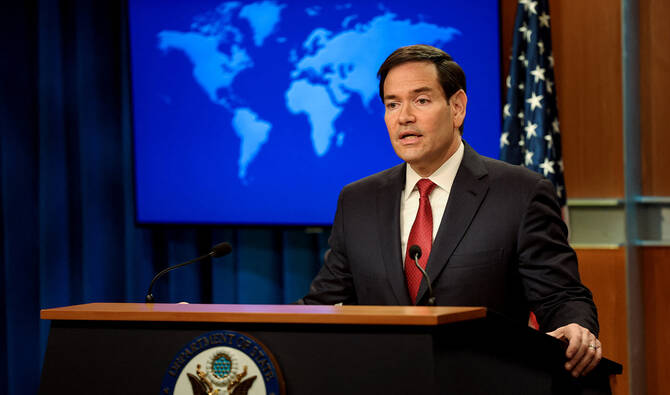
US Secretary of State Marco Rubio speaks during his end-of-year press conference at the State Department in Washington, D.C., US, on December 19, 2025. (REUTERS/File)
Short Url
Updated 20 December 2025
Follow

US ‘grateful’ for Pakistan’s offer to be part of Gaza stabilization force, Rubio says

  • The international stabilization force is a cornerstone of President Donald Trump’s peace plan for Gaza announced in September
  • Islamabad has previously said it is willing to join the Gaza peace force but ‘not ready’ to play any role in disarming Hamas

ISLAMABAD: The United States (US) is grateful for Pakistan’s offer to take part in a potential international stabilization force for Gaza, Secretary of State Marco Rubio said on Friday, as diplomatic efforts continue over the Palestinian enclave’s post-war security arrangements.

The statement came days after Pakistan among dozens of countries attended a conference in Qatar, hosted by the US, to discuss command structure and other unresolved operational issues relating to the Gaza stabilization force.

Top officials of Qatar and Egypt — key mediators of the ceasefire — and regional power Turkiye headed Friday to Miami to meet US envoys including Steve Witkoff, President Donald Trump’s friend and roving envoy.

Speaking at a news conference in Washington, Rubio was hopeful that countries would send troops as part of the force in Gaza and pointed to Pakistan which does not recognize Israel but is considering a troop deployment.

“I feel very confident that we have a number of nation states acceptable to all sides in this who are willing to step forward and be a part of that stabilization force,” Rubio said.

“We’re very grateful to Pakistan for their offer to be a part of it, or at least their offer to consider being a part of it.”

Islamabad has previously said that it is willing to join the Gaza peace force but “not ready” to play any role in disarming Palestinian group Hamas. Hamas’s Gaza chief Khalil Al-Hayya said Sunday the militant group had a “legitimate right” to hold weapons. Israel has repeatedly insisted that Hamas will be disarmed.

The international stabilization force, which is to be composed of troops from Muslim countries, is a cornerstone of President Donald Trump’s peace plan for Gaza announced on Sept. 29 this year.

The United Nations Security Council last month approved Washington’s plan, which called for a yet-to-be-established Board of Peace as a transitional authority that Trump would head, and the stabilization force, which would be empowered to oversee borders, provide security and demilitarize the territory.

Rubio said he thought they owe these nations a few more answers before asking them to commit to the Gaza peace force.

“We are trying to make a lot more progress here with them,” he shared. “The next step here is announcing the border peace, announcing the Palestinian technocratic group that will help provide daily governance... I think that will allow us to firm up the stabilization force, including how it’s going be paid for, what the rules of engagement are, what their role in demilitarization will be and so forth.”


Pakistan missions in Saudi Arabia establish helplines, airport teams to facilitate passengers

Updated 5 sec ago
Follow

Pakistan missions in Saudi Arabia establish helplines, airport teams to facilitate passengers

  • Several regional countries shut down their airspace when Iran launched retaliatory strikes against US bases in Gulf nations last week
  • Conflict has disrupted air travel, particularly for Pakistani Umrah pilgrims, other passengers in Kingdom’s western regions

Islamabad: The Pakistani embassy in Riyadh and the country’s consulate in Jeddah have set up helplines and deployed teams at regional airports to facilitate Pakistani passengers suffering flight disruptions, state media reported on Sunday. 

Several regional countries shut down their airspace when Iran launched strikes against US bases in the Gulf following US-Israeli strikes on Iran last week. The conflict has affected key air corridors and forced airlines to cancel or reroute thousands of flights.

Hundreds of international and domestic flights have been canceled in Pakistan since the conflict began on Feb. 28, with most of them scheduled to fly between the South Asian country and destinations in the Middle East.

“As per the instructions of the Government of Pakistan, the Pakistani Embassy in Riyadh and the Consulate General of Pakistan in Jeddah have set up round the clock helplines and deployed teams at regional airports to facilitate Pakistani passengers,” state broadcaster Radio Pakistan reported. 

The state media outlet noted that the Middle East war has disrupted air travel, particularly for Pakistani Umrah pilgrims and other passengers in the western regions of Saudi Arabia. 

“The situation of Pakistani pilgrims and passengers in Jeddah, Makkah and Madinah is stable, while minor operational restrictions and risk warnings are in place in these airspaces,” Radio Pakistan added. 

Earlier this week, the Pakistan Aviation Authority (PAA) denied media reports of a partial closure of the Pakistani airspace from Mar. 3 and Mar. 31.

It said Pakistan’s entire airspace remains fully open, safe, and available for all civil aviation traffic, including commercial flights. It added that alternative routing options are routinely used for affected flows.

“There are no restrictions on commercial operations, arrivals, departures, or overflights across Pakistan,” the PAA said. “Our air traffic controllers and airport teams are fully operational and managing traffic normally.”
