Pakistan orders schools, colleges shut from Thursday to stem COVID-19 second wave

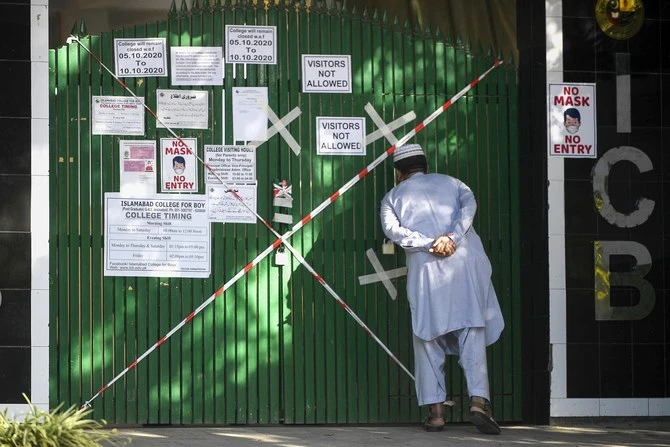
A man looks inside from a closed gate of a school sealed by authorities as some teachers and students tested positive for the Covid-19 Coronavirus in Islamabad on October 5, 2020. (AFP)
Short Url
Updated 23 November 2020
Follow

Pakistan orders schools, colleges shut from Thursday to stem COVID-19 second wave

  • Move follows spike in COVID-19 cases with 19% reported from the education sector 
  • Online learning to commence from Nov. 26 until Dec. 24, officials say 

ISLAMABAD: Pakistani authorities on Monday ordered the closure of all educational institutions from November 26 until January 11 to curb the spread of the coronavirus disease in the country, amid fears of a second wave of the deadly outbreak.

It follows a meeting chaired by Planning Minister Asad Umar after the National Command and Operation Center (NCOC) recorded the highest COVID-19 positivity ratio, at 7.46 percent, on Monday, with 19 percent of the cases reported from the education sector.

The NCOC is a government-appointed body for the prevention and control of the coronavirus disease. 

After the NCOC meeting on Monday, Education Minister Shafqat Mahmood told a press briefing that officials had decided to shut down all educational institutions for six weeks – from November 26 to December 24 – based on an assessment of the COVID-19 situation in the country. 

“From December 25 to January 10, there will be winter vacations and all educational institutions would be completely closed," Mahmood said.

He added that provincial governments would "decide on a mechanism wherever possible", and that all efforts would be made to ensure students continued learning online.

The government is expected to review the situation in the first week of January and "hoped" to reopen all educational institutions from January 11, Mahmood said. 

As an additional measure, he said that examinations scheduled for December had been postponed, with the meeting recommending that all board exams slotted for March or April be moved to May or June instead.

“We have also recommended that the new academic year that begins in April at government schools be postponed till August and summer vacations are reduced," he added. 

However, Special Assistant to the Prime Minister on Health Dr Faisal Sultan said that "professional exams" would be held on schedule "because those can be managed with standard operating procedures (SOPs)".

Pakistan first shut down all of its schools and colleges in March after enforcing a nationwide lockdown to contain the spread of the coronavirus disease.  

Authorities, however, began easing restrictions in May and eventually allowed almost all businesses and the tourism sector to reopen in the months that followed.

Schools and educational institutions were finally allowed to reopen in phases from September 15 onwards.

However, for the past several weeks, authorities have been sounding the alarm over a second wave of the coronavirus outbreak.  

More than 34 deaths and 2,756 cases were recorded on Monday, taking the national caseload to 376,929 infections and 7,696 deaths since the outbreak was first reported in March, according to government data.  


At ECO meeting, Pakistan proposes ‘Regional Innovation Hub’ to curb natural disasters

Updated 21 January 2026
Follow

At ECO meeting, Pakistan proposes ‘Regional Innovation Hub’ to curb natural disasters

  • Pakistan hosts high-level 10th ECO Ministerial Meeting on Disaster Risk Reduction in Islamabad
  • Innovation hub to focus on early warning technologies, risk informed infrastructure planning

ISLAMABAD: Pakistan has proposed to set up a “Regional Innovation Hub on Disaster Risk Reduction” that focuses on early warning technologies and risk informed infrastructure planning, the Press Information Department (PID) said on Wednesday, as Islamabad hosts a high-level meeting of the Economic Cooperation Organization (ECO).

The ECO’s 10th Ministerial Meeting on Disaster Risk Reduction (DRR) is being held from Jan. 21-22 at the headquarters of the National Disaster Management Authority (NDMA) in Pakistan’s capital. 

The high-level regional forum brings together ministers, and senior officials from ECO member states, representatives of the ECO Secretariat and regional and international partner organizations. The event is aimed to strengthen collective efforts toward enhancing disaster resilience across the ECO region, the PID said. 

“Key agenda items include regional cooperation on early warning systems, disaster risk information management, landslide hazard zoning, inclusive disaster preparedness initiatives, and Pakistan’s proposal to establish a Regional Innovation Hub on Disaster Risk Reduction, focusing on early warning technologies, satellite data utilization, and risk-informed infrastructure planning,” the statement said. 

The meeting was attended by delegations from ECO member states including Pakistan, Türkiye, Azerbaijan, Iran, Kyrgyzstan, Tajikistan, Turkmenistan and Uzbekistan. Representatives of regional and international organizations and development partners were also in attendance.

Discussions focused on enhancing regional coordination, harmonizing disaster risk reduction frameworks, and strengthening collective preparedness against transboundary and climate-induced hazards impacting the ECO region, the PID said. 

ECO members states such as Pakistan, Türkiye, Afghanistan and others have faced natural calamities such as floods and earthquakes in recent years that have killed tens of thousands of people. 

Heavy rains triggered catastrophic floods in Pakistan in 2022 and 2025 that killed thousands of people and caused damages to critical infrastructure, inflicting losses worth billions of dollars. 

Islamabad has since then called on regional countries to join hands to cooperate to avert future climate disasters and promote early warning systems to avoid calamities in future.