

Pakistan reports highest single-day death toll from COVID-19 since July

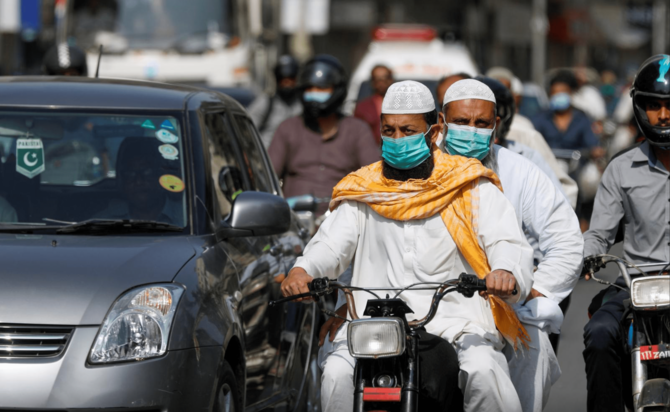
Men wear protective masks as they ride a motorcycle amid the outbreak of the coronavirus disease (COVID-19) in Karachi, Pakistan November 16, 2020. (Reuters)
Short Url
Updated 22 November 2020
Follow

Pakistan reports highest single-day death toll from COVID-19 since July

  • Nearly 60 fatalities recorded in past 24 hours; more than 2,600 test positive
  • Authorities begin imposing lockdowns in four "high-risk" Karachi districts 

ISLAMABAD: Pakistan on Sunday recorded 59 deaths from the coronavirus disease, the highest single-day fatality count recorded since July 15, with authorities linking the uptick in numbers to a second wave of the deadly outbreak across the country.

According to the health ministry's COVID-19 portal, 2,665 people had tested positive for the disease in the past 24 hours, taking the national caseload to 374,173 infections and 7,662 deaths since the outbreak was first reported in March.

In Karachi, officials began imposing smart lockdowns in four "high-risk" areas of the city – namely the South District, West District, Korangi District and Central District – after more than 850 people tested positive for the disease on Saturday night. 

The lockdown measures include a restriction on the movement of residents in the COVID-19 hotspots, in addition to a ban on gatherings at home.

For the past several weeks, authorities have been sounding the alarm over a second wave of the coronavirus outbreak.
Earlier this week, the National Command and Operation Center (NCOC), which leads the anti-COVID-19 efforts in the country, had made it mandatory for residents to wear masks in public places – failing which they would be fined – and ordered all business centers, wedding halls, eateries and shopping centers to close shop by 10 pm. 

The surge in infections follows Pakistan's move to ease restrictions on May 9, ahead of the Eid Al-Fitr festivities which marks the end of the fasting month of Ramadan and is celebrated with congregational prayers, family gatherings and feasting.

The country’s transportation sector and most businesses were reopened, though cinemas, theaters and schools remained closed.

More recently, however, the government warned that there was an uptick in infection numbers, telling people to take precautionary measures and announcing that Pakistan was witnessing the second wave of the pandemic which could prove more lethal than the first one.


Amid political standoff, Pakistan PM engages KP chief minister on security, development

Updated 14 sec ago
Follow

Amid political standoff, Pakistan PM engages KP chief minister on security, development

  • Shehbaz Sharif urges counterterrorism, development cooperation with PTI-run province
  • Meeting notable amid long strain between federal government and Imran Khan’s party

ISLAMABAD: Pakistani Prime Minister Shehbaz Sharif met the chief minister of Khyber Pakhtunkhwa on Monday in a rare high-level engagement between the federal government and a province governed by former prime minister Imran Khan’s opposition party, as Islamabad presses for closer cooperation on security and development.

The meeting is notable given Pakistan’s deeply polarized political landscape. Relations between the federal government, led by Sharif’s Pakistan Muslim League-Nawaz (PML-N), and the provincial KP government ruled by Khan’s Pakistan Tehreek-e-Insaf (PTI) party, have remained severely strained since Khan’s removal from office in 2022 and his subsequent imprisonment on multiple convictions, which PTI says are politically motivated. 

Khyber Pakhtunkhwa, which borders Afghanistan, has faced a sharp rise in militant violence in recent years, with attacks by Pakistani Taliban factions straining provincial law enforcement and security institutions. Islamabad has repeatedly called for stronger provincial cooperation as it battles a nationwide resurgence of militancy.

According to a statement issued by the Prime Minister’s Office, Sharif met KP CM Sohail Afridi in Islamabad, with discussions focusing on law and order, counterterrorism and coordination between federal and provincial authorities.

“The Prime Minister emphasized the need for cooperation between the federal and provincial governments for the development and prosperity of the people of Khyber Pakhtunkhwa,” the PMO statement said.

On security, Sharif described coordination between Islamabad and Peshawar as essential. 

“The Prime Minister declared cooperation between the federal and provincial governments indispensable for maintaining law and order in the province,” the statement said, adding that “there is a need to further intensify the provincial government’s efforts to establish peace.”

Sharif also called on the provincial administration to strengthen its own institutions to counter militancy. 

“The provincial government should reinforce provincial institutions to combat terrorism,” the statement quoted him as saying, while stressing that both governments would continue “joint efforts for the complete elimination of terrorism.”

The prime minister underlined that maintaining security and delivering welfare were constitutional responsibilities of the provincial government. 

“The provincial government is empowered and should take measures for health and education for the people of Khyber Pakhtunkhwa,” the statement said.

Sharif said the federal government remained committed to supporting the province within its constitutional mandate. 

“The federal government has always strived for the betterment of the people of Khyber Pakhtunkhwa,” he said, describing the province as “an important unit of the federation.”

He added that national development required sustained coordination between Islamabad and the provinces.

“For national development and public service, close relations and effective coordination between the federation and the provinces are indispensable,” the statement said.

The prime minister assured cooperation on development projects, infrastructure, education, health and employment generation “within the federal domain,” reiterating that the government was pursuing a vision of balanced development across all provinces.

The meeting comes as Pakistan’s federal authorities seek to stabilize security conditions and revive economic confidence amid persistent political divisions, with analysts warning that continued friction between Islamabad and opposition-led provinces could complicate counterterrorism efforts and governance in vulnerable regions.