


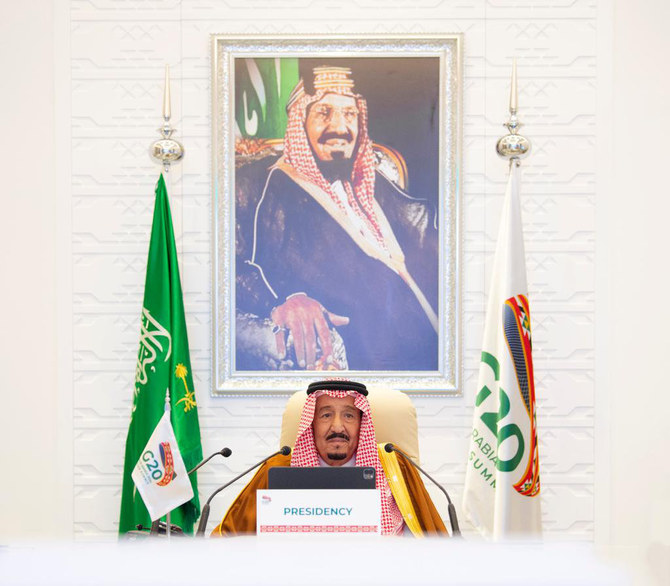


RIYADH: As the Group of Twenty (G20) forum’s 15th meeting got under way on Saturday, Saudi Arabia’s King Salman, in his opening remarks, expressed confidence in the outcome of the summit, being held virtually for the first time since its founding owing to the coronavirus pandemic.
“I am confident that the Riyadh summit will deliver significant and decisive results, and will lead to the adoption of economic and social policies that will restore hope and reassurance to the people of the world,” he said.
The hope is that the two-day G20 Leaders’ Summit, being held under Saudi Arabia’s presidency, will lay the foundations for a more inclusive, resilient and sustainable recovery from the COVID-19 crisis. The meeting has brought together economies that account for about 85 percent of global GDP to discuss the most challenging socio-economic issues.
“It is unfortunate that we are unable to host you in person in Riyadh, due to the exceptional circumstances that we are all facing this year,” King Salman told other G20 leaders. “Our peoples and economies are still suffering from this shock. However, we will do our best to overcome this crisis through international cooperation.”
The Nov. 21-22 summit, expected to be dominated by the pandemic and its economic repercussions, is not the first meeting of the leaders in Riyadh. In March, just a few weeks after COVID-19 was declared a global pandemic, King Salman hosted an extraordinary virtual gathering aimed at forging a common strategy to confront the unprecedented challenge.
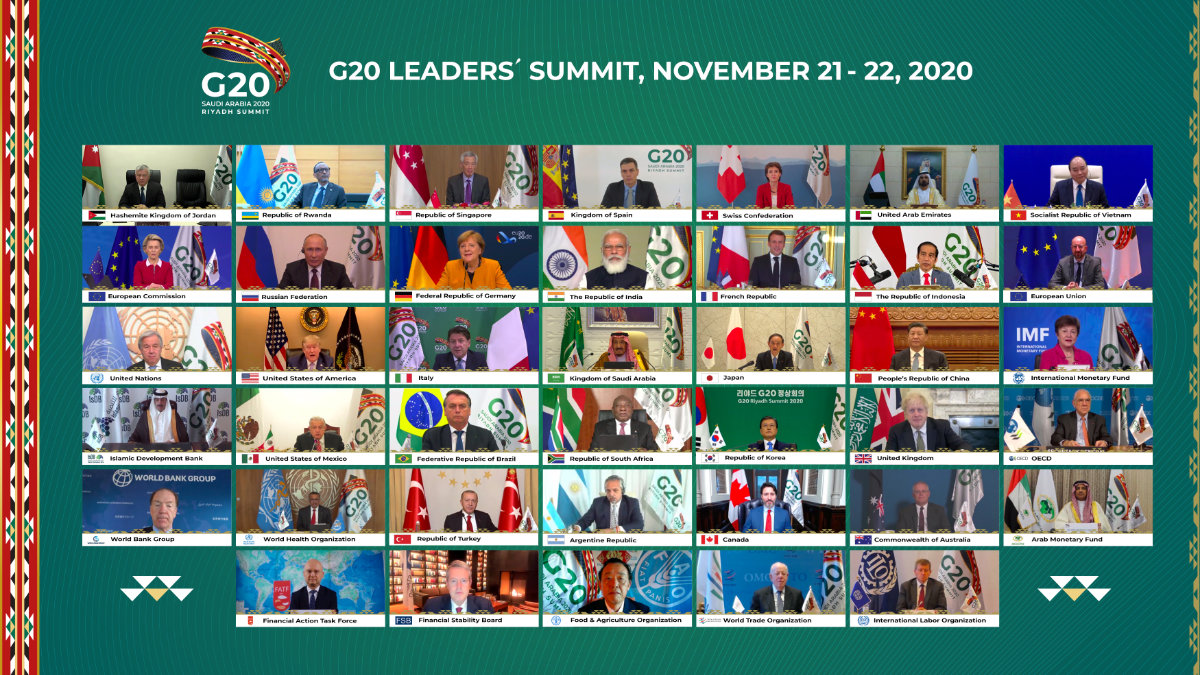
Leaders of the world's 20 biggest economies attend the virtual G20 Leaders’ Summit on Saturday. (SPA)
“We expressed our commitment during our extraordinary summit to urgently mobilize resources, and we all pledged, at the onset of the crisis, over $21 billion to support the global efforts to combat this pandemic,” King Salman said on Saturday. “We took extraordinary measures to support our economies by injecting over $11 trillion to support individuals and businesses.”
“We also extended our social safety nets to protect those prone to losing their jobs or source of income. To this end, we have provided emergency support to the developing countries, including the G20 Debt Service Suspension Initiative to the low-income countries.
“This has been an extraordinary year. The COVID-19 pandemic has been an unprecedented shock that affected the entire world within a short period of time, causing global economic and social losses.”
Opinion
This section contains relevant reference points, placed in (Opinion field)
The G20 presidency rotates between member countries, and in December 2019 Saudi Arabia became the first Arab country to assume the role. Each presidency typically concludes with the G20 Leaders’ Summit, a powerful gathering of heads of state that made its debut in 2008.
The normal G20 calendar has been changed due to restrictions put in place across the forum’s membership in response to the pandemic. G20 leaders and ministers have held virtual meetings to coordinate the international response to the crisis and put the global economy on a pathway to recovery.
IN NUMBER
- $21 billion: Contribution of G20 member states to fight against COVID-19.
King Salman stressed that the Riyadh summit was inclusive of the interests of all countries and not just G20 member states. “The theme of our presidency is ‘Realizing Opportunities of the 21st Century for All,’” he noted, adding: “Although the COVID-19 pandemic has forced us to adjust our focus rapidly to face its repercussions, the subject areas under this general theme, namely ‘Empowering People,’ ‘Safeguarding the Planet,’ and ‘Shaping New Frontiers,’ remain essential to overcome this global challenge and shape a better future for our people.”
King Salman urged G20 leaders to address the vulnerabilities exposed by COVID-19 while working to protect lives and livelihoods. “Although we are optimistic about the progress made in developing vaccines, therapeutics and diagnostics tools for COVID-19, we must work to create the conditions for affordable and equitable access to these tools for all peoples,” he said.
With G20 countries adopting the Riyadh Initiative on the Future of the World Trade Organization, which aims to make the multilateral trading system more capable of facing any challenges, King Salman said: “We must continue to support the global economy and reopen our economies and borders to facilitate the mobility of trade and people. We must provide support to the developing countries in a coordinated manner to maintain the development already achieved over the past decades.”

Saudi Arabia’s King Salman, right, presides over the Group of Twenty (G20) forum’s 15th Summit meeting on Saturday. (SPA)
Pointing out that the inaugural leaders’ summit was held in response to the 2008 global financial crisis, King Salman said: “The outcomes achieved are ample proof that the G20 is the most prominent forum for international cooperation and for tackling global crises. Today, we are working together again to face another, deeper global crisis, that has ravaged people and economies.”
Looking to the future, King Salman said: “The G20 is promoting access to opportunities for all, especially women and youth, and building a future that protects our land, our oceans, our natural resources. The leaders of the G20 came together to give hope, to agree on a way forward that ensures we protect the people and build a better future.”
The opening virtual ceremony saw a number of heads of government and heads of state deliver short speeches wishing the summit all success.
Boris Johnson, the UK prime minister, praised Saudi Arabia’s Neom city, which he said represents “a greener future” for the world, “If we were in Saudi Arabia today,” he said, “we may have visited the exciting new city of Neom, whose origins I was able to inspect a couple of years ago, built on the sands of fossil fuels but powered by green hydrogen, under an enviable climate and an enviably reliable sun to provide inexhaustible solar energy.”
He added: “That future will only be possible if the world’s leading economies drive forward more ambitious action, more quickly to prevent further catastrophic climate change.”
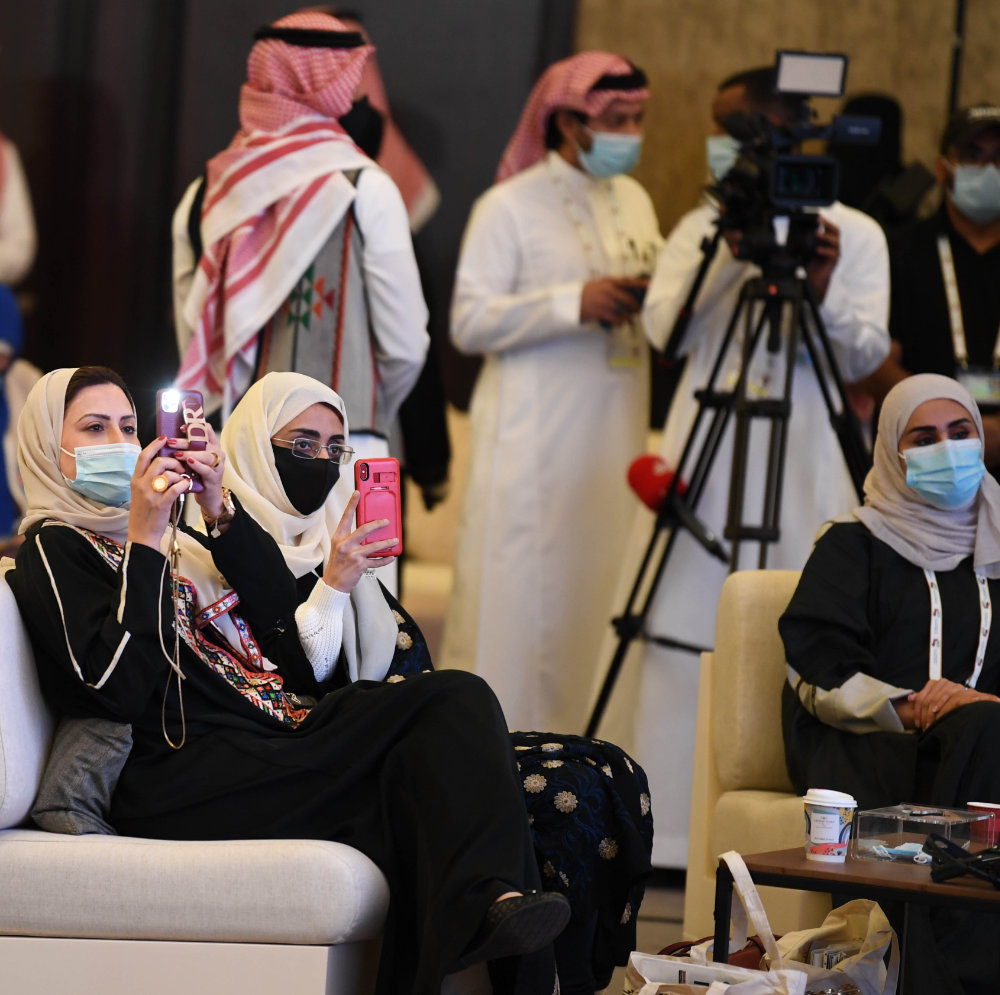
Members of the Saudi media covering a press conference calle by King Salman in Riyadh on Saturday. (SPA)
Pedro Sanchez, Spain’s prime minister, said the summit is a unique opportunity to establish a collective road map to work for “prosperity, sustainability, equality, and well-being, to work for the benefit of our economies but above all for the benefit of all citizens.”
Turkish President Recep Tayyip Erdogan said the COVID-19 pandemic has increased the responsibility and importance of the G20. “The decisions taken at the Riyadh summit will be decisive in not only alleviating the negative impact of the pandemic, but also in meeting the expectations from the G20,” he said.
Brazil’s President Jair Bolsonaro said that ever since the outset of the coronavirus crisis, the leaders had emphasized the importance of taking care of people’s health and of the economy at the same time. “Time has proven us right,” he said. “We must uphold our firm commitment to work toward economic growth, the freedom of our peoples and the prosperity of the world at large.”
Giuseppe Conte, Italy’s prime minister, said the Riyadh summit will reflect the G20 forum’s commitment to rapidly recover from the crisis, and to find solutions for the major challenges currently facing humanity.
We must stand united in the use of opportunities offered by this crisis to create a new, better normal,” he said. “Italy, as the upcoming 2021 presidency, is determined to build upon the outcomes of the Riyadh summit and to continue promoting the important action of the G20.”
_____________________
Twitter: @LujainBenGassem


