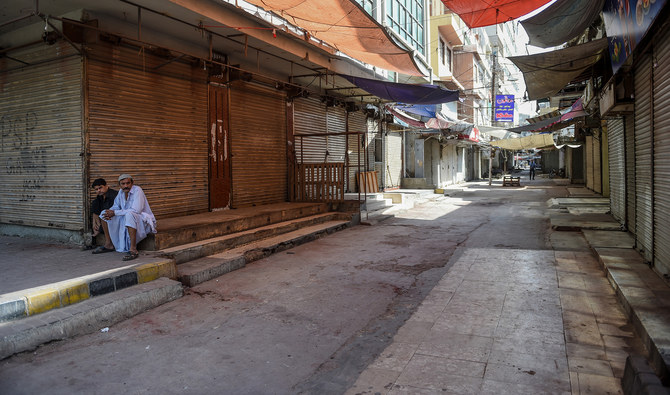
ISLAMABAD: Four ‘high-risk’ districts in Pakistan’s largest city, Karachi, have been marked by provincial authorities for coronavirus related lockdowns after over 850 people in the city tested positive for COVID-19 overnight on Saturday.
Pakistan has seen coronavirus infections rising to peak levels as the country comes in the grip of a second wave of the virus.
In what is dubbed a ‘smart lockdown,’ the deputy commissioners of the administrations of several districts in the seaside metropolis have imposed mobility restrictions, with smaller, ‘micro’ lockdowns also coming into effect in numerous streets and localities.
As part of restrictions, movements of residents in areas that have been earmarked as hotspots for COVID-19 will be restricted and will not be allowed gatherings in their homes. The districts in question are South District, West District, Korangi District and Central District.
Three days earlier, the National Coordination Committee spearheading coronavirus relief efforts, had imposed an immediate ban on large gatherings, including weddings.
The Karachi lockdowns came into effect Saturday morning and will last until Dec. 5.
Pakistan recorded 42 deaths in the last 24 hours-- the country’s highest fatality count since mid-July.

Karachi imposes lockdowns in four districts after surge in coronavirus cases
https://arab.news/6b4u3
Karachi imposes lockdowns in four districts after surge in coronavirus cases
- Over 850 people tested positive for COVID-19 in Karachi overnight on Saturday
- Three days earlier, the National Coordination Committee imposed an immediate ban on large gatherings
Pakistan, Canada explore deeper mineral investment as Reko Diq mine project advances
- Canadian envoy cites Reko Diq as model for expanding Pakistan-Canada mineral cooperation
- Islamabad pitches vast copper-gold reserves as economic lifeline after years of stalled development
ISLAMABAD: Pakistan and Canada are exploring deeper cooperation in the minerals and energy sectors as Islamabad accelerates efforts to revive long-delayed mining projects, including the Reko Diq copper-gold mine, one of the world’s largest undeveloped mineral deposits, according to a statement from Pakistan’s Information Ministry this week.
The Reko Diq copper-gold project is one of the world’s largest undeveloped mineral deposits, with estimated reserves of around 5.9 billion tons of ore containing both copper and gold. The project, in Balochistan’s Chagai District, was stalled for over a decade amid international legal disputes but was reconstituted in 2022 with Canadian mining giant Barrick Gold holding a 50 percent stake alongside Pakistani federal and provincial partners.
Recent steps toward implementation include multilateral financing arrangements involving international banks and institutions, and major equipment contracts, such as a $440 million deal with Japan’s Komatsu for mining machinery, signaling readiness for construction phase activities starting in 2026. Last month, Washington approved $1.25 billion in US Export-Import Bank financing for Reko Diq, with the package also expected to unlock up to $2 billion in US equipment and service exports for the project.
First production is expected by late 2028 under the revived partnership, with estimates suggesting annual output of around 200,000 tons of copper and significant gold yields once operations scale up. This project is central to Islamabad’s strategy to position mining as a pillar of economic recovery, as it hosts international mineral investment forums, seeks partnerships with Western and Gulf countries, and signs cooperation agreements on critical minerals, including with the United States. Officials see large-scale mining projects as potential drivers of exports, foreign exchange earnings and job creation in a country grappling with debt pressures and slow growth.
Against this backdrop, Federal Minister for Petroleum Ali Pervaiz Malik met Canada’s High Commissioner to Pakistan, Tarik Ali Khan, on Wednesday to discuss expanding bilateral cooperation in mining and energy, the information ministry said.
“The success of Barrick Gold at Reko Diq is a strong example to build upon Pakistan–Canada mineral cooperation,” the high commissioner said, according to the statement, adding that Canada was actively working to encourage more Canadian companies to engage with Pakistan’s mining sector.
The envoy said Canada’s ministry of natural resources was ready to support cooperation with Pakistan, noting that Canadian expertise in large-scale mining, environmental standards and community development could play a role as Pakistan opens up its mineral sector. He also said Canada was encouraging participation in the Pakistan Minerals Investment Forum to attract global investors.
The Canadian high commissioner also invited Pakistan to participate in the Prospectors & Developers Association of Canada (PDAC) convention in 2026, one of the world’s largest mining investment forums, calling it an opportunity to showcase Pakistan’s mineral potential to international investors.
Petroleum Minister Malik welcomed Canadian interest, saying technical expertise and intellectual capital would help strengthen Pakistan’s systems and boost investor confidence, particularly among international mining companies, the statement said.
Both sides also discussed cooperation in the energy sector, with Canada offering technical assistance, according to the statement.
...


