UN agency slaps ban on heavy fuel oil in Arctic

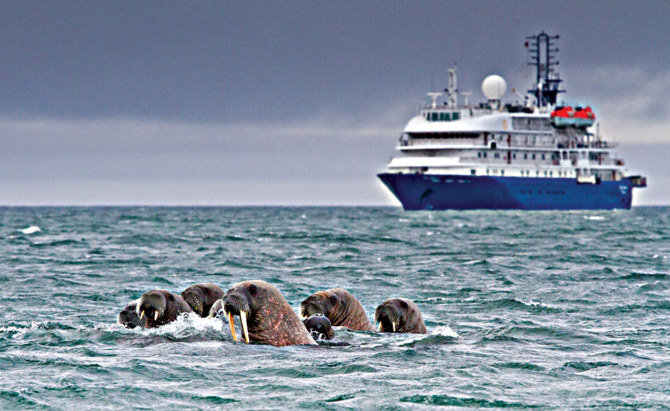
Green groups claim the UN ban on heavy fuel oil in the Arctic will have minimal environmental benefit. (Shutterstock)
Short Url
Updated 21 November 2020
Follow

UN agency slaps ban on heavy fuel oil in Arctic

  • The Arctic has warmed at least twice as quickly as the rest of the world over the last three decades and shipping traffic has expanded

LONDON: The UN shipping agency on Friday approved a ban on the use of heavy fuel oil in the Arctic region in a move criticized by green groups which said loopholes will allow many vessels to keep sailing without enough regulatory control.

Antarctic waters are protected by stringent regulations, including a ban on heavy oil fuel (HFO) adopted in 2011, even though no cargo moves through the turbulent southern waters. For the Arctic, the rules have been looser.

In a virtual session of its Marine Environment Protection Committee (MEPC) the UN’s International Maritime Organization (IMO) approved a ban on the use of HFO and its carriage for use by ships in Arctic waters after July 1, 2024.

The Clean Arctic Alliance coalition described the regulations as “outrageous” as it included exemptions and waivers, which would mean a complete HFO ban would only come into effect in mid-2029.

“In its current form, the ban will achieve only a minimal reduction in HFO use and carriage by ships in the Arctic in mid-2024,” said Sian Prior, lead adviser to the Clean Arctic Alliance.

“The ban will mean that a full three-quarters of the ships using HFO today will be eligible for an exemption.”

An IMO spokeswoman said there would be an exemption for ships with oil fuel tanks located inside their double hull. There would also be a provision allowing countries with coastlines bordering Arctic waters to issue waivers to ships flying their flag while they operate there until July 1, 2029.

The Arctic has warmed at least twice as quickly as the rest of the world over the last three decades and shipping traffic has expanded.

Environmentalists say HFO produces higher emissions of harmful pollutants, including sulfur oxide, nitrogen oxides, and black carbon. In addition, a possible oil spill involving HFO from a ship could have a devastating impact on the Arctic’s ecosystem.

The next MEPC session, scheduled for June 2021, is expected to formally adopt the measures.


UAE adds 250k companies in 2025, says minister

Updated 44 min 12 sec ago
Follow

UAE adds 250k companies in 2025, says minister

RIYADH: The UAE saw 250,000 new companies in 2025, bringing the total number of businesses operating in the Emirates to 1.4 million, said Abdulla bin Touq Al-Marri, the country’s minister of economy and tourism. 

Speaking during a media briefing, Al-Marri said that the number of small businesses in the Emirates has grown by 63 percent over the past five years. 

The minister added that the UAE has attracted around 760,000 companies since the introduction of full foreign ownership for commercial businesses in September 2021. 

Until the end of 2025, the number of firms operating in the country increased by 118.7 percent compared to the end of the first half of 2021. 

Discussing new amendments to the Commercial Companies Law, Al-Marri said that they provide a comprehensive and clear legal framework that supports the growth of the companies and their long-term sustainability. 

“The amendments grant multiple quotas and share classes in limited liability companies and public and private joint stock companies as a legal right, compared to the previous system where this right was limited to public joint stock companies through a Cabinet decision,” said the minister. 

The amendments also facilitate access to financing and investment opportunities, and are expected to strengthen companies’ ability to continue operations and expand geographically across free zones and financial free zones. 

The minister further highlighted that the law enhances the ease of doing business and ensures smoother entry to the markets by allowing the transfer of a company’s registration between Emirates, free zones and financial free zones, while maintaining the company’s original legal terms. 

“The UAE is among the first countries in the Middle East to allow multiple quota classes for LLCs, while many countries restrict this to joint stock companies, particularly public joint stock companies. It enhances flexibility in ownership structures and better regulates the relationship among shareholders,” said Al-Marri. 

The minister added that the total number of business registrations and licenses in the UAE is expected to increase by 10 to 15 percent within the first year of implementing the new amendments.

Al-Marri revealed that the UAE witnessed the registration of approximately 37,794 national and international trademarks in 2025. 

The number of registered trademarks also rose by 74 percent over four years, underscoring the Emirates’ business-friendly environment. 

In terms of intellectual property, 3,595 works were registered in 2025, representing a 124 percent growth rate over four years. 

The minister said that the contribution of the tourism sector to the country’s gross domestic product reached 291 billion dirhams ($79.24 billion) by the end of 2025. 

Currently, tourism contributes 15 percent to the country’s GDP compared to 6 percent in 2021. 

Al-Marri added that the UAE economy is projected to grow by 5 percent in 2025, driven by the continued expansion of non-oil sectors, whose contribution reached 77.5 percent to the nation’s GDP by the end of the first half of 2025.