


LONDON: The Abraham Accords, signed recently between Israel, the UAE and Bahrain, could serve as a blueprint for resolving other conflicts in the Middle East, according to panelists at a discussion hosted by the Emirates Society and attended by Arab News.
Ephraim Mirvis, chief rabbi of the UK, said the accords are “among the most significant events of my life.”
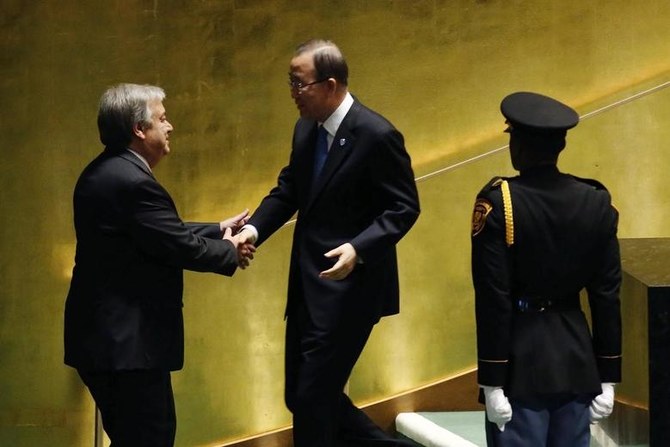
He was joined on the panel by UAE Minister of State for International Cooperation Reem Ebrahim Al-Hashimy and former UN Secretary-General Ban Ki-moon.
The latter said at the turn of 2019, the region had been on the brink of renewed conflict in the wake of the fraying of the Joint Comprehensive Plan of Action (JCPOA), also known as the Iran nuclear deal.
The failure of dialogue, according to Moon, had run concurrently with Iran stockpiling 10 times the quantity of uranium permitted under the terms of the JCPOA.
Iranian proxies in Iraq, meanwhile, had attacked the US Embassy in Baghdad, leading to retaliation from Washington in the form of the assassination of Iranian Maj. Gen. Qassem Soleimani on Jan. 3, 2020.
The world had only been spared further escalation, Ban said, by the coronavirus outbreak, which led to a temporary climbdown on all sides.
Though still “deeply concerned” at the “dangerous” situation with Iran, he said the Abraham Accords have helped reset the tone around seeking dialogue in the region.
“I was concerned that other Middle East nations may consider eschewing their commitment under the Nuclear Non-Proliferation Treaty and developing their own nuclear weapons programs in tandem with Iran’s,” Ban said.
“In this regard, I believe there are important lessons to be learned. We must … elevate our sustained efforts to revitalize multilateralism. I see the Abraham Accords as a recent diplomatic victory, and I really hope this momentum can be expanded in other areas between other nations to elevate diplomatic solutions,” he added.
“The Israeli-Palestinian issue, Iran’s nuclear program, the conflict in Syria, the war and crippling humanitarian crisis in Yemen — all these regional problems can only be solved through peaceful, diplomatic solutions born out of multilateralism.”
Al-Hashimy said this opportunity to change the direction of the whole region and its myriad conflicts, especially between Israel and the Palestinians, was of central importance to the signing of the accords.
“The UAE really wanted to look at a fresher and different way, and with a commitment to suspend annexation, we went ahead with our Israeli colleagues and signed off on a deal that we believe continues to put in place the importance of Palestinian statehood, but also doesn’t create an impediment or obstacle to dialogue,” she said.
“I’m very keen on trying to see a very different Middle East emerge and evolve. The conflict that has continued to percolate in the Arab and in the Muslim world is really something that we didn’t want to continue to inherit. (We) wanted to try something different and try to actually see whether or not, through direct conversation, we could continue to advance the cause of the rightful statehood of both nations in a Middle East that fights extremism and … believes in plurality,” she added.
“Given the UAE’s commitment to advance the rights of different groupings and different orientations … this commitment to inclusivity has really been part and parcel of who we are as a people.”
Mirvis said such an approach is essential to ensuring any peace agreement endures. “I believe strongly that there can’t be peace among the nations if there can’t be peace among the faiths,” he added.
“A lot has been spoken about in terms of the potential for fruitful bilateral relations, the potential in the dimensions of diplomacy, tourism, hi-tech and so on. But in addition, there’s so much potential relating to Jewish-Muslim relations, and I believe the Abraham Accords have unlocked certain doors for us.”
Al-Hashimy said those doors, including to regional development and progress through technology, education and other areas, are vital to facilitating that peace, and that cooperation with Israel will play a central role in creating opportunities for young people, enabling the Middle East to move away from extremism and old prejudices.
“As we continue to advance our own UAE national agenda, we’re very much focused on new sectors of growth, and we believe there’s great ingenuity in countries like Israel,” she added.
“Our region has a lot of extremist language running through it. We want to be able to offer alternatives to that, and that’s why the UAE was very focused on appointing a minister of youth a few years ago to … include youth in government policy.”
Mirvis said though momentous, the accords are just the first step on the road to a total reset in regional relations.
“Within Jewish tradition and Jewish faith, nothing is more sacred than peace. When peace is established with a former foe or enemy, there can be nothing more sweet than that,” he added.
“We need to be patient. Relationships take time to build, create and nurture. Our relationships between our faith groups depend on interpersonal relationships. We need to go ahead with enthusiasm and with passion, but we also need to be realistic.”


