

Saudi stock market rises as financial shares gain strength

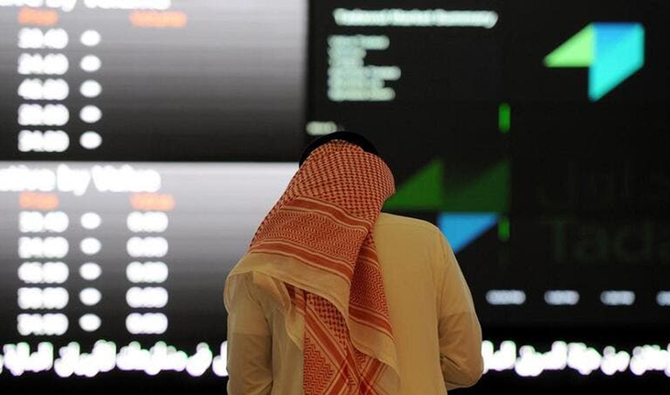
Saudi Arabia leading gains on a rise in financial shares, while Egypt bucked the trend to close lower. (AFP/File)
Short Url
Updated 16 November 2020
Follow

Saudi stock market rises as financial shares gain strength

  • By Thursday major Gulf markets had logged weekly gains following positive developments in a COVID-19 vaccine

DUBAI: Most major stock markets in the Middle East ended higher on Sunday, with Saudi Arabia leading gains on a rise in financial shares, while Egypt bucked the trend to close lower.

By Thursday major Gulf markets had logged weekly gains following positive developments in a COVID-19 vaccine, which boosted hopes of a faster-than-expected global economic recovery.

Saudi Arabia’s benchmark index increased 0.8 percent on Sunday, with Al-Rajhi Bank rising 1.4 percent, while utility firm Saudi Electricity jumped 5.1 percent.

Official data showed on Sunday that Saudi Arabia’s consumer price index increased by 5.8 percent in October compared with the same month last year, slightly above September’s 5.7 percent.

Dubai’s main share index added 0.3 percent, helped by a 1.5 percent rise in Emirates NBD Bank and a 1.8 percent gain in budget airliner Air Arabia.

The Abu Dhabi index gained 0.3 percent, with the UAE’s largest lender First Abu Dhabi Bank rising 0.5 percent.

Among gainers, Dana Gas was up 0.3 percent. On Thursday, the energy firm said it expects to complete the sale of its onshore Egyptian oil and gas assets to IPR Wastani Petroleum Ltd., a member of the IPR Energy Group, in early 2021.

The UAE has reopened its land border crossings as it works to shield the economy from the effects of the coronavirus pandemic, Reuters reported on Friday, citing state news agency WAM.

The statement said Omani citizens would not need authorization to enter the country from Nov. 16, but would need a negative PCR coronavirus test.

Qatar’s index eased 0.1 percent, weighed down by a 1 percent drop in the Gulf’s largest lender Qatar National Bank.

Outside the Gulf, Egypt’s blue-chip index fell 0.6 percent, hit by a 1.3 percent fall in the country’s largest lender Commercial International Bank.


Saudi Arabia’s budget deficit widens to $25.3bn in Q4 2025 as spending rises 

Updated 5 sec ago
Follow

Saudi Arabia’s budget deficit widens to $25.3bn in Q4 2025 as spending rises 

RIYADH: Saudi Arabia’s capital spending rose 18 percent year on year in the fourth quarter of 2025, while higher overall expenditure widened the Kingdom’s budget deficit to SR94.85 billion ($25.28 billion), official data showed. 

According to the Ministry of Finance’s Quarterly Budget Performance Report, government spending increased to SR371.6 billion in the three months to December, up 3 percent from SR360.5 billion in the same period a year earlier. 

Capital expenditure — classified as spending on non-financial assets — climbed to SR50.9 billion in the fourth quarter from SR43.1 billion a year earlier, highlighting sustained investment in infrastructure and development projects. 

Total revenues reached SR276.7 billion in the quarter, increasing from SR269.9 billion in the third quarter but declining about 9 percent from a year earlier due to weaker oil income. 

Oil revenues totaled SR154.2 billion in the fourth quarter, down 10 percent year on year despite a quarterly increase supported by higher production levels. For the full year, oil revenues fell around 20 percent to SR606.5 billion from SR756.6 billion in 2024. 

Non-oil revenues — a key pillar of Saudi Arabia’s diversification strategy — stood at SR122.6 billion in the fourth quarter. On an annual basis, non-oil revenues rose by 1 percent to SR505.3 billion in 2025, compared with SR502.5 billion the previous year. 

Saudi Arabia maintained an expansionary fiscal stance throughout 2025, with total government expenditure reaching SR1.39 trillion, up 1 percent from SR1.36 trillion in 2024. 

Spending increased across several priority sectors. Education expenditure rose 4 percent to SR212.5 billion, while health and social development spending increased 2 percent to SR278.9 billion.  

Military and security sector spending climbed about 5 percent to SR249.1 billion, while public administration expenditure grew 7 percent. Spending on general items rose 3 percent, and regional administration outlays increased marginally by 0.4 percent. 

For the full fiscal year, total revenues reached SR1.11 trillion against expenditure of SR1.388 trillion, resulting in a budget deficit of SR276.6 billion — exceeding earlier government projections as oil revenues declined. 

Public debt rose to SR1.52 trillion at the end of 2025, compared with SR1.22 trillion a year earlier, as the Kingdom increased borrowing to finance fiscal gaps while continuing to fund large-scale development and infrastructure projects.