


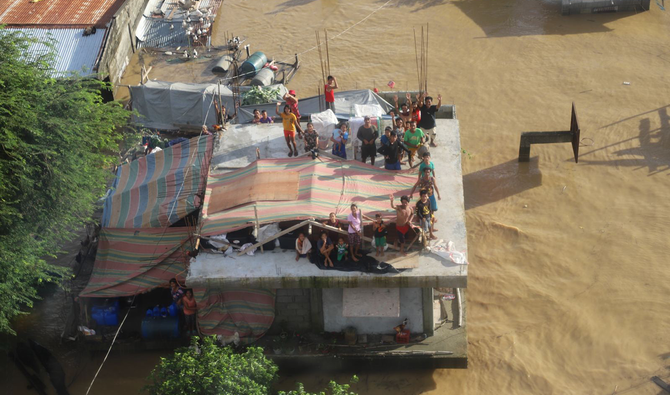


MANILA: Days of heavy rains brought by Typhoon Vamco and the monsoon-inundated Cagayan Valley in the northern Philippines have turned parts of the region into an “ocean,” officials said on Saturday.
At least 37 people have died, with 22 injured and 15 others missing after Typhoon Vamco (local name Ulysses) cut a swathe through the main island of Luzon on Friday, the National Disaster Risk Reduction and Management Council (NDRRMC) said.
The Cagayan province has been the worst hit.
“If you come to Cagayan now, it’s like an ocean. You won’t see the river,” Gov. Manuel Mamba said during a radio interview on Saturday.
“This is the first time for so many years that we have experienced this kind of flooding,” he said, adding that ordinarily floodwater “would reach up to 11 meters” in the province, but this time “it went as high as 13.1 meters.”
Cagayan is one of five provinces that constitute the region, with Cagayan Valley designated as Region 2.
While not directly hit by Vamco, the valley accounted for 20, or more than half of the deaths, from the typhoon while about 343,202 people have been impacted in the region.
The NDRRMC gave the breakdown of affected localities in Cagayan Valley as 21 municipalities and the city of Tuguegarao in Cagayan province, 22 municipalities and three cities in Isabela, 15 municipalities in Nueva Vizcaya, and five municipalities in Quirino.
Mamba cited multiple factors for the flooding in the province, including the “denudation of forests due to illegal logging, a saturation of soil caused by recent storms,” and the release of water from the Magat Dam.
“We were prepared. We anticipated this, so we had preventive, even forced evacuation. But we did not anticipate how enormous the volume of water (would be that poured into Cagayan),” he said.
During a virtual press briefing on Saturday, Mamba said that “no typhoon signal was hoisted over the province” since Vamco entered the country on Wednesday.
The floodwaters that submerged Cagayan came from its neighboring provinces of Isabela, Quirino, Nueva Vizcaya, Kalinga, and Ifugao, according to the governor.
“Our big problem is the denudation of our forests ... The forests are abused here both on the Cordillera and the Sierra Madre side. And then the heavy siltation of our riverbeds,” Mamba said, adding that what had happened in Cagayan “was a summation of all the wrongs that were done to the environment.”
Besides not dredging the Cagayan River, Mamba said that the national go-green program had failed, with unabated illegal logging despite a total ban.
“I think all the sacrifices and sufferings we are experiencing now should serve as a lesson to all of us here and it should also open the eyes of the national government,” Mamba said.
He added that addressing environmental concerns should be an inter-regional initiative.
“We have long been saying that (Cagayan) is the most disaster-prone province in the north, now here it is, and the city of Tuguegarao is the most disaster-prone city not only in the country but even worldwide. So this is it. This is just the start of the worst . . .”
With the region flooded for the third consecutive day, several residents remained trapped on rooftops with rescuers unable to reach them on small boats.
Several turned to social media for help.
Mamba, however, assured the public that both the local and national government were “doing everything to rescue them.”
Meanwhile, the Armed Forces of the Philippines (AFP), responding to calls for help from affected residents, said that it had sent personnel and assets to the areas in Cagayan Valley.
“All resources of these units are being used to rescue and provide relief to stricken individuals and communities in Cordillera Administrative Region and Region 2 (Cagayan Valley),” an AFP statement said.
The Coast Guard, police, and Bureau of Fire Protection are also involved in the rescue operations.
“We call on everyone to hold on to safety. Help is on the way. And help will come,” said Navy Capt. Jonathan Zata, chief of the AFP public affairs office.


