

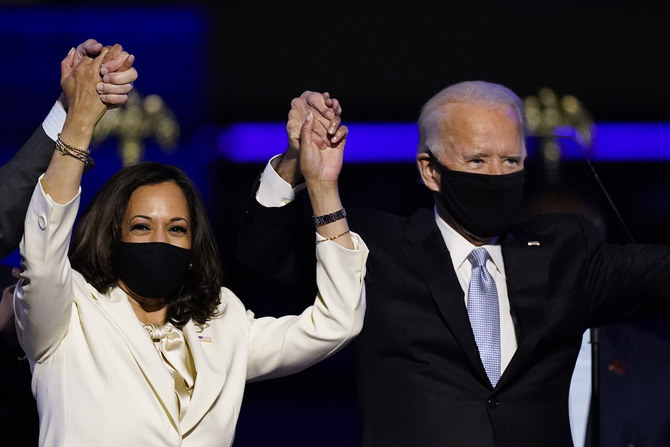


REHOBOTH BEACH, Delaware/WASHINGTON: US President-elect Joe Biden solidified his election victory on Friday by winning the state of Georgia, and President Donald Trump said “time will tell” if another administration takes over soon, the closest he has come to acknowledging Biden could succeed him.
Edison Research, which made the Georgia call, also projected that North Carolina, the only other battleground state with an outstanding vote count, would go to Trump, finalizing the electoral vote tally at 306 for Biden to 232 for Trump.
The numbers gave Biden, a Democrat, a resounding defeat of Trump in the Electoral College, equal to the 306 votes that Trump, a Republican, won to defeat Hillary Clinton in a 2016 victory Trump called a “landslide.”
At a White House event where he predicted a coronavirus vaccine would be available for the whole population by April, Trump edged closer to acknowledging he might leave the White House in January but stopped short.
“This administration will not be going to a lockdown. Hopefully the, uh, whatever happens in the future — who knows which administration it will be? I guess time will tell,” Trump said in his first public remarks since Biden was projected as the election’s winner on Nov. 7.
Trump did not take questions after the event.
Trump, a Republican, has claimed without evidence that he was cheated by widespread election fraud and has refused to concede. State election officials report no serious irregularities, and several of his legal challenges have failed in court.
While Trump had yet to concede, Biden officials reiterated they were moving ahead with transition efforts regardless.
Although the national popular vote does not determine the election outcome, Biden was ahead by more than 5.3 million votes, or 3.4 percentage points. His share of the popular vote, at 50.8%, was slightly higher than Ronald Reagan’s share of the vote in 1980 when he defeated Jimmy Carter.

President Donald Trump speaks at the Rose Garden of the White House in Washington on Nov. 13, 2020. (AP Photo/Evan Vucci)
To win a second term, Trump would need to overturn Biden’s lead in at least three states, but he has so far failed to produce evidence that he could do so in any of them. States face a Dec. 8 “safe harbor” deadline to certify their elections and choose electors for the Electoral College, which will officially select the new president on Dec. 14.
Biden’s legal team in Georgia said on Friday they do not expect a hand recount of votes in the state to change the results there. Trump campaign spokesman Tim Murtaugh told Fox News the campaign has “great confidence” it can prevail in the Georgia recount.
A Michigan state court rejected on Friday a request by Trump’s supporters to block the certification of votes in Detroit, which went heavily in favor of Biden. And lawyers for Trump’s campaign dropped a lawsuit in Arizona after the final vote count rendered it moot.
Federal election security officials have found no evidence that any voting system deleted or lost votes, changed votes, “or was in any way compromised,” two security groups said in a statement released on Thursday by the lead US cybersecurity agency.
Transition talk
Biden officials said on Friday they would press forward with the transition, identifying legislative priorities, reviewing federal agency policies and preparing to fill thousands of jobs in the new administration.
“We’re charging ahead with the transition,” Jen Psaki, a senior adviser to Biden’s transition team, said on a conference call while stressing that Biden still needs “real-time information” from the Trump administration to deal with the resurgent pandemic and national security threats.
Psaki urged Trump’s White House to allow Biden and Vice President-elect Kamala Harris to receive daily intelligence briefings on potential threats around the world.
“With every day that passes on, it becomes more concerning that our national security team and the president-elect and the vice president-elect don’t have access to those threat assessments, intelligence briefings, real-time information about our engagements around the world,” Psaki said. “Because, you know, you don’t know what you don’t know.”
Biden will be briefed by his own group of national-security experts next week, she said. He met with transition advisers again on Friday at his Delaware beach house where he is mapping out his approach to the pandemic and prepares to name his top appointees, including Cabinet members.
Trump’s refusal to accept defeat has stalled the official transition. The federal agency that releases funding to an incoming president-elect, the General Services Administration, has yet to recognize Biden’s victory, denying him access to federal office space and resources.
Trump has discussed with advisers media ventures and appearances to keep him in the spotlight ahead of a possible 2024 White House bid. In the near term, he is expected to campaign for Republican US Senate candidates in Georgia ahead of Jan. 5 runoff elections that will determine which party controls the chamber, aides said.
He also is considering starting a new television channel or social media company to compete with those he felt betrayed him and stifled his ability to communicate directly with Americans, according to several advisers.
Fox News correspondent Geraldo Rivera, a Trump confidant, said he had spoken to the president by phone on Friday and Trump gave him the impression he would follow the US Constitution and surrender his office after every vote was counted.
“He told me he’s a realist. He told me he would do the right thing,” Rivera said in an interview with Fox. “I got no impression that he was plotting the overthrow of the elected government. He just wants a fair fight.”


