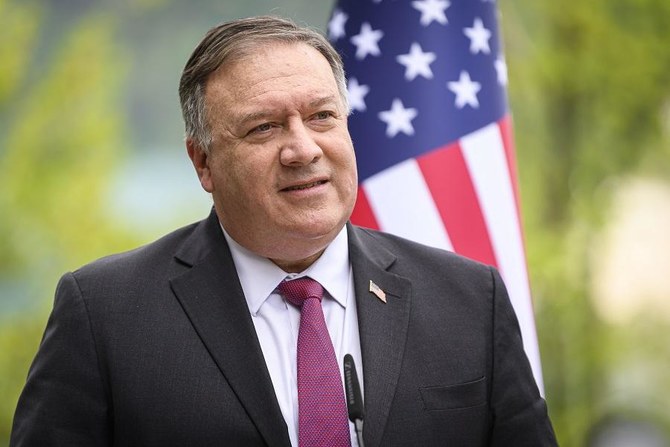
WASHINGTON: After refusing to acknowledge President Donald Trump’s loss in last week’s election, Secretary of State Mike Pompeo is leaving Friday on a trip to Europe and the Middle East, to countries where leaders have all congratulated former vice president Joe Biden for his victory.
The seven-nation trip is aimed at shoring up the outgoing Trump administration’s priorities, notably its anti-China and -Iran policies, and will include visits to Israeli settlements in the West Bank that have been avoided by previous secretaries of state.
But the usual foreign policy issues are likely to be overshadowed by the extraordinary moment in global politics: Most of the world has accepted the results of America’s election, while the United States’ top diplomat — as well as its president and much of his Republican Party — have not.
Pompeo’s trip comes days after he raised eyebrows by dismissing a reporter’s question about the presidential transition by saying “there will be a smooth transition to a second Trump administration.” He appeared to be speaking in jest and went on to say, in a more serious tone, that the world should be assured that the State Department will be functional and successful with the president who takes office Jan. 20. But those comments and subsequent statements in interviews with conservative media did not acknowledge that it’s Biden who will become president then.
Pompeo’s weeklong tour takes him to France, Turkey, Georgia, Israel, the United Arab Emirates, Qatar and Saudi Arabia. The leaders of each of those countries have offered public congratulations to Biden.
Four of those countries — France, Turkey, Georgia and Qatar — have had a fractious relationship with the Trump administration and it was not clear if Pompeo would hold public engagements with any of their leaders. Pompeo has had a notoriously frosty relationship with the press and it was also unclear if he planned to take questions from reporters.
In keeping with Trump’s refusal to concede and orders for Cabinet agencies not to cooperate with the Biden transition team, the State Department has not been involved with facilitating Biden’s calls to foreign leaders, according to officials familiar with the process.
Pompeo’s ardent support for Trump, who has claimed without evidence that the election was beset by fraud, threatens to hurt America’s standing in making pronouncements about other countries’ democratic shortcomings.
On Thursday, Pompeo weighed in on Hong Kong’s legislature, and he has in recent weeks denounced alleged electoral problems in Belarus, Tanzania and Ivory Coast.
Yet, at his news conference Tuesday, Pompeo roundly dismissed a question about whether Trump’s unfounded protests have created problems for US credibility. “You asked a question that is ridiculous,” he responded. “This department cares deeply to make sure that elections around the world are safe and secure and free and fair, and my officers risk their lives to ensure that that happens.”
Biden has already spoken with the leaders of Australia, Canada, Japan and South Korea and fielded congratulatory notes on social media and elsewhere from others.
Yet, Pompeo said he would carry on as if there was no change.
“I’m the secretary of state,” he said. “I’m getting calls from all across the world. These people are watching our election. They understand that we have a legal process. They understand that this takes time.”

Denying Biden victory, Pompeo heads to Europe, Mideast
https://arab.news/zf7d9
Denying Biden victory, Pompeo heads to Europe, Mideast
- The seven-nation trip is aimed at shoring up the outgoing Trump administration’s priorities
- Pompeo’s weeklong tour takes him to France, Turkey, Georgia, Israel, the United Arab Emirates, Qatar and Saudi Arabia
Power outages hit Ukraine and Moldova as Kyiv struggles against the winter cold
- Outages had been caused by a technical malfunction affecting power lines linking Ukraine and Moldova
- Blackouts were reported in Kyiv, as well as Zhytomyr and Kharkiv regions
KYIV: Emergency power cuts swept across several Ukrainian cities as well as neighboring Moldova on Saturday, officials said, amid a commitment from the Kremlin to US President Donald Trump to pause strikes on Kyiv as Ukraine battles one of its bleakest winters in years.
Ukraine’s Energy Minister Denys Shmyhal said that the outages had been caused by a technical malfunction affecting power lines linking Ukraine and Moldova.
The failure “caused a cascading outage in Ukraine’s power grid,” triggering automatic protection systems, he said.
Blackouts were reported in Kyiv, as well as Zhytomyr and Kharkiv regions, in the center and northeast of the country respectively. The outage cut water supplies to the Ukrainian capital, officials said, while the city’s subway system was temporarily suspended because of low voltage on the network.
Moldova also experienced major power outages, including in the capital Chisinau, officials said.
“Due to the loss of power lines on the territory of Ukraine, the automatic protection system was triggered, which disconnected the electricity supply,” Moldova’s Energy Minister Dorin Junghietu said in a post on Facebook. “I encourage the population to stay calm until electricity is restored.”
Weaponizing winter
The large-scale outage followed weeks of Russian strikes against Ukraine’s already struggling energy grid, which have triggered long stretches of severe power shortages.
Moscow has sought to deny Ukrainian civilians heat, light and running water over the course of the war, in a strategy that Ukrainian officials describe as “weaponizing winter.”
While Russia has used similar tactics throughout the course of its almost four-year invasion of Ukraine, temperatures throughout this winter have fallen further than usual, bringing widespread hardship to civilians.
Forecasters say Ukraine will experience a brutally cold period stretching into next week. Temperatures in some areas will drop to minus 30 degrees Celsius (minus 22 Fahrenheit), Ukraine’s State Emergency Service said.
Trump said late Thursday that President Vladimir Putin had agreed to a temporary pause in targeting Kyiv and other Ukrainian towns amid the extreme weather.
“I personally asked President Putin not to fire on Kyiv and the cities and towns for a week during this ... extraordinary cold,” Trump said during a Cabinet meeting at the White House. Putin has “agreed to that,” he said, without elaborating on when the request to the Russian leader was made.
The White House didn’t immediately respond to a query seeking clarity about the scope and timing of any limited pause.
Kremlin spokesperson Dmitry Peskov confirmed Friday that Trump “made a personal request” to Putin to stop targeting Kyiv until Sunday “in order to create favorable conditions for negotiations.”
Talks are expected to take place between US, Russian and Ukrainian officials on Feb. 1 in Abu Dhabi. The teams previously met in late January in the first known time that officials from the Trump administration simultaneously met with negotiators from both Ukraine and Russia. However, it’s unclear many obstacles to peace remain. Disagreement over what happens to occupied Ukrainian territory, and Moscow’s demand for possession of territory it hasn’t captured, are a key issue holding up a peace deal, Zelensky said Thursday.
Russian presidential envoy Kirill Dmitriev said on social media Saturday that he was in Miami, where talks between Russian and US negotiators have previously taken place.
Russia struck Ukrainian energy assets in several regions on Thursday but there were no strikes on those facilities overnight, Ukraine’s President Volodymyr Zelensky said Friday.
In a post on social media, Zelensky also noted that Russia has turned its attention to targeting Ukrainian logistics networks, and that Russian drones and missiles hit residential areas of Ukraine overnight, as they have most nights during the war.
Trump has framed Putin’s acceptance of the pause in strikes as a concession. But Zelensky was skeptical as Russia’s invasion approaches its fourth anniversary on Feb. 24 with no sign that Moscow is willing to reach a peace settlement despite a US-led push to end the fighting.
“I do not believe that Russia wants to end the war. There is a great deal of evidence to the contrary,” Zelensky said Thursday.


