Pakistan central bank orders banks not to accept online payments for Indian content

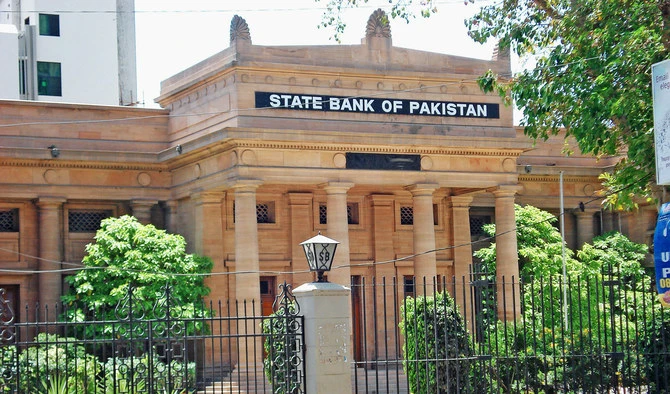
This undated file photo shows premises of the State Bank of Pakistan. (Shutterstock)
Short Url
Updated 13 November 2020
Follow

Pakistan central bank orders banks not to accept online payments for Indian content

  • The new directives will hit online payments for Direct to Home platforms like Zee5, an Indian video on demand service
  • Zee5 recently broadcast a fiery online series about a group of women who unleash revenge on cheating men that has sparked backlash in Pakistan

ISLAMABAD: Pakistan’s central bank has ordered banks to stop accepting online payments for media content from India with immediate effect, a circular issued this week said. 
The new directives will hit online payments for Direct to Home (DTH) platforms like Zee5, an Indian video on demand service that has recently broadcast the Pakistani online series ‘Churails.’
The fiery show about a group of women who set out to take revenge on cheating men, and which covers a range of taboo subjects, has sparked a backlash in Pakistan, where tough censorship rules prevent such shows from being broadcast on local television channels. 
“We are in receipt of a letter from the cabinet division, Government of Pakistan, whereby they have instructed to stop different modes of payments, including credit cards, for subscribing (to) Indian Content in Pakistan, including Zee5 video-on-demand service,” the state bank circular said. 
“In this regard, it is advised to ensure meticulous compliance of aforementioned instructions of Government of Pakistan and submit compliance status to SBP (by) Nov 13, 2020.”
Insiders say the order has come in the backdrop of the ‘Churails’ series, written and directed by British Pakistani film-maker Asim Abbasi. The show followed the story of four women who launch a detective agency to catch cheating husbands, behind the facade of a burqa boutique.
Abbasi announced on Twitter last month that the show had been removed from Zee5 for Pakistani viewers on the request of Pakistan’s electronic media regulator. The platform initially complied with the instructions only to later restore the show.
In response to a tweet announcing that Pakistani banks could no longer accept online payments for Indian media platforms, Abbasi tweeted “Laazim hai ke hum bhi dekehnge,” the title of a poem by Pakistani poet Faiz Ahmad Faiz, written to protest the oppressive regime of military ruler General Zia-ul-Haq. The poem was banned in Pakistan when it was first written, but has since developed a cult-following as a leftist song of resistance and defiance.

Anti-fuel smuggling drive boosts Pakistan revenues 82%, PM office says

Updated 19 December 2025
Follow

Anti-fuel smuggling drive boosts Pakistan revenues 82%, PM office says

  • Crackdown targets illegal petroleum trade using GPS tracking and pump registration
  • July–November gains cited as government intensifies tax, customs enforcement

ISLAMABAD: The Pakistani prime minister’s office said on Friday revenues from petroleum products rose 82% between July and November 2025 after a nationwide crackdown on fuel smuggling, as the government steps up enforcement to curb tax evasion and losses that have long strained public finances.

The increase was cited during a weekly performance review of the Federal Board of Revenue (FBR), where Prime Minister Shehbaz Sharif directed authorities to accelerate action against smuggling and tax evasion, according to a statement issued by the PM’s Office.

Fuel smuggling has been a persistent problem in Pakistan, where subsidised or untaxed petroleum products are often trafficked across borders or sold through unregistered pumps, depriving the state of revenue and distorting domestic energy markets. Successive governments have blamed the practice for billions of rupees in annual losses, while international lenders have repeatedly urged tighter enforcement as part of broader fiscal reforms.

“Every year the nation loses billions due to smuggling,” Sharif was quoted as saying in a statement, praising customs authorities for successful operations and noting that revenues from petroleum products increased by 82% from July to November 2025 compared with the same period last year.

The PM said stricter enforcement had brought several goods back into the formal economy, adding that there would be “no leniency” toward those involved in tax evasion or illegal trade.

Officials briefed the prime minister that Pakistan Customs has rolled out a nationwide enforcement framework, including GPS tracking of petroleum product transportation, registration of fuel stations through a digital monitoring system, and legal action against illegal machinery under updated petroleum laws.

The government has also instructed provincial administrations to cooperate fully with federal authorities in shutting down illegal petrol pumps, the statement said.

Sharif said enforcement efforts would continue until smuggling networks were dismantled and tax compliance improved, as the government seeks to strengthen revenues amid ongoing economic reforms.

Pakistan has struggled for years with weak tax collection and a narrow revenue base, forcing repeated bailouts from the International Monetary Fund. Smuggling of fuel, cigarettes, electronics and consumer goods has been identified by policymakers as a major obstacle to improving revenues and stabilising the economy.

Independent research shows that Pakistan loses an estimated Rs750 billion (about $2.7 billion) annually in tax revenue due to illicit trade and smuggling across sectors such as petroleum, tobacco and pharmaceuticals. Broader analyzes suggest total tax revenue losses linked to the informal economy and smuggling may reach as high as Rs3.4 trillion (around $12.1 billion) a year, roughly a quarter of the government’s annual tax targets.

Smuggled petroleum products alone are thought to cost the state about Rs270 billion (around $960 million) a year in lost revenue, underscoring why authorities have focused recent enforcement efforts on fuel tracking and pump registration.