

Pakistan says Panda bond launch to diversify funding, avoid overreliance on dollar

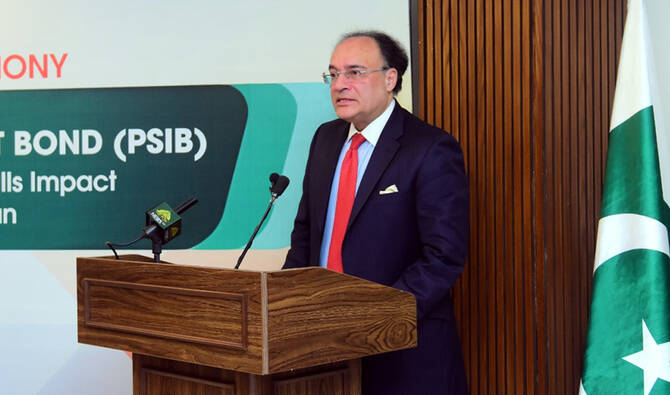
Federal Minister for Finance and Revenue, Muhammad Aurangzeb, addresses the signing ceremony of financing documents under the Pakistan Skills Impact Bond (PSIB) in Islamabad, Pakistan, on December 30, 2025. (Finance Ministry/File)
Short Url
Updated 30 December 2025
Follow

Pakistan says Panda bond launch to diversify funding, avoid overreliance on dollar

  • Pakistan has said it plans to issue its first-ever yuan-denominated Panda bond in January 2026
  • Pakistan minister identifies agriculture, minerals, AI as key areas to attract Chinese investment

ISLAMABAD: Pakistan’s Finance Minister Muhammad Aurangzeb said on Tuesday that launching its first-ever Panda bond would allow Islamabad to diversify its external financing sources away from overreliance on the US dollar, the Finance Division said. 

Pakistan has said it aims to launch the Panda bond— a yuan-denominated bond issued in China’s domestic market— by January next year. This highlights Pakistan’s efforts to find alternatives to dollar-denominated borrowing as global financial conditions tighten and Islamabad looks to escape a prolonged macroeconomic crisis. 

Panda bonds are renminbi-denominated instruments sold to Chinese investors by foreign governments or companies, offering issuers access to China’s deep domestic capital markets while reducing exposure to foreign-exchange volatility.

“He said the [Panda bond] issuance would allow Pakistan to tap into the second-largest and second-deepest capital market in the world, helping diversify funding sources away from overreliance on the US dollar by complementing existing access to euro and sukuk markets,” the Finance Division said. 

Aurangzeb was speaking to the state-owned China Global Television Network (CGTN), the Finance Division said. 

The finance minister acknowledged Pakistan had “previously underutilized” the opportunity to take advantage of the Panda bond, expressing optimism about investor interest in the Chinese market.

He said Pakistan remains hopeful of launching the bond ahead of the Chinese New Year, calling it a “landmark development” in the country’s external financing strategy. 

In response to a question about Pakistan’s economic priorities, Aurangzeb identified agriculture, minerals and mining, artificial intelligence and digital economy as key areas where Islamabad could attract Chinese investment. 

“He emphasized that beyond capital flows, this phase of cooperation places strong emphasis on knowledge transfer and technical support,” the Finance Division said. 


Pakistan’s deputy PM discusses ways to boost economic, trade ties with Iran

Updated 02 January 2026
Follow

Pakistan’s deputy PM discusses ways to boost economic, trade ties with Iran

  • Both countries agreed in August to increase bilateral trade to $10 billion by 2028
  • Pakistan and Iran have been working to stabilize relations after strained security ties

ISLAMABAD: Pakistan’s Deputy Prime Minister Ishaq Dar presided over a meeting to discuss economic and trade cooperation with Iran, the foreign office said on Friday, as the neighboring countries seek to expand ties.

The development took place during an inter-ministerial meeting on Pakistan-Iran bilateral relations chaired by Dar in Islamabad. Pakistan and Iran have been working to stabilize ties following a period of strained security relations.

Both countries have been working to enhance bilateral trade, setting up border markets and exploring barter trade to circumvent banking and currency restrictions. Sanctions and foreign exchange shortages remain key hurdles for Iran, making these alternative systems central to its trade strategy with Pakistan.

“The meeting reviewed ongoing cooperation across a range of sectors and discussed ways to further enhance economic and trade ties,” the foreign office said in a statement.

“The DPM/FM reaffirmed Pakistan’s commitment to deepening engagement with Iran in key priority areas.”

In December, the foreign ministers of Iran and Pakistan vowed to strengthen bilateral cooperation in trade and connectivity while working for regional peace.

Iranian President Dr. Masoud Pezeshkian also visited Pakistan in August, during which both countries signed agreements to increase bilateral trade to $10 billion by 2028.