Iranian foreign minister in Islamabad on two-day visit, border management to be discussed

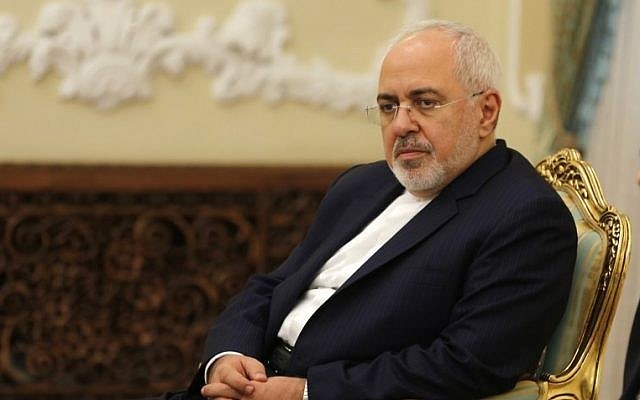
Iranian Foreign Minister Mohammad Javad Zarif seen during a meeting between the Iranian president and the North Korean foreign minister in Tehran, Iran, on August 8, 2018. (AFP/File)
Short Url
Updated 10 November 2020
Follow

Iranian foreign minister in Islamabad on two-day visit, border management to be discussed

  • Iranian media reported that Zarif would discuss effective management of a 900-km shared border between Pakistan and Iran
  • Last year Iran and Pakistan said they would form a joint quick reaction force to combat militant activity on their shared border

ISLAMABAD: Iranian Foreign Minister Mohammad Javad Zarif will visit Pakistan from November 10-11 to ‘deepen’ bilateral cooperation between the two countries, the Pakistani foreign office said on Tuesday.
Zarif’s visit to Pakistan forms part of regular high-level exchanges between the two countries, the foreign office said. This is his fourth visit to Pakistan in the last two and a half years.
Relations between Iran and Pakistan have been strained in the last two years, with both sides accusing each other of not doing enough to stamp out militants allegedly sheltering across the border.
“The Iranian Foreign Minister will have delegation-level talks with Foreign Minister Shah Mahmood Qureshi and have interaction with other dignitaries.” the foreign office said in a statement. “He will also call on Prime Minister Imran Khan.”
“Pakistan and Iran enjoy close, cordial relations founded on mutual trust and augmented by affinities of faith and culture,” the statement added. “Bilateral collaboration between the two countries has been growing in diverse fields. The Iranian leadership has been vocal in its steadfast support on the Jammu & Kashmir dispute.”
Iranian media reported that Zarif would lead a high-ranking political and economic delegation to discuss various issues, including effective management of a 900-km shared border with Pakistan.
Last year, Iran and Pakistan said they would form a joint quick reaction force to combat militant activity on their shared border. Pakistan began fencing its border with Iran in May 2019.
In May this year, Pakistan’s military chief General Qamar Javed Bajwa spoke to his Iranian counterpart Major General Mohammed Bagheri via telephone and discussed border fencing, improvement of border terminals, enhancing security and recent attacks on Pakistani troops near the border, among other issues, according to a statement from the Pakistani Army’s media wing.
The visit of the Zarif will help “further deepen bilateral cooperation and enhance understanding on various regional issues,” the foreign office said.
On Monday, Zarif said in a tweet: “Top-level talks on bilateral & regional issues with brothers FM @SMQureshiPTI, Army Chief Gen. Bajwa & PM @ImranKhanPTI tomo in Pakistan.”


ADB, Pakistan sign over $300 million agreements to undertake climate resilience initiatives

Updated 30 December 2025
Follow

ADB, Pakistan sign over $300 million agreements to undertake climate resilience initiatives

  • Pakistan ranks among nations most vulnerable to climate change and has seen erratic changes in weather patterns
  • The projects in Sindh and Punjab will restore nature-based coastal defenses and enhance agricultural productivity

ISLAMABAD: The Pakistani government and the Asian Development Bank (ADB) have signed more than $300 million agreements to undertake two major climate resilience initiatives, Pakistan’s Press Information Department (PID) said on Tuesday.

The projects include the Sindh Coastal Resilience Sector Project (SCRP), valued at Rs50.5 billion ($180.5 million), and the Punjab Climate-Resilient and Low-Carbon Agriculture Mechanization Project (PCRLCAMP), totaling Rs34.7 billion ($124 million).

Pakistan ranks among nations most vulnerable to climate change and has seen erratic changes in its weather patterns. In 2022, monsoon floods killed over 1,700 people, displaced another 33 million and caused over $30 billion losses, while another 1,037 people were killed in floods this year.

The South Asian country is ramping up climate resilience efforts, with support from the ADB and World Bank, and investing in climate-resilient infrastructure, particularly in vulnerable areas.

“Both sides expressed their commitment to effectively utilize the financing for successful and timely completion of the two initiatives,” the PID said in a statement.

The Sindh Coastal Resilience Project (SCRP) will promote integrated water resources and flood risk management, restore nature-based coastal defenses, and strengthen institutional and community capacity for strategic action planning, directly benefiting over 3.8 million people in Thatta, Sujawal, and Badin districts, according to ADB.

The Punjab project will enhance agricultural productivity and climate resilience across 30 districts, improving small farmers’ access to climate-smart machinery, introducing circular agriculture practices to reduce residue burning, establishing testing and training facilities, and empowering 15,000 women through skills development and livelihood diversification.

Earlier this month, the ADB also approved $381 million in financing for Pakistan’s Punjab province to modernize agriculture and strengthen education and health services, including concessional loans and grants for farm mechanization, Science, Technology, Engineering and Mathematics (STEM) education, and nursing sector reforms.