Hong Kong journalist charged as press freedom fears grow

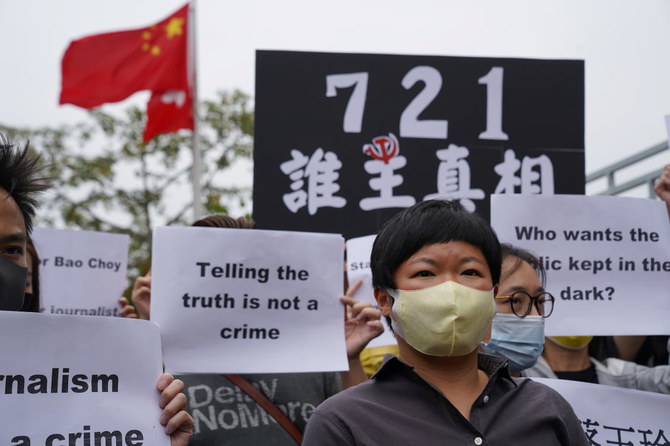
Choy Yuk-ling, above, was previously involved in the production of an investigative documentary into the behavior of Hong Kong police during last year’s anti-government protests. (Reuters)
Short Url
Updated 10 November 2020
Follow

Hong Kong journalist charged as press freedom fears grow

  • Choy Yuk-ling, a producer at public broadcaster Radio Television Hong Kong, was arrested earlier this month on charges of making false statements

HONG KONG: A Hong Kong journalist appeared in court Tuesday on charges of making false statements while obtaining information from a vehicle database, amid growing concerns that press freedom is at risk in the semi-autonomous Chinese city.
Choy Yuk-ling, a producer at public broadcaster Radio Television Hong Kong, was arrested earlier this month on charges of making false statements about why she was obtaining license plate information from a publicly accessible database.
She was previously involved in the production of an investigative documentary into the behavior of Hong Kong police during last year’s anti-government protests, after the force was accused of not intervening during a violent clash between protesters and a mob of men in a subway station.
Ahead of her court appearance, Choy told reporters the case was a matter related to public interest and press freedom in Hong Kong.
“There has been a very strong social understanding … that journalists are free to obtain public information for the sake of public interest,” she said. “I didn’t see any reason that the government has to restrict the flow of information.”
She said that many scholars, unions and lawyers have expressed concerns as to whether the police are using the law to suppress press freedom.
Members from an RTHK union, as well as supporters and pro-democracy activists, held up placards in support of Choy, some of which read “Journalism is not a crime” and “Without fear of favor.”
Choy’s case was adjourned until Jan. 14 to give the police more time to investigate, and she was released on bail.
Media groups are concerned Hong Kong’s new security law, which outlaws secession, subversion and foreign collusion to interfere in the city’s internal matters, could be used against journalist reporting on issues thought to be related to national security.
The US and others have denounced the law imposed by Beijing as an attack on Hong Kong’s autonomy and freedoms. The US State Department on Monday announced sanctions against additional Chinese officials over the crackdown.


Britain needs to step up defense spending faster, says Starmer

Britain's Prime Minister Keir Starmer takes part in a panel discussion in Munich, Germany. (AP file photo)
Updated 5 sec ago
Follow

Britain needs to step up defense spending faster, says Starmer

  • Britain’s budget watchdog, the Office for Budget Responsibility, said last year that raising defense spending to 3 percent of the GDP would cost an additional £17.3 billion a year ($24 billion) in 2029-30

LONDON: Britain should step up and accelerate its ​defense spending, Prime Minister Keir Starmer said on Monday, following a report that the government was considering bringing forward its target to spend 3 percent of economic output on defense.
Britain, which has warned of the risks posed by Russia, said in February 2025 that it would lift annual defense spending to 2.5 percent of the GDP by 2027 and aim for 3 percent in the next Parliament, which is expected to begin after an ‌election due in ‌2029.
The BBC reported that the government was ​now ‌exploring ways to ​reach the 3 percent target by 2029. It said no decision had been taken but the government recognized current plans would not cover rising defense costs.

HIGHLIGHT

The BBC reported that the government is ​now ‌exploring ways to ​reach the 3 percent target by 2029.

Asked whether he would bring the target forward to 2029, Starmer echoed comments he made at the Munich Security Conference, where he said Europe had united to support Ukraine with the supply of weapons and munitions and to strengthen military readiness.
“We need to step up. That means on ‌defense spending, we need to go faster,” ‌Starmer told reporters on Monday. “We’ve obviously made commitments ​already in relation to that, but ‌it goes beyond just how much you spend.”
Latest NATO estimates show ‌that Britain spent 2.3 percent of the GDP on defense in 2024, above the alliance’s 2 percent guideline. But like other European countries, it has faced US pressure to spend more to protect the continent. Struggling with high debt and spending commitments, the government last ‌year cut its international aid budget to fund the hike in defense spending to 2.5 percent of GDP but is yet to publish an investment plan with spending priorities, something that has frustrated the defense industry.
Britain’s budget watchdog, the Office for Budget Responsibility, said last year that raising defense spending to 3 percent of the GDP would cost an additional £17.3 billion a year ($24 billion) in 2029-30.
Finance Minister Rachel Reeves has struggled to stay on track with her plans to repair the public finances. The BBC said the Finance Ministry was believed to be cautious about the new defense spending proposals.
A government spokesperson said Britain was “delivering ​the largest sustained increase in defense ​spending since the Cold War.”