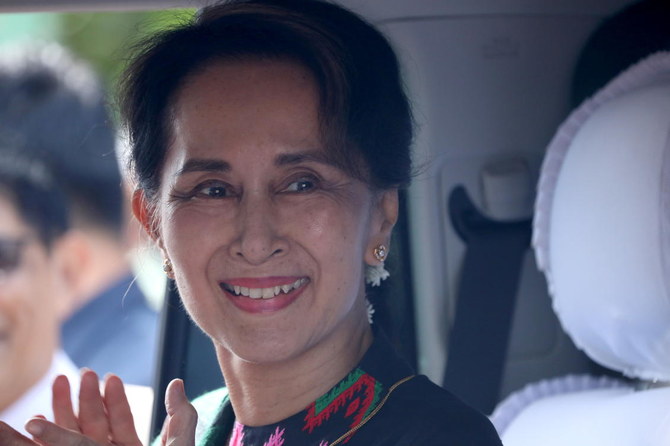
YANGON: Aung San Suu Kyi’s ruling National League for Democracy (NLD) said Monday it was confident of winning a landslide victory in Myanmar as official results trickled in following the weekend’s coronavirus-disrupted election.
Millions lined up for hours to cast their ballots on Sunday — only the second national election since the country emerged from outright military rule in 2011.
Nobel laureate Suu Kyi remains a heroine for many in the Bamar majority heartlands, in spite of a global reputation left in tatters by her handling of the Rohingya crisis and widespread disillusionment in many ethnic minority areas.
NLD supporters celebrated late into the night on Sunday — and hundreds more drove in convoys around the outskirts of Yangon Monday, wearing red and flying the party’s fighting peacock flag.
Party spokesman Myo Nyunt told AFP that information from party agents across the country suggested the NLD had “won a landslide victory.”
“We won’t only win the 322 seats we need to form a government, but we expect to break our 2015 record of 390.”
In 2015, the NLD won a landslide but was forced by the constitution into an uneasy power-sharing agreement with the military, which controls three key ministries and a quarter of parliamentary seats.
The military-aligned USDP opposition, Myanmar’s next biggest party, said it was still collecting information and would not comment.
Official confirmation of the overall result is not expected for another few days.
Spiralling coronavirus cases did not deter millions from voting on Sunday.
Face masks were compulsory, but crowds ignored strict physical distancing measures at many polling stations at a time when swathes of the country are in a lockdown.
Suu Kyi refused to delay the polls and many observers fear the day could have been one huge super-spreader event.
But voter Kyaw Min Han, 65, told AFP he had been “very impressed” with the government’s organization as well as polling station staff and volunteers.
Rights groups slammed the election, however, which saw nearly two million disenfranchised from an electorate of 37 million.
The polls were canceled in many ethnic minority areas for “security reasons” — while nearly all of the country’s remaining 600,000 Rohingya Muslims have long been stripped of citizenship and rights.
“A core principle of elections under international law is universal and equal suffrage and that is not what took place,” said Ismail Wolff from Fortify Rights.
In Washington, US Secretary of State Mike Pompeo called the election an “important step in the country’s democratic transition.”
But he highlighted some of the problems on Sunday, including the “disfranchisement of groups including Rohingya” and the cancelation of voting in some areas.
He also expressed US concern over “the large number of unelected seats constitutionally reserved for the military.”
The EU on Monday commended the high participation and peaceful voting but also called for the “full inclusion of all ethnic, religious and minority groups of the country, including the Rohingya community.”


Suu Kyi’s party confident of landslide victory in Myanmar polls
https://arab.news/r5stg
Suu Kyi’s party confident of landslide victory in Myanmar polls

- Nobel laureate Suu Kyi remains a heroine for many in the Bamar majority heartlands, in spite of a global reputation left in tatters by her handling of the Rohingya crisis
- NLD supporters celebrated late into the night on Sunday — and hundreds more drove in convoys around the outskirts of Yangon Monday, wearing red and flying the party’s fighting peacock flag


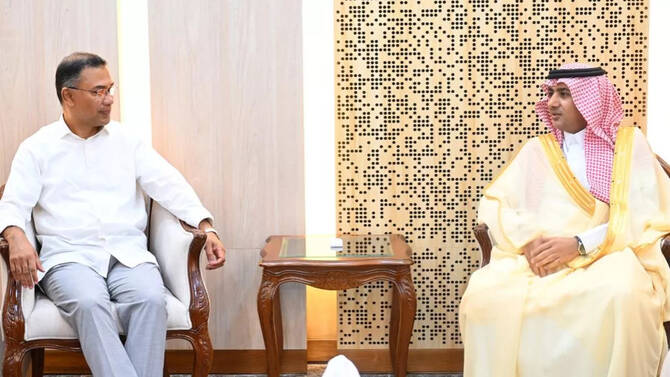
Saudi ambassador becomes first foreign envoy to meet Bangladesh’s new PM
- Tarique Rahman took oath as PM last week after landslide election win
- Ambassador Abdullah bin Abiyah also meets Bangladesh’s new FM
Dhaka: Saudi Arabia’s ambassador to Dhaka became on Sunday the first foreign envoy to meet Bangladesh’s new Prime Minister Tarique Rahman since he assumed the country’s top office.
Rahman’s Bangladesh Nationalist Party made a landslide win in the Feb. 12 election, securing an absolute majority with 209 seats in the 300-seat parliament.
The son of former Prime Minister Khaleda Zia and former President and BNP founder Ziaur Rahman, he was sworn in as the prime minister last week.
The Saudi government congratulated Rahman on the day he took the oath of office, and the Kingdom’s Ambassador Abdullah bin Abiyah was received by the premier in the Bangladesh Secretariat, where he also met Bangladesh’s new foreign minister.
“Among the ambassadors stationed in Dhaka, this is the first ambassadorial visit with Prime Minister Tarique Rahman since he assumed office,” Saleh Shibli, the prime minister’s press secretary, told Arab News.
“The ambassador conveyed greetings and best wishes to Bangladesh’s prime minister from the king and crown prince of Saudi Arabia … They discussed bilateral matters and ways to strengthen the ties among Muslim countries.”
Rahman’s administration succeeded an interim government that oversaw preparations for the next election following the 2024 student-led uprising, which toppled former leader Sheikh Hasina and ended her Awami League party’s 15-year rule.
New Cabinet members were sworn in during the same ceremony as the prime minister last week.
Foreign Minister Khalilur Rahman is a former UN official who served as Bangladesh’s national security adviser during the interim government’s term.
He received Saudi Arabia’s ambassador after the envoy’s meeting with the prime minister.
“The foreign minister expressed appreciation for the Saudi leadership’s role in promoting peace and stability in the Middle East and across the Muslim Ummah. He also conveyed gratitude for hosting a large number of Bangladeshi workers in the Kingdom and underscored the significant potential for expanding cooperation across trade, investment, energy, and other priority sectors, leveraging the geostrategic positions of both countries,” the ministry said in a statement.
“The Saudi ambassador expressed his support to the present government and his intention to work with the government to enhance the current bilateral relationship to a comprehensive relationship.”
Around 3.5 million Bangladeshis live and work in Saudi Arabia. They have been joining the Saudi labor market since 1976, when work migration to the Kingdom was established during the rule of the new prime minister’s father.
Bangladeshis are the largest expat group in the Kingdom and the largest Bangladeshi community outside Bangladesh and send home more than $5 billion in remittances every year.


