

Tourism-reliant Bali turns tide on pandemic

1 / 3
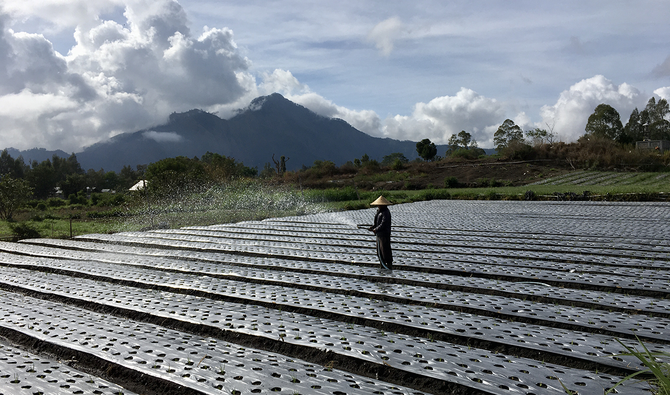
Tourism in Bali, an island famous for its beaches, bore the brunt of the coronavirus pandemic. (AN Photo/Ismira Lutfia Tisnadibrata)
2 / 3
An international travel ban and an absence of foreign visitors to the country forced him and dozens of his employees to return to their village on the foothills of Mount Batur in the northeast of Bali. (AN Photo/Ismira Lutfia Tisnadibrata)
3 / 3
Balinese tour operators have turned to novel methods to weather the storm of the coronavirus pandemic as health measures force business closures across the island. (AN Photo/Ismira Lutfia Tisnadibrata)
Short Url
Updated 10 November 2020
Follow

Tourism-reliant Bali turns tide on pandemic

  • Travel workers return to island’s farms in bid to weather economic storm

DENPASAR: Balinese tour operators have turned to novel methods to weather the storm of the coronavirus pandemic as health measures force business closures across the island.

It did not take long for the outbreak to take a toll on I Kadek Didi Suprapta’s business as a tour operator in Indonesia.

An international travel ban and an absence of foreign visitors to the country forced him and dozens of his employees to return to their village on the foothills of Mount Batur in the northeast of Bali and away from the southern part of the island, where most of its tourism hot spots are located.

“It never crossed my mind that I would be back at my parents’ house in the village. I had to shut down my business as tourism abruptly stopped and we no longer had clients,” Suprapta told Arab News.

Towards the end of March after reporting its first coronavirus case, Indonesia’s government issued a travel restriction order which included the suspension of free visas for foreigners.

The restrictions brought tourism — a lifeline for the island’s economy — to a standstill.

Tourism in Bali, an island famous for its beaches, bore the brunt of the coronavirus pandemic.

The sector, which normally contributes 55 percent to regional gross domestic product, previously survived and recovered from two terrorist attacks in 2002 and 2005, the SARS and rabies outbreaks, and volcanic eruptions from the famous Mount Agung.

But eight months into the pandemic, islanders are yet to see light at the end of the tunnel.

Several closed shops, hotels and restaurants line empty and quiet streets which would normally be bursting at the seams with tourists.

The cafes along the main street in Ubud’s Tegallalang village, which offers a view to the lush rice terrace fields, as well those along the Legian Street, where the first Bali bomb attack took place, were shut down, with the street housing them wearing a deserted look.

Footfall in Bali’s Jimbaran, Kuta and Seminyak beaches is also low, except for a few locals enjoying uninterrupted access without the usual crowd of tourists.

Meanwhile, farmers in Gobleg village in the northern district of Buleleng said they had also felt the impact of the pandemic after demand for their vegetables, which were mostly grown for the tourism sector, plummeted.

“Hotels, restaurants and supermarkets absorbed about 90 percent of our vegetables,” said Gede Suardita from Gobleg village, who left the tourism industry 20 years ago to become a farmer.

Suardita added that the village also saw the return of nearly 1,200 residents who were previously employed in the tourism sector.

Suprapta agreed and said the retail space where his office was located has now been converted into a laundry shop, while he has switched to earning a living by opening a convenience store in Songan village near Lake Batur.

He says he used his IT skills to develop an app and introduced farmers to digital marketing. The app connects his former employees-turned-shallot farmers with customers and cuts out the middleman along the distribution chain.

According to data from the Bali Tourism Agency, 2,667 people in the sector were dismissed from their jobs, while 73,631 are on a furlough scheme following a freeze of the tourism sector. At the same time, the provincial government lost 9.57 trillion Indonesian rupiahs ($679 million) in revenue from tourism every month.

However, a public holiday to commemorate the birthday of Prophet Muhammad (peace be upon him) on Thursday and the government allowing Wednesday and Friday off as collective leave days, offered Bali a respite due to a steady flow of domestic tourists from other parts of Indonesia holidaying on the island during the long weekend.

“We had up to 1,000 domestic tourists during the five-day holiday. The hotels along Kuta and Jimbaran beaches were full again. We are grateful that the central government has declared the collective leave days,” I Putu Astawa, head of the Bali Tourism Agency said in a virtual press conference from Seminyak.

Meanwhile, Deputy Foreign Minister Mahendra Siregar said the central government was working with Bali’s provincial government and other agencies to secure the reopening of the island to foreign tourists.

“We hope to do it in a pilot project involving a number of selected countries by the end of the year,” Siregar added.

The provincial government had intended to reopen the island for foreign tourists on Sept. 11, but the plan was shelved after the central government said Indonesia would not be welcoming foreign tourists until the end of the year.

However, Balinese have learned to avoid relying on tourism for an income, despite the sector being the island’s main economic driver for at least two or three generations.

“There are some lessons learned from this pandemic. We have learned that the agriculture sector is resilient since it absorbs the workforce from all kinds of background and education levels,” Astawa said.

In Gobleg, the villagers who returned have become farmers, said Suardita, who is part of the island’s Petani Muda Keren (Cool Young Farmers) network.

The network is using the tourism hiatus to turn the tide on the pandemic in the form of farming. The customs and culture of agriculture pushed forward Bali’s popularity as a tourist destination several decades ago.

But the quick money from tourism may lure those who found temporary solace in farming back to the tourism sector, said I Nengah Sumerta, also an activist at Petani Muda Keren.

“I think 90 percent of those who have benefited from tourism would return when tourism revives in two or three years. We have been so hammered by tourism since it is the easiest way to earn money compared to farming,” he told Arab News.


Poland expects trade with Saudi Arabia to grow to $10 billion, finance and economy minister tells Arab News

Updated 10 February 2026
Follow

Poland expects trade with Saudi Arabia to grow to $10 billion, finance and economy minister tells Arab News

  • Andrzej Domanski says his country’s companies are looking for reliable partners like Saudi Arabia
  • Highlights opportunities in clean energy, ICT, food security and construction cooperation on Riyadh visit

RIYADH: Saudi Arabia’s pace of transformation, its economic ambition under Vision 2030, and its role as Poland’s biggest Middle Eastern trading partner are driving a new phase in bilateral relations, Andrzej Domanski, Poland’s finance and economy minister, has said.

Speaking to Arab News during a visit to Riyadh on Monday, Domanski discussed how the two nations might expand their trade ties, the sectors where Polish businesses enjoy an edge, and the potential for broadening the bilateral relationship.

“We have better and better economic relations with the Kingdom of Saudi Arabia. We will reach $10 billion in our trade,” Domanski said, describing Saudi Arabia as a “reliable partner” at a time when Polish companies are actively seeking diversification and new markets.

His visit comes as Saudi-Polish economic ties deepen beyond a historically oil-focused relationship into a broader partnership spanning energy transition, technology, construction, food security and potentially defense cooperation.

This evolution mirrors Saudi Arabia’s Vision 2030 diversification drive and Poland’s emergence as one of Europe’s fastest-growing large economies.

Domanski said Riyadh itself offered a powerful visual symbol of Saudi Arabia’s economic momentum.

“I must say that it’s my first visit to Riyadh and I’m really impressed,” he said. “I’m impressed by the pace of development. The thousands of cranes in the city. It is also a proof of how quickly Saudi Arabia is developing.”

Bilateral trade between Saudi Arabia and Poland has expanded rapidly in recent years, driven largely by energy flows. Saudi Arabia is now Poland’s main crude-oil supplier, accounting for roughly 60 percent of Poland’s oil imports.

Trade volumes have risen from about $7 billion in 2022 to around $8.5 billion in 2023, with Domanski predicting the $10 billion mark will soon be reached.

“We are, of course, importing crude oil. But we’d like to together search for new business opportunities for both Saudi and, of course, Polish companies,” he said.

Domanski argued that growth prospects make the country an attractive destination for Saudi investment.

Andrzej Domanski, Polish minister of finance and economy. (AN photo by Loai Elkelawy)

“On our side, we are also doing pretty well. We are the fastest growing large European economy,” he said. “This year we will work in the G20 format. This is because last year we joined the Group of the 20 biggest economies in the world. And we are frankly proud of that.”

Inflation, he added, has fallen sharply. “Inflation went down significantly, 2.5 percent. Very reasonable. A reasonable level. Investment started to pick up,” he said, pitching Poland as a stable European base for Saudi capital.

A recurring theme of Domanski’s visit was the alignment between Poland’s development priorities and Saudi Arabia’s Vision 2030 agenda.

“Our companies, our economy, are fully aligned with the ambitious Vision 2030 that is realized here,” he said.

Energy cooperation remains central, anchored by Saudi Aramco’s stake in the Lotos refinery in Gdansk — the largest Saudi direct investment in Poland — which underpins long-term crude-supply contracts and Poland’s energy-security strategy.

But Domanski stressed that the future lies increasingly in clean energy.

“It’s worth noting that right now Poland is building onshore capabilities, offshore capabilities, solar capabilities. And we are constructing the first Polish nuclear power plant,” he said.

“We want to diversify from coal into nuclear and renewables. And I believe that our Saudi partners could participate in this clean energy transformation of the Polish economy.”

The shift reflects broader cooperation under way between Warsaw and Riyadh on green energy and hydrogen, dovetailing Poland’s decarbonization plans with Saudi Arabia’s push to develop non-oil sectors.

Technology and digital services emerged as one of the most promising areas for expansion, with Poland positioning itself as a provider of high-end IT talent for Saudi Arabia’s digital and AI-driven projects.

“ICT solutions. We have really great companies that provide the best solutions. They are already well recognized in Western European countries. They have their footprint here in Riyadh,” Domanski said.

“Having said that, they still lack scale. So my visit here is also to discuss that kind of business opportunity.”

Polish officials frequently point to the country’s deep pool of programmers and cybersecurity specialists. Warsaw has signaled plans for dozens of Polish firms to establish regional headquarters in Saudi Arabia, particularly in AI, cybersecurity and digital infrastructure.

Domanski underscored Poland’s strengths in specific niches.

“I believe that we are really top class,” he said. “For example, in cybersecurity, we really have companies that are providing the best solutions for smart cities in Western Europe.

“But, I believe there is lots of room for strengthening this presence and the cooperation with Saudi partners.”

Food security is another area where Poland sees scope for joint ventures and long-term cooperation. “We are quite an important food producer,” Domanski said. “We have knowhow. We have land. We have a growing sector.

“And I believe that, for example, through joint ventures with our Saudi partners, we could establish a long lasting cooperation in this sector.”

The construction sector also featured prominently, reflecting the scale and pace of development under way across the Kingdom.

“We have lots of contractors that proved to be very efficient and contractors that keep timelines and realize how it is important to deliver on time,” Domanski said.

“And I believe that here, seeing how quickly Saudi Arabia is developing, those contractors could also help in your development.”

Domanski highlighted the importance of institutional frameworks and regular high-level engagement. During his visit, discussions focused on communication mechanisms and a formal framework for cooperation.

“First of all, we need communication and we need to have a frame for cooperation,” he said.

Andrzej Domanski, Polish minister of finance and economy, with Arab News report Lama Alhamawi. (AN photo by Loai Elkelawy)

“So this is why I’m really glad that together with the minister of trade, minister of investment, we were discussing both communication, and we’d like to see each other, invite each other more often, as this is very, very, important.

“And we’d like to set, also, the frame for cooperation. And such a document will be signed today. So we will decide who will be responsible for some particular areas and when we would like some results to be delivered.”

The move builds on existing structures, including the Saudi-Polish Coordination Council and a Saudi-Polish Business Council, as well as a new memorandum of understanding signed in January to strengthen the partnership’s strategic character.

Domanski said he hopes Saudi delegations will soon travel to Poland, including for major economic and reconstruction-focused events.

“I do hope that our friends from Saudi Arabia will join us during our economic congress, which will take place in Katowice in the Silesia region, the most industrialized region of Poland, at the end of June,” he said.

He also highlighted Poland’s role in hosting a major summit on Ukraine.

“We will host the Ukrainian Recovery Conference, which is a truly international event. And we would also love to see our Saudi friends to be there,” he said.

“I’ve invited ministers to participate in those events.”

While his focus remains economic, Domanski did not rule out expanding cooperation into defense, particularly as Poland ramps up military spending and industrial capacity.

“Unfortunately I couldn’t attend,” he said, referring to the World Defense Show currently taking place in Riyadh. “Having said that, it’s worth noting that Poland spends close to 5 percent of our GDP on defense. We intend to build a very strong defense industry in Poland.

“We are, of course, supporting, building a strong defense industry in Europe. But of course, I’m mostly focused on Poland. And therefore I believe that we can provide really, very good solutions for and very good equipment that could be presented here, and hopefully we can develop our cooperation also in this sector.”

For Domanski, Saudi Arabia represents not only Poland’s most important economic partner in the Arab world, but a gateway to diversification and scale.

“Polish companies are getting larger and larger,” he said. “And, of course, are looking for diversification, looking for new markets and for reliable partners like Saudi Arabia.”