CAPE CANAVERAL, Florida: Four astronauts headed to Kennedy Space Center on Sunday for SpaceX’s second crew launch, coming up next weekend.
For NASA, it marks the long-awaited start of regular crew rotations at the International Space Station, with private companies providing the lifts. There will be double the number of astronauts as the test flight earlier this year, and their mission will last a full six months.
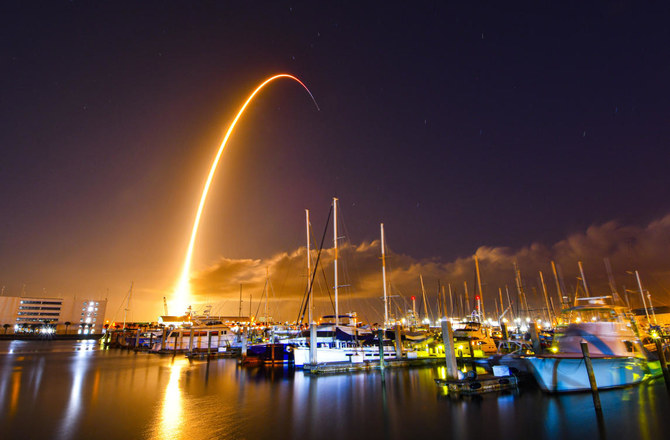
The crew of three Americans and one Japanese are scheduled to rocket away Saturday night. It will be a speedy trip to the space station, a six-orbit express lasting under nine hours.
The astronauts have named their Dragon capsule Resilience given all the challenges of 2020: coronavirus and social isolation, civil unrest and a particularly difficult election and campaign season. They have been in quarantine for a week and taking safety precautions — masks and social distancing — long before that.
The four will remain in orbit until spring, when their replacements arrive aboard another SpaceX Dragon capsule. The cargo version of the capsule also will keep making regular deliveries of food and supplies.
SpaceX’s Benji Reed said the company expects to launch seven Dragons over the next 14 months: three for crew and four for cargo.
“Every time there’s a Dragon launch, there will be two Dragons in space,” said Reed, director of crew mission management.
NASA’s other hired taxi service, meanwhile, Boeing, isn’t expected to fly its first crew until next summer. The company plans a second unpiloted test flight in a couple months; the first one suffered so many software problems that the Starliner capsule failed to reach the space station.
NASA turned to private companies for space station deliveries — cargo, then crew — following the shuttle fleet’s retirement in 2011. US astronauts kept hitching rides on Russian rockets at increasingly steep prices. The last Soyuz ticket cost NASA $90 million.
SpaceX finally ended NASA’s nearly decade-long launch drought for astronauts last May, successfully delivering a pair of test pilots to the space station from Kennedy for a two-month stay. The returning capsule was scrutinized by SpaceX following its splashdown, resulting in a few changes for this second flight.
Engineers discovered excessive erosion in the heat shield from the searing reentry temperatures; the company shored up the vulnerable section for the upcoming launch, said SpaceX’s Hans Koenigsmann, a vice president. Improvements also were made to the altitude-measuring system for the parachutes, after the chutes opened a little too low on the first astronaut flight. More recently, the Falcon rocket had two engines replaced because of contamination from a red lacquer used in processing. The engine swaps delayed the flight two weeks.
Perhaps the biggest surprise from the first SpaceX crew flight was all the private boats full of gawkers who surrounded the capsule in the Gulf of Mexico following splashdown in August. Koenigsmann promises a bigger keep-out zone and more patrols for future returns.
The second crew has three veteran fliers and one first-timer:
— Commander Mike Hopkins, 51, is an Air Force colonel and former space station resident who grew up on a hog and cattle farm in Missouri.
— Navy Cmdr. Victor Glover, 44, is the pilot and the lone space rookie; he’s from the Los Angeles area and will be the first African-American astronaut to move into the space station for a long stay.
— Shannon Walker, 55, a Houston-born-and-raised physicist, also has lived before on the space station; her husband, retired astronaut Andrew Thomas, helped build the outpost.
— The Japanese Space Agency’s Soichi Noguchi, 55, another former station resident, will become the first person in decades to launch on three kinds of rocketships; he’s already flown on a US space shuttle and Russian Soyuz.
They will join two Russians and one American who arrived at the space station last month from Kazakhstan.
Hopkins and his crew will ride to the launch pad in Teslas — SpaceX founder Elon Musk’s other company — in spacesuits color-coordinated with the spacecraft. But beneath all the good looks is “lots of amazing capability,” according to Glover.
“It’s a very sleek capsule. But it’s got the advantage of having great leaps in technology since the last time we built spacecraft here in this country,” Walker said in a recent interview with The Associated Press.
Noguchi, who along with Walker joined the crew just this year, is particularly excited about riding a Dragon. In Japan, the dragon is an esteemed mythical creature — “almost a ride to the heaven.”
“It’s quite a privilege to learn how to train the Dragon actually, how to ride a Dragon,” he said. “SpaceX did pretty good job teaching from scratch to dragon rider in six months.”

Astronauts head to launch site for SpaceX’s 2nd crew flight
https://arab.news/9z5yq
Astronauts head to launch site for SpaceX’s 2nd crew flight
Rising energy prices from the Iran war could help Russia pay for fighting in Ukraine
- Prices for Russia’s oil exports have risen from under $40 per barrel as recently as December to about $62 per barrel
- The halt in production of ship-borne liquefied natural gas, or LNG, by major supplier Qatar will sharply increase global competition for available cargoes — including those from Russia
FRANKFURT: The Iran war’s disruption of Middle East oil and gas supplies and soaring prices are strengthening Russia’s ability to profit from its energy exports, a pillar of the Kremlin’s budget and a key to paying for its own war in Ukraine.
Prices for Russia’s oil exports have risen from under $40 per barrel as recently as December to about $62 per barrel — first on fears of war and then due to interruption of almost all tanker traffic through the Strait of Hormuz, the conduit for some 20 percent of the world’s oil consumption.
Russian oil still trades at a considerable discount to international benchmark Brent crude, which has risen above $82 from the closing price of $72.87 on Friday, the eve of the attack on Iran by the US and Israel. However, Russian crude is now above the benchmark of $59 per barrel that was assumed in the Russian Finance Ministry’s budget plan for 2026. Oil and gas tax revenues account for up to 30 percent of the Russian federal budget.
Additionally, the halt in production of ship-borne liquefied natural gas, or LNG, by major supplier Qatar will sharply increase global competition for available cargoes — including those from Russia.
A change in fortunes
Russia had seen state oil and gas revenue fall to a four-year low of 393 billion rubles ($5 billion) in January and the budget shortfall of 1.7 trillion rubles ($21.8 billion) for that month was the biggest on record, according to Finance Ministry figures.
The lower revenue was due to weaker global prices and to deep discounts fueled by US and European Union hindrance of Russia’s “shadow fleet” of tankers with obscure ownership used sell oil to its biggest customers, China and India, in defiance of a Western-imposed price cap and sanctions on Russia’s two biggest oil companies, Lukoil and Rosneft.
Economic growth has stagnated as massive military spending has leveled off. President Vladimir Putin has resorted to tax increases and increased borrowing from compliant domestic banks to keep state finances on an even keel in the fifth year of the war.
“Russia is a big winner from the war-related energy turmoil,” said Simone Tagliapietra, energy expert at the Bruegel think tank in Brussels. “Higher oil prices mean higher revenues for the government and therefore stronger capability to finance the war in Ukraine.”
Amena Bakr, head of Middle East and OPEC+ insights at data and analytics firm Kpler, writes: “With Middle East barrels facing logistical disruption, both India and China face strong incentives to deepen reliance on Russian supply.”
Additionally, the price of future delivery of natural gas has skyrocketed in Europe, raising questions about EU plans to put an end to imports of Russian LNG by 2027 — reviving bad memories of a 2022 energy crunch after Moscow cut off most supplies of pipeline gas due to the war.
Length of strait’s closure is the key factor
Much depends on how long the Strait of Hormuz remains closed to most ship traffic, said Alexandra Prokopenko, an expert on the Russian economy at the Carnegie Russia Eurasia Center in Berlin.
A quick exit from the conflict would return Brent prices to roughly $65 per barrel and “a short-lived spike would not fundamentally change” Russia’s budget picture, she said. A middle scenario in which some shipping resumes and oil stabilizes at around $80 per barrel would give Russia “some fiscal relief,” depending on how long the higher prices last.
A long-term closure with Iranian strikes damaging refineries and pipelines could send oil to $108 per barrel, accelerate inflation and push Europe to the edge of recession. “This scenario would bring the largest windfall to Russia,” she said.
Even several weeks of interruption in Gulf LNG could lead to calls in Europe to suspend plans to ban new Russian supply contracts after April 25, said Chris Weafer, CEO of Macro-Advisory Ltd. consultancy.
“The EU is under even more pressure to work with the US to find a solution to the Ukraine conflict and, very likely, to consider easing the plan for a total block for Russian oil and gas imports,” he said. “Countries such as Hungary and Slovakia and those who have been big buyers of Russian LNG, will press for that review.”
In any case “the Russian federal budget will have a much better result in March,” Weafer said, due to lower discounts on Russian oil and “because there are eager buyers of Russian oil and oil products.”
Putin says European leaders have only themselves to blame
Putin said European governments were to blame for their energy predicament.
“What is happening today on the European markets, is, of course, above all the result of the mistaken policies of European governments in the energy sphere,” Putin said Wednesday on state TV.
He said that “maybe it would be more beneficial for us to halt (gas) supplies now to the European market, and leave for the markets that are opening and get established there,” adding that “it’s not a decision, but in this case what’s called ‘thinking out loud.’”
Putin said he would have the government to look into the issue.
Russia’s Deputy Prime Minister Alexander Novak said Wednesday that Russian oil was “in demand” and that Russia was ready to increase supplies to China and India, the Tass news agency reported.
The head of Russia’s sovereign wealth fund, Kirill Dmitriev, took a dig at European Commission President Ursula von der Leyen and EU foreign policy chief Kaja Kallas, writing on X that “surely the wise Ursula and Kaja have a backup LNG plan. Or maybe not.”
Belgium, France, the Netherlands and Spain have continued to import around 2 billion cubic meters of Russian LNG per month, and on top of that Hungary imports 2 billion cubic meters a month through the Turkstream pipeline across the Black Sea, Tagliapietra said. That would amount to 45 billion cubic meters in 2026, 15 percent of total gas demand for this year.
It’s “not easy to replace this in case the LNG market gets tighter with continued shutdowns in Qatar,” he said.


