

‘Shame for my country’: Rohingya excluded from Myanmar election

1 / 2
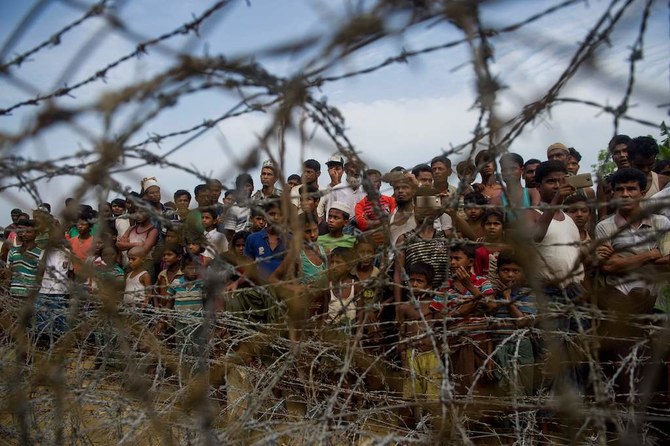
In this file photo taken on April 25, 2018, Rohingya refugees gather in the "no man's land" behind Myanmar's boder lined with barb wire fences in Maungdaw district, Rakhine state bounded by Bangladesh. (AFP)
2 / 2
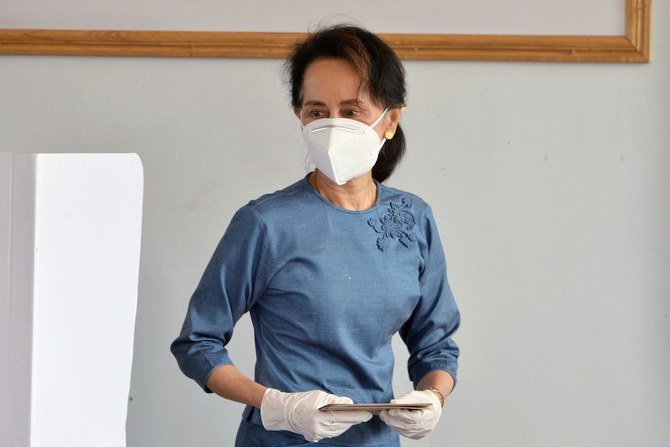
In this file photo taken on October 29, 2020, Myanmar's State Counsellor Aung San Suu Kyi casts an advance vote at a polling station in Naypyidaw ahead of the November 8 general election. (AFP)
Short Url
Updated 08 November 2020
Follow

‘Shame for my country’: Rohingya excluded from Myanmar election

  • Millions of refugees housed in Bangladesh face ‘miserable’ lives, lack basic rights

DHAKA: Myanmar has excluded more than 1.1 million Rohingya refugees from voting as the country went to the polls for general elections on Sunday.

Many Rohingya, forming the world’s largest refugee settlement in neighboring Bangladeshi city Cox’s Bazar, said they felt “anguished” after being deprived of their rights.

“I have never been able to exercise my voting rights in Myanmar’s elections. I don’t know whether I will be able to do so in my lifetime,” Nurul Amin, 32, a Rohingya community leader from the Kutupalang refugee camp, told Arab News.

“This voting right is very significant for us as, without it, we can’t avail any other citizenship rights. There is no opportunity to run any business and enroll our children in government-run schools and colleges,” the father of three added.

Amin is among a majority of refugees in Cox’s Bazar demanding the restoration of their citizenship rights, including the right to vote in Myanmar’s elections.

Bangladesh is hosting hundreds of thousands of Rohingya who fled from persecution at the hands of the Myanmar military in the Buddhist-majority country.

The Rohingya endured decades of abuse and trauma in Myanmar, beginning in the 1970s, when hundreds of thousands sought refuge in Bangladesh.

Between 1989 and 1991, an additional 250,000 fled when a military crackdown followed a popular uprising and Burma was renamed Myanmar.

In 1992, Bangladesh and Myanmar agreed on a repatriation deal that led to thousands of Rohingya returning to Rakhine State.

The latest Rohingya exodus to Bangladesh resumed in August 2017 following a military crackdown on the ethnic minority group in the country.

Sunday’s elections are Myanmar’s second since the end of a long-time military dictatorship.

Recalling the trauma of past events, 42-year-old Ayub Khan, a Rohingya refugee from Kutupalang camp, said he felt “non-existent” after being excluded from the voting process.

“I have served my community as a chairman for two terms, but I couldn’t vote during the last national election since the government withdrew our citizenship rights. It’s our fundamental right, and we want it back when our repatriation to Myanmar begins,” Khan told Arab News.

“My father voted in the 1978 Myanmar election. How can I be considered an outsider when we have been living there for generations?”

The Myanmar government denies Rohingya citizenship and has labeled them “Bangla intruders.” Authorities even excluded the minority group from the 2014 census.

Temporary identity cards issued to Rohingya were also canceled just before the last general election in 2015, making them ineligible to vote.

“According to Myanmar government data, we don’t have any existence as we were excluded from the latest census. I already spent half of my life with this discrimination, but I want to provide my children with a good education. In the current situation, I can’t make my dream true,” said Rohingya refugee Ayesha Bibi, a 37-year-old mother of three.

Fatema Begum, 47, agreed and expressed her frustration at Myanmar’s latest move.

“Myanmar has an elected government now, but we don’t have any representation in that process. It’s a shame for my country," Begum said.

“We hope the new government will expedite our repatriation process and restore our rights. We are experiencing a miserable life in the refugee camps.”

Experts in Bangladesh said that Rohingya could not take part in the election since their “political rights” have been “ignored by the authorities.”

Humayun Kabir, former Bangladeshi ambassador to the US, told Arab News: “Refugees can take part in their homeland’s election process only if the authorities register them and introduce special mechanisms to cast refugee votes.”

In a statement on Friday, UN Secretary-General Antonio Guterres called for a “peaceful, orderly and credible” election process in Myanmar and expressed hope that it might lead to refugees returning “in safety and dignity.”

However, Human Rights Watch (HRW) expressed doubts about Myanmar’s ability to conduct free and fair elections.

“The election can’t be free and fair so long as a quarter of the seats are reserved for the military, access to state media isn’t equal, government critics face censorship or arrest and Rohingya are denied the vote,” Brad Adams, Asia director of HRW, said in a statement.


Shooter kills 9 at Canadian school and residence

Updated 53 min 16 sec ago
Follow

Shooter kills 9 at Canadian school and residence

  • The shooter was found dead with an apparent self-inflicted gunshot wound
  • A total of 27 people were wounded in the shooting, including two with serious injuries

TORONTO: A shooter killed nine people and wounded dozens more at a secondary school and a residence in a remote part of western Canada on Tuesday, authorities said, in one of the deadliest mass shootings in the country’s history.
The suspect, described by police in an initial emergency alert as a “female in a dress with brown hair,” was found dead with an apparent self-inflicted gunshot wound, officials said.
The attack occurred in Tumbler Ridge, British Columbia, a picturesque mountain valley town in the foothills of the Rockies.
A total of 27 people were wounded in the shooting, including two with serious injuries, the Royal Canadian Mounted Police said in a statement.
Prime Minister Mark Carney said he was “devastated” by the “horrific acts of violence” and announced he was suspending plans to travel to the Munich Security Conference on Wednesday, where he had been set to hold talks with allies on transatlantic defense readiness.
Police said an alert was issued about an active shooter at Tumbler Ridge Secondary School on Tuesday afternoon.
As police searched the school, they found six people shot dead. A seventh person with a gunshot wound died en route to hospital.
Separately, police found two more bodies at a residence in the town.
The residence is “believed to be connected to the incident,” police said.
At the school, “an individual believed to be the shooter was also found deceased with what appears to be a self?inflicted injury,” police said.
Police have not yet released any information about the age of the shooter or the victims.
“We are devastated by the loss of life and the profound impact this tragedy has had on families, students, staff, and our entire town,” the municipality of Tumbler Ridge said in a statement.
Tumbler Ridge student Darian Quist told public broadcaster CBC that he was in his mechanics class when there was an announcement that the school was in lockdown.
He said that initially he “didn’t think anything was going on,” but started receiving “disturbing” photos about the carnage.
“It set in what was happening,” Quist said.
He said he stayed in lockdown for more than two hours until police stormed in, ordering everyone to put their hands up before escorting them out of the school.
Trent Ernst, a local journalist and a former substitute teacher at Tumbler Ridge, expressed shock over the shooting at the school, where one of his children has just graduated.
He noted that school shootings have been a rarity occurring every few years in Canada compared with the United States, where they are far more frequent.
“I used to kind of go: ‘Look at Canada, look at who we are.’ But then that one school shooting every 2.5 years happens in your town and things... just go off the rails,” he told AFP.

‘Heartbreak’ 

While mass shootings are extremely rare in Canada, last April, a vehicle attack that targeted a Filipino cultural festival in Vancouver killed 11 people.
British Columbia Premier David Eby called the latest violence “unimaginable.”
Nina Krieger, British Columbia’s minister of public safety, said it was “one of the worst mass shootings in our province’s and country’s history.”
The Canadian Olympic Committee, whose athletes are competing in the 2026 Winter Games in Italy, said Wednesday it was “heartbroken by the news of the horrific school shooting.”
Ken Floyd, commander of the police’s northern district, said: “This has been an incredibly difficult and emotional day for our community, and we are grateful for the cooperation shown as officers continue their work to advance the investigation.”
Floyd told reporters the shooter was the same suspect police described as “female” in a prior emergency alert to community members, but declined to provide any details on the suspect’s identity.
The police said officers were searching other homes and properties in the community to see if there were additional sites connected to the incident.
Tumbler Ridge, a quiet town with roughly 2,400 residents, is more than 1,100 kilometers (680 miles) north of Vancouver, British Columbia’s largest city.
“There are no words sufficient for the heartbreak our community is experiencing tonight,” the municipality said.