

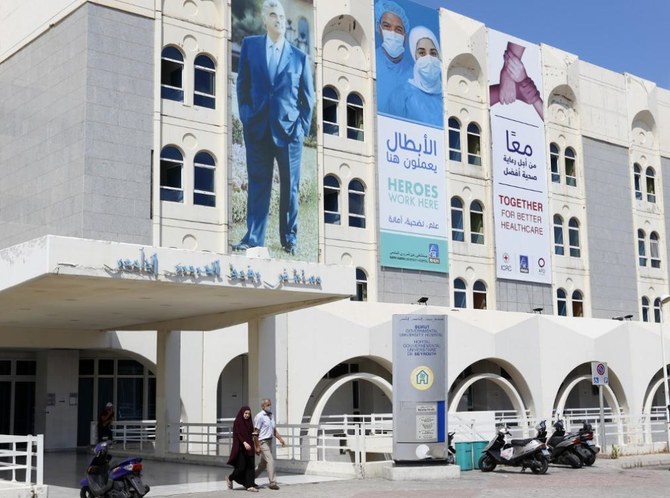

BEIRUT: A Syrian refugee in Lebanon on Thursday set himself on fire outside the UN High Commissioner for Refugees’ (UNHCR) reception center in Beirut.
Security personnel at the center acted swiftly to smother flames engulfing the man before he was rushed to hospital for emergency treatment.
The incident followed another recent suicide attempt by a Syrian suffering unbearable economic hardship in Lebanon and wanting to leave the country.
Omer Elnaiem, senior strategic communication and advocacy officer for the UN agency in Beirut, told Arab News: “It’s a tragic incident. UNHCR is in close contact with the family and medical team at the hospital to follow up on his condition. Efforts are now focused on ensuring he gets all the necessary medical support.
“Syrian refugees are demanding the UNHCR to resettle them and their families in a third country,” he said.
According to latest figures, as of Sept. 30 there were 879,529 Syrian refugees registered with the UNHCR in Lebanon, most of them living in camps scattered around the country. Large numbers of Syrians also work in agriculture, construction, security, and other professions in Lebanon.
The UNHCR said more than 80 percent of Syrian refugees in Lebanon live below the extreme poverty line, up from 55 percent last year.
“By the end of 2019, the UNHCR had submitted the files of 84,000 Syrian refugees for resettlement from Lebanon, and 59,500 refugees have left.
“The countries that receive refugees to be resettled do not reveal the numbers they receive. And the spread of the coronavirus disease (COVID-19) has paralyzed, at a global level, the process of searching for a third country and having countries receive any refugees,” Elnaiem added.
Of the 1.4 million refugees that the UNHCR has estimated were in urgent need of resettlement around the world, only 63,696 got the chance through the agency last year.
Elnaiem said: “We understand the pain of the Syrian refugees as we understand the situation of the Lebanese hosting these refugees. We monitor how the economic crisis reflects on the situation of the Syrian refugees, and we are trying to increase financial assistance to them.”
Abu Ahmed Saiba, head of the Syrian Refugee Voice in Lebanon committee, told Arab News that needs now exceeded all the assistance provided.
He said: “A Syrian in his 60s attempted a few weeks ago to hang himself in the border town of Arsal due to the stress he was suffering. He could not bear the humiliation he was subjected to by the aid providers after he became unemployed due to the economic situation in Lebanon.”
He added: “With the return of winter, the rain flooded the refugees’ tents again, and tens of families spent the night on Wednesday in the open because the water swept away their tents. Eighty tents have been destroyed.”
Arsal, situated about 124 km northeast of Beirut, houses 150 Syrian refugee camps filled mostly by people who fled fighting in the western Syrian city of Al-Qusayr and its surrounding area.
Saiba called for urgent action from the UNHCR, the International Committee of the Red Cross (ICRC), and other global aid organizations to help avert the humanitarian crisis, exacerbated by the COVID-19 outbreak.
“There is an acute shortage of all that is required — shades, wood, mattresses, blankets, cleaning materials, disinfectants, and relief materials.
“Humanitarian aid, according to the funding available to the UNHCR, reaches 31 percent of the total number of Syrian refugee families. This includes monthly multi-purpose cash and food support. An additional 17 percent of the families receive food aid only.”
Elnaiem said: “With the onset of winter, refugees are suffering greatly as they are unable to secure their basic needs. Winter is their biggest challenge, especially for those who live in mountainous areas.
“The UNHCR is preparing to launch its winter campaign to secure winter clothes, blankets, food, and cash assistance to help refugees during the harsh winter season.”
He added that UNHCR aid had not diminished despite Lebanon’s economic crisis and the pandemic.
A recent Access Center for Human Rights research paper highlighted difficulties being faced by local civil society organizations.

keywords


