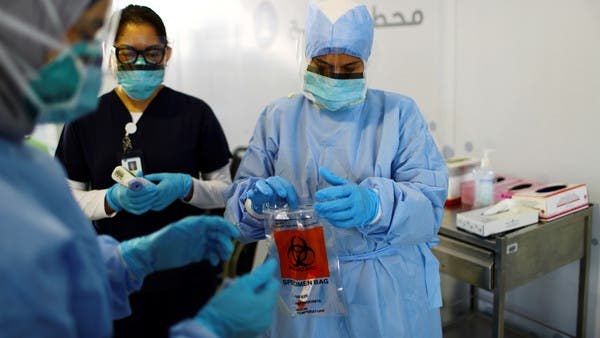

DUBAI: Health authorities in the UAE on Tuesday announced a further 1,161 confirmed cases of COVID-19 and two additional deaths from conditions related to the disease.
The Ministry of Health and Prevention said the total number of cases in the country now stands at 137,310, and the death toll has reached 505. A further 1,493 patients have recovered, bringing the total number of recoveries to 134,983.
During daily inspections, teams from Dubai’s economic authority issued fines to three shops in a shopping center for not adhering to COVID-19 precautionary measures.
Authorities in Abu Dhabi have announced new entry requirements that will apply to people entering the emirate from Nov. 8 to enhance early-detection efforts.
Residents and visitors who enter #AbuDhabi from 8 Nov and stay for 4 or more consecutive days must take a PCR test on the 4th day of entry. If they stay for 8 or more consecutive days, they must take another PCR test on the 8th day. Day 1 is counted from the day of entry.
— مكتب أبوظبي الإعلامي (@admediaoffice) November 4, 2020
The Abu Dhabi Crisis, Emergency and Disasters Committee said residents and visitors who arrive and remain in the emirate “for four or more consecutive days must take a PCR (polymerase chain reaction) test on the fourth day (after) entry. If they stay for eight or more consecutive days, they must take another PCR test on the eighth day.”
Residents and visitors will continue to be allowed to enter the emirate if they can provide evidence of a negative PCR test or laser-based DPI (diffractive phase interferometry) test within 48 hours of receiving the result.
Abu Dhabi has also announced the formation of a Scientific and Technical Advisory Group for Emergencies as part of its efforts to enhance and assist the health-care sector’s response to emergencies.
STAGE includes leading experts from public and private sectors in the UAE, KSA, USA, UK and South Korea in academic, technical and scientific specialisms relating to the COVID-19 pandemic.
— مكتب أبوظبي الإعلامي (@admediaoffice) November 4, 2020
It has a number of Emirati, regional and international COVID-19 specialists from the public and private sectors, including experts from academic, technical and scientific fields from the US, Britain, South Korea and Saudi Arabia.
Sheikh Abdullah Al-Hamed, the head of Abu Dhabi’s Department of Health said: “We are working in the department to harness all available resources and capabilities to move forward in strengthening the health sector, enriching its outputs and empowering its workers, which is part of our vision aimed at making Abu Dhabi a healthy society.”
Meanwhile, the director-general of Abu Dhabi Police, Maj. Gen. Maktoum Ali Al-Sharifi, and sector directors were given doses of a COVID-19 vaccine as part of a national program and to promote the use of the vaccine.
Kuwait recorded 763 new COVID-19 cases, bringing the total there to 128,843. The death toll stands at 794 after five more patients died.
تعلن #وزارة_الصحة عن تأكيد إصابة 763 حالة جديدة، وتسجيل 662 حالة شفاء، و 5 حالات وفاة جديدة بـ #فيروس_كورونا_المستجدّ COVID-19 ، ليصبح إجمالي عدد الحالات 128,843 حالة pic.twitter.com/uOaQuQjG2f
— وزارة الصحة - الكويت (@KUWAIT_MOH) November 4, 2020
Oman’s health ministry reported 319 new cases and 11 deaths, bringing the totals to 116,847 and 1,275 respectively.
#Statement No. 219
November 4, 2020 pic.twitter.com/EUbqr66oaq— وزارة الصحة - عُمان (@OmaniMOH) November 4, 2020
In Bahrain, three deaths were reported, bringing the death toll to 327, while 261 new infected cases were confirmed.
Out of 11552 COVID-19 tests carried out on 4 November 2020, 261 new cases have been detected among 86 expatriate workers, 171 new cases are contacts of active cases, and 4 are travel related. There were 249 recoveries from #COVID19, increasing total recoveries to 79929 pic.twitter.com/AqNsXWMAe9
— وزارة الصحة | مملكة البحرين (@MOH_Bahrain) November 4, 2020