COVID-19 second wave: Pakistan to decide on schools’ closure on November 5

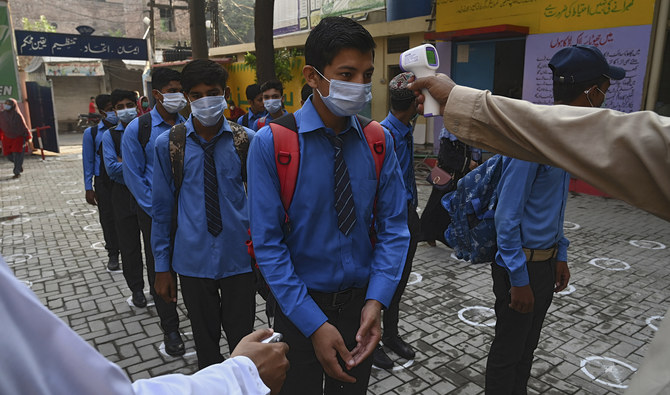
A teacher checks the body temperature of students at a government school in Lahore on Sept. 15, 2020 after the educational institutes were reopened nearly six months after the spread of the Covid-19 coronavirus. (AFP/File)
Short Url
Updated 03 November 2020
Follow

COVID-19 second wave: Pakistan to decide on schools’ closure on November 5

  • Government portal on Monday reported highest rise in coronavirus cases in a single day since July 26, with 1,123 new infections
  • PM Khan to chair a meeting of National Coordination Committee today to decide on new measures and restrictions

ISLAMABAD: The federal government has called a meeting of all provincial education ministers on Thursday, November 5, to discuss the possibility of closing down schools and universities, and announcing early winter holidays, as the country grapples with a second wave of the coronavirus, local media reported on Tuesday.

On Monday, the Pakistani minister for education said the government had not yet made a decision to close schools and universities. Prime Minister Imran Khan is scheduled to chair a meeting of the National Coordination Committee (NCC) today to discuss new measures and restrictions to help curb the spread of the coronavirus.

“Rumours again afloat regarding school closures,” education minister Shafqat Mahmood said in a tweet. “It is again clarified that educational institutions are NOT being closed. We will continue to monitor the situation as health of the students, teachers and staff is very important but at the moment no such decision has been made.”

On Monday, a government portal reported Pakistan’s highest rise in coronavirus cases in a single day since July 26, with 1,123 new infections recorded, taking the country’s total infections to 335,093. On Tuesday, the portal showed 336,260 total infections and 6,849 deaths.

Last week, Pakistan’s de facto health minister, Dr. Faisal Sultan, announced that the second wave of coronavirus had arrived and new restrictions and lockdowns were ‘inevitable.’

“NCOC discussed additional measures today to control the rising spread of Covid19,” planning minister Asad Umar tweeted on Monday, referring to the National Command and Control Center, which he heads. “Need to take immediate measures which have the most impact on disease spread without curtailing economic activity.”

Prime Minister Khan has repeatedly said the country would need to learn to “live with” the virus to avert pushing tens of millions living on daily wages into destitution.

Pakistan began to lift its lockdown, imposed in March, on May 9, about two weeks before the Eid Al-Fitr festival that marks the end of the Islamic holy month of Ramadan and is celebrated with congregation prayers, family gatherings and feasting. Transport and most businesses re-opened but cinemas, theaters and schools remain closed.

In August, the government announced that virtually all sectors shut down to prevent the spread of the coronavirus would be reopened that month, other than schools and marriage halls, which opened in September. Since then, there has been a slow uptick in infection numbers.

Last week, the NCOC made it mandatory for residents to wear masks in public places and ordered all business centers, wedding halls, eateries and shopping centers to close shop by 10 pm.

The NCOC’s has also set up a helpline where citizens can notify authorities if members of the public break COVID-19 rules.

Pakistan says 177 militants killed in Balochistan counteroffensive after wave of attacks

Updated 7 sec ago
Follow

Pakistan says 177 militants killed in Balochistan counteroffensive after wave of attacks

  • Authorities say coordinated attacks last weekend killed 31 civilians, 17 security personnel
  • Separatist BLA group claimed responsibility as operations expanded across multiple districts

ISLAMABAD: Pakistan’s security forces have killed 22 more militants in overnight counteroffensive operations in the southwestern province of Balochistan, state media reported on Monday, taking the total number of insurgents killed over the past three days to 177 following a wave of coordinated separatist attacks.

Militants launched simultaneous assaults across multiple districts in Balochistan on Friday and Saturday, targeting security installations and government facilities. The attacks marked one of the deadliest escalations in recent years in the resource-rich but restive province, with at least 31 civilians and 17 members of law enforcement agencies killed.

The banned separatist group, the Baloch Liberation Army, claimed responsibility for the attacks, saying it had launched a coordinated operation dubbed Herof, or “black storm,” targeting security forces across the province. The assault included pre-dawn strikes on high-security installations in the cities of Quetta, Gwadar, Dalbandin, Pasni, Nushki, Kalat, Turbat and Mastung.

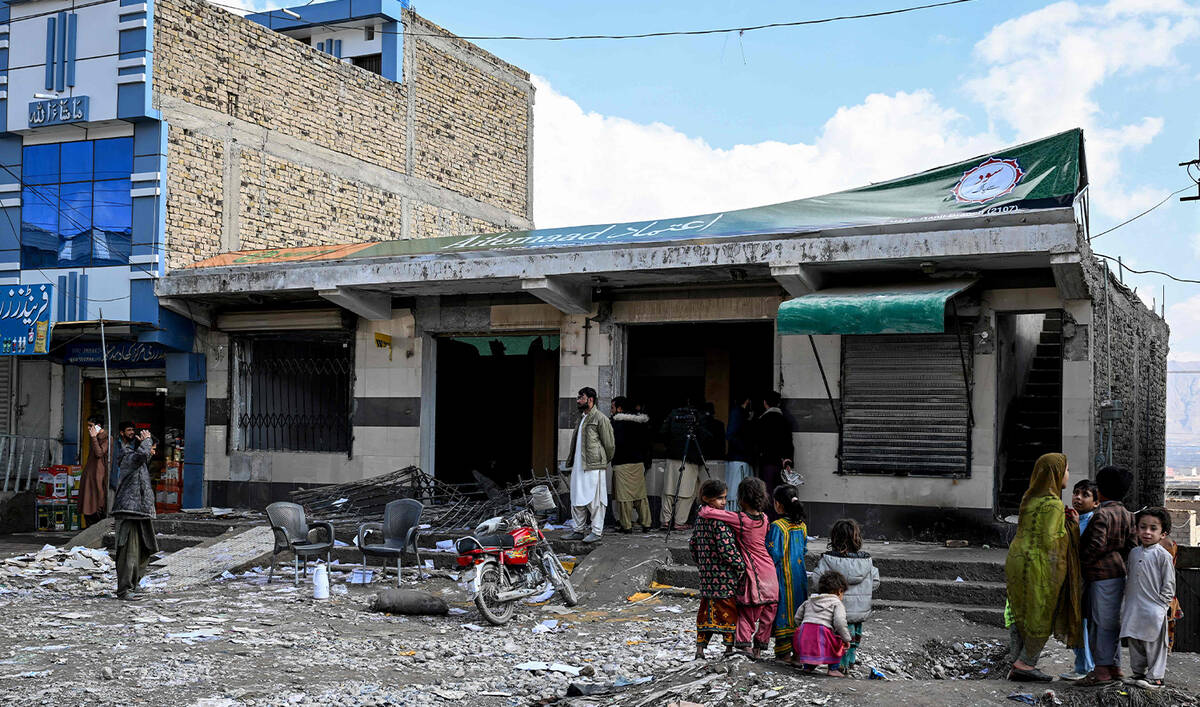
Local residents look at a damaged bank on the outskirts of Quetta on February 1, 2026 a day after an attack by Baloch separatists. (AFP)

On Monday, state broadcaster Radio Pakistan said security forces carried out the latest “sanitization operations” against what it described as “Fitna-al-Hindustan” in Balochistan late Sunday night. Pakistan’s military and civilian authorities use the term to describe separatist militants in the province whom Islamabad alleges are supported by India, a charge New Delhi denies.

“According to security sources, 22 more terrorists were killed last night during pursuit operations,” Radio Pakistan said. “At least 177 terrorists have been eliminated in the operations conducted over the last three days.”

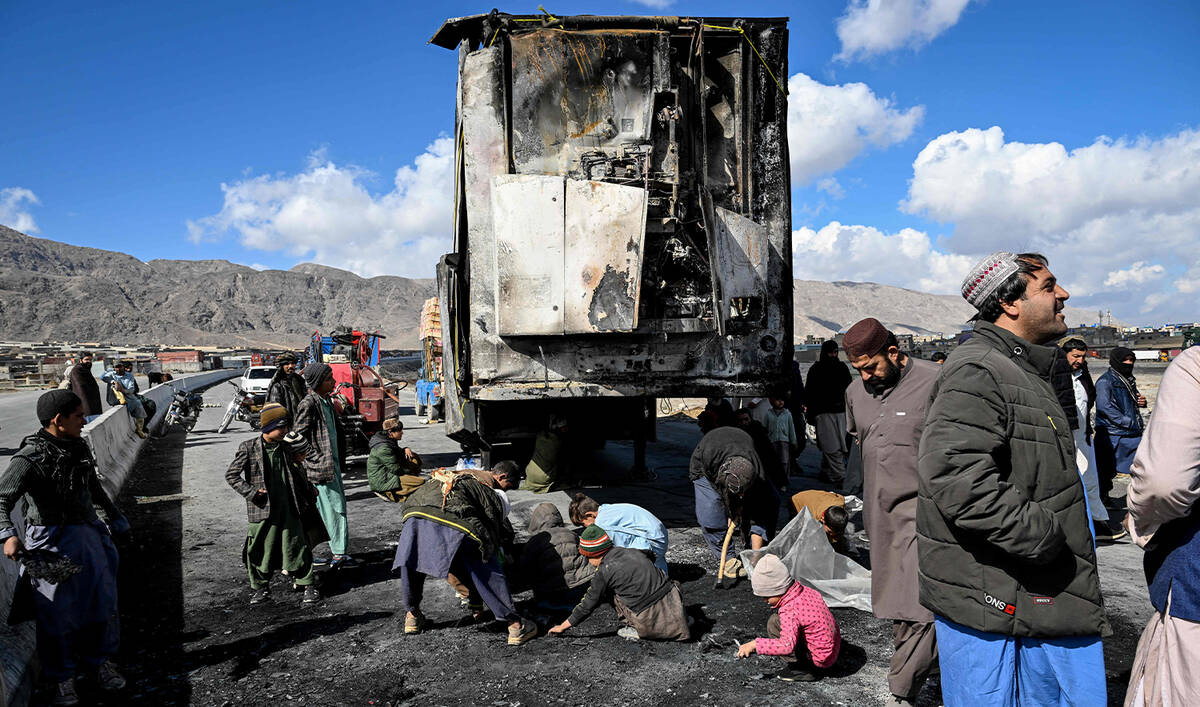
People gather as others collect recyclable items beside a burnt vehicle along a road on the outskirts of Quetta on February 1, 2026 a day after an attack by Baloch separatists. (AFP)

Balochistan, Pakistan’s largest province by area, has long been gripped by a separatist insurgency that has intensified in recent years. Militants frequently target security forces, government officials, infrastructure projects, foreigners and non-local workers.

Balochistan is strategically significant for Pakistan due to its vast reserves of minerals and hydrocarbons and its role as a transit hub for the multibillion-dollar China-Pakistan Economic Corridor (CPEC), a flagship component of China’s Belt and Road Initiative. The province is home to the deep-sea Gwadar Port on the Arabian Sea, which Islamabad views as critical to regional trade and energy routes linking China, Central Asia and the Middle East. 

Local residents look at a damaged bank on the outskirts of Quetta on February 1, 2026, a day after an attack by Baloch separatists. (AFP)

Separatist groups accuse the central government of exploiting the province’s natural resources while neglecting local communities. Islamabad rejects the allegations, saying it is investing in development and security to stabilize the province.