

Erdogan ‘trying to start a war in the Med’

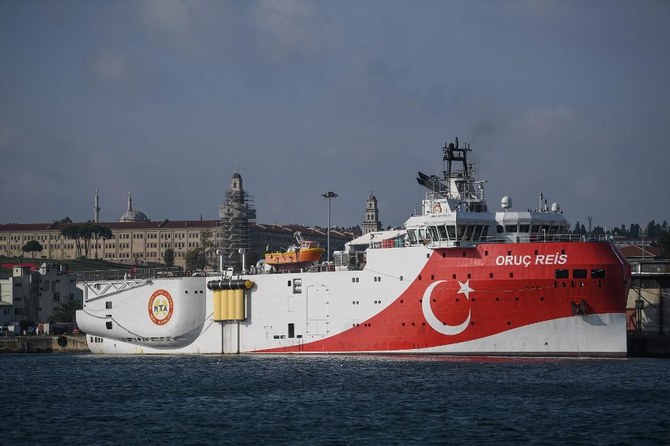
The Oruc Reis, escorted by military ships, has become the symbol of Ankara’s quest for natural gas in the eastern Mediterranean. (File/AFP)
Short Url
Updated 01 November 2020
Follow

Erdogan ‘trying to start a war in the Med’

  • The Greek Foreign Ministry condemned the Turkish move
  • Greek Foreign Minister Nikos Dendias is to inform the country’s allies about the developments

ANKARA: Turkey has extending research activities of its Oruc Reis seismic research vessel in the disputed waters of the eastern Mediterranean until Nov. 14.

The move is likely to re-ignite regional tensions after the 7.0 magnitude earthquake that hit Turkey and Greece last week, which was expected to lead to a period of earthquake diplomacy, as happened in 1999.

The new navigational alert (Navtex) issued by Turkey covers sea surveys 16 nautical miles off the Greek island of Rhodes and 50 nautical miles from the island of Kastellorizo.

The Greek Foreign Ministry condemned the Turkish move.

“This action creates further tension in a vulnerable region in which attention is now focused on the provision of assistance and on expressions of support and solidarity,” it said in a press release.

“These actions show once again that Turkey is continuing to act in defiance of the appeals of the international community, including the conclusions of the October meeting of the European Council, which called on Turkey to cease these actions,” it added.

Greek Foreign Minister Nikos Dendias is to inform the country’s allies and partners about the latest developments.

EU leaders agreed on Oct. 2 to give Turkey until early December to reconsider its moves in eastern Mediterranean before considering economic sanctions.

Evangelos D. Kokkinos, an Athens-based geopolitical expert, thinks Turkey issued its Navtex to take advantage Europe’s inability to impose sanctions.

“Most European nations are expected to ‘condemn’ Turkish aggression, but sanctions are out of the question. So, Turkey extending its research activities in the region is another example of ignoring international law and Greek sovereignty,” he told Arab News.

As to what regional tensions it might trigger, Kokkinos thinks that Turkey is already causing serious problems for most of its neighbors, but since both Greece and Turkey are NATO member countries, Turkish President Recep Tayyip Erdogan’s strategy is to provoke Athens into starting a military conflict, so that NATO supports Turkey.

“This is why the tension will remain in what seems like the Mediterranean Cold War,” he said.

According to Seth J. Frantzman, executive director of the Middle East Center for Reporting and Analysis, “the renewal of a provocative Navtex is the latest crisis pushed by Ankara.”

“It had already declared a Navtex in early October. Greece and European countries have condemned the use of these navigational notifications,” he told Arab News.

Frantzman thinks that Turkey uses the Navtex as a way to challenge Greece at sea, which is an abuse of the concept of the Navtex.

“Turkey has done it numerous times in the past several months, shifting from one crisis to another each time. Now Turkey is moving on from having incited against France and Armenia to attacking Greece,” he said, and added:

“It is made even more shameful by the recent earthquake where Greece and others had offered Turkey aid and Ankara’s response is a naval provocation and threat.”

The maritime dispute escalated in August when Turkey first sent its Oruc Reis vessel into waters claimed by Greece and Cyprus. Ankara then withdrew its drilling vessel last month to allow more room for diplomacy ahead of an Oct. 2 European Union summit, where Cyprus and Greece demanded for tough sanctions against Turkey.

Insisting on its rights in the energy-rich Mediterranean region, Turkey dispatched its vessel again on Oct. 12, inciting reaction from the international communit. It sparked concerns about a potential military conflict between the two neighbors who argue over the extent of their continental shelves and claims about regional hydrocarbon resources.


Last Christians gather in ruins of Turkiye’s quake-hit Antakya

Updated 5 sec ago
Follow

Last Christians gather in ruins of Turkiye’s quake-hit Antakya

  • Saint Peter’s, one of the world’s oldest rock churches, is a sacred rallying point for the isolated Christians still left in quake-hit Antakya in southeastern Turkiye
ANTAKYA: Saint Peter’s, one of the world’s oldest rock churches, is a sacred rallying point for the isolated Christians still left in quake-hit Antakya in southeastern Turkiye, the city known in ancient times as Antioch.
“Since the earthquake, our community has scattered,” said worshipper Mari Ibri.
“Those who remain are trying to regroup. We each had our own church but, like mine, they have been destroyed.”
The landscape around the cave remains scarred by the disaster nearly three years ago, when two earthquakes devastated Hatay province on February 6, 2023 and its jewel, Antakya, the gateway to Syria.
Sad fields of rubble and the silhouettes of cracked, abandoned buildings still scar the city — all enveloped in the ever-present grey dust.
Since the earthquakes, Antakya city has emptied and the Christian community has shrunk from 350 families to fewer than 90, Father Dimitri Dogum told AFP.
“Before, Christmas at our house was grandiose,” Ibri recalled.
“Our churches were full. People came from everywhere.”
Ibri’s own church in the city center was rendered inaccessible by the earthquakes.
Now she and other worshippers gather at the cave on December 24 — Christmas Eve in some Christian calendars.
It is here, they believe, that Peter, the disciple Jesus assigned to found the Christian church, held his first religious service in the 1st century.
The rock church was later enlarged and 11th-century crusaders added a pale stone facade.
It is now a museum, opened to the faithful only on rare occasions.
Christmas Eve is one.
The morning sun was still glowing red in the sky when Fadi Hurigil, leader of Antakya’s Orthodox Christian community, and his assistants prepared the service.
They draped the stone altar and unpacked candles, holy oil, chalices and plastic chairs.
Out in front they placed figurines of Christ and three saints near a bottle of rough red wine, bread baskets and presents for the children.
The sound system played a recording of the bells of Saint Peter and Paul church, which now stands empty in Antakya city center.
“That was my church,” said Ibri, crossing herself. “They recorded the peals.”
Around one hundred worshippers soon squeezed into the incense-filled cave and at least as many congregated outside.
A large police contingent looked on. Sniffer dogs had already inspected the cave and esplanade.
“It’s normal,” said Iliye, a 72-year-old from Iskenderun, 60 kilometers (40 miles) further north. “We’re a minority. It’s to protect us.”
The slow chanting of Orthodox hymns heralded the start of the two-hour service, conducted entirely in chants sung in Arabic and Turkish by Dogum and another cleric.
“It’s very moving for us to be here in the world’s first cave church, where the first disciples gathered,” the priest said.
“There used to be crowds here,” he added.
“In 2022, there were at least 750 people outside, Christians and non-Christians alike.”
Since the earthquakes, the gathering has been much smaller, although it is now starting to grow again.
At the end of the service, when Christmas carols fill the air, Dogum and Hurigil cut a huge rectangular cake.
The Nativity scene at its center — Mary, baby Jesus, the ox and the ass — was edged with whipped cream.
“There’s the religious dimension but it’s also important that people can gather here again,” a worshipper said.
“After February 6, our fellow citizens scattered. But they’re starting to come back. We’re happy about that.”