

Security forces keep radical protesters away from French Embassy in Beirut

1 / 4
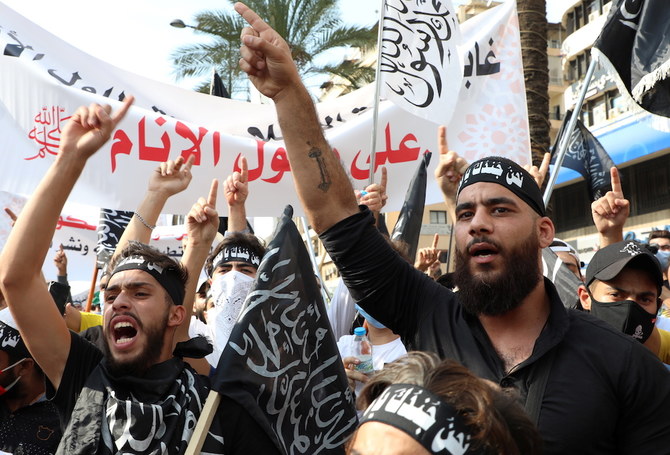
Demonstrators gesture during a protest against the cartoon publications of Prophet Mohammad in France and comments by the French President Emmanuel Macron, in Beirut. (AFP)
2 / 4
A demonstrator gestures during a protest against the cartoon publications of Prophet Mohammad in France and comments by the French President Emmanuel Macron, in Beirut. (Reuters)
3 / 4
Demonstrators gesture and chant slogans during a protest against the cartoon publications of Prophet Mohammad in France and comments by the French President Emmanuel Macron, in Beirut. (Reuters)
4 / 4
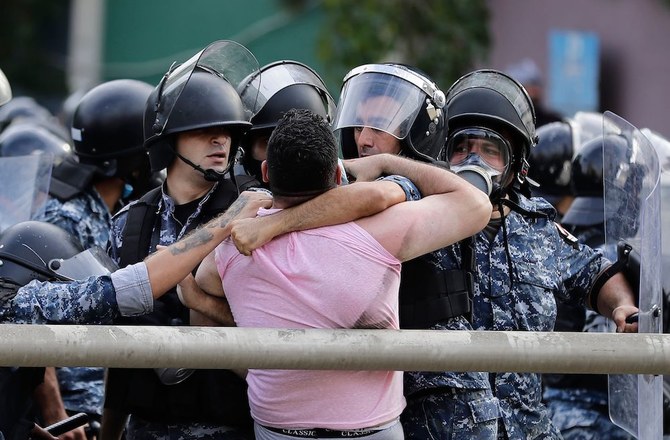
Members of Lebanon's security forces clash with a demonstrator at a rally called by an Islamist group to protest the French President's defence of the right to publish cartoons seen as offensive to Islam, near the residence of the French Ambassador in the capital Beirut, on October 30, 2020. (AFP)
Short Url
Updated 31 October 2020
Follow

Security forces keep radical protesters away from French Embassy in Beirut

  • Calls for a demonstration by radical Islamic groups spread on social media platforms
  • Security forces had anticipated Friday’s protest and tightened security in the heart of Beirut

BEIRUT: Lebanese security forces prevented the arrival of hundreds of protesters at the French ambassador’s residence and the French Embassy in Lebanon on Friday.

They feared the recurrence of riots similar to the ones that erupted in front of the Danish Embassy in Ashrafieh, Beirut, in 2006, and led to 28 people being injured, damage to storefronts, and the burning of the consulate building and terrorizing of people.

A few hundred worshippers left mosques after Friday prayers and marched saying they intended to ‘defend the Prophet Muhammad.‘

Calls for a demonstration by radical Islamic groups spread on social media platforms.

Khaldoun Qawwas, Dar Al-Fatwa’s media spokesperson, told Arab News: “These groups have nothing to do with Dar Al-Fatwa, which has already announced its position regarding what happened in France in two separate statements.”

Sheikh Abdul Latif Deryan, the grand mufti of Lebanon, in a statement issued a week earlier, said that “freedom of opinion and expression does not entail insulting the beliefs and symbols of others, and this requires a reconsideration of the concept of absolute freedom.”

He stressed the “renunciation of violence and confrontation of radicalism and terrorism that has no religion or race.”

Security forces had anticipated Friday’s protest and tightened security in the heart of Beirut, since the embassy and the French ambassador’s residence are located where roads leading to the city’s western and eastern neighborhoods intersect. This led to a huge traffic jam in the capital.

The protest’s starting point was the Gamal Abdel Nasser Mosque in Al-Mazraa, situated only a few kilometers from the Residence des Pins (Pine Residence).

Three major security checkpoints — one set up by the riot police — separated the Residence des Pins and protesters, some of whom were transported by buses from the north of Lebanon to Beirut.

Protesters held Islamic signs and chanted slogans denouncing France, its President Emmanuel Macron and its former colonization of the country. Some protesters tried to remove barbed wire and threw stones, water bottles and batons at the security forces. Another group burned the French flag. Security forces responded by throwing tear gas canisters, leading to the retreat of the protesters.

In a statement, Lebanon’s Supreme Council of the Roman Catholic condemned “the terrorist attack in the French city of Nice.”

The council considered that “this terrorist crime has nothing to do with Islam and Muslims. It is an individual act carried out by terrorists haunted by radicalism, obscurantism and the rejection of the French people’s historical civilizational values. Through their acts, they abuse the spirit of tolerance, coexistence, acceptance of the other and the freedom of thought and belief which all religions call for.”

The council called for “staying away from defaming religions and beliefs and inciting hate and resentment among people, raising the voice of moderation, wisdom and reason, working together in the spirit of the Document on Human Fraternity for World Peace and Living Together announced by Pope Francis and the Grand Imam of Al-Azhar, Sheikh Ahmed Al-Tayeb from the UAE last year.”

During the Friday sermon, Grand Jaafari Mufti Sheikh Ahmad Kabalan condemned “any criminal act against any people, including the French people.” He added: “We categorically reject what happened in Nice yesterday, strongly condemn it and consider it a blatant and insolent attack on Muslims before others.”

He simultaneously condemned “the official French position that affronted the Prophet, took lightly and made light of the feelings of millions of Muslims.”


Syrian Alawites protest in coastal heartland after mosque bombing

Updated 59 min 20 sec ago
Follow

Syrian Alawites protest in coastal heartland after mosque bombing

  • Syrian Alawites took to the streets on Sunday in the coastal city of Latakia to protest after a mosque bombing that killed eight people in Homs two days before

LATAKIA: Syrian Alawites took to the streets on Sunday in the coastal city of Latakia to protest after a mosque bombing that killed eight people in Homs two days before.
The attack, which took place in an Alawite area of Homs city, was the latest against the religious minority, which has been the target of several episodes of violence since the December 2024 fall of longtime ruler Bashar Assad, himself an Alawite.
Security forces were deployed in the area, and intervened to break up clashes between demonstrators and counter-protesters, an AFP correspondent witnessed.
“Why the killing? Why the assassination? Why the kidnapping? Why these random actions without any deterrent, accountability or oversight?” said protester Numeir Ramadan, a 48-year-old trader.
“Assad is gone, and we do not support Assad... Why this killing?“
Sunday’s demonstration came after calls from prominent spiritual leader Ghazal Ghazal, head of the Islamic Alawite Council in Syria and Abroad, who on Saturday urged people to “show the world that the Alawite community cannot be humiliated or marginalized.”
“We do not want a civil war, we want political federalism. We do not want your terrorism. We want to determine our own destiny,” he said in a video message on Facebook.
Protesters carried pictures of Ghazal along with banners expressing support for him, while chanting calls for decentralized government authority and a degree of regional autonomy.
“Our first demand is federalism to stop the bloodshed, because Alawite blood is not cheap, and Syrian blood in general is not cheap. We are being killed because we are Alawites,” Hadil Salha, a 40-year-old housewife said.
Most Syrians are Sunni Muslim, and the city of Homs — where Friday’s bombing took place — is home to a Sunni majority but also has several areas that are predominantly Alawite, a community whose faith stems from Shiite Islam.
The community is otherwise mostly present across their coastal heartland in Latakia and Tartus provinces.
Since Assad’s fall, the Syrian Observatory for Human Rights monitor and Homs province residents have reported kidnappings and killings targeting members of the minority community.
Alawite massacres 
The country has also seen several bloody flare-ups of sectarian violence.
Syria’s coastal areas saw the massacre of Alawite civilians in March, with authorities accusing armed Assad supporters of sparking the violence by attacking security forces.
A national commission of inquiry said at least 1,426 members of the minority were killed, while the Syrian Observatory for Human Rights monitor put the toll at more than 1,700.
Late last month, thousands of people demonstrated on the coast to protest fresh attacks targeting Alawites in Homs and other regions.
Before and after the March bloodshed, authorities carried out a massive arrest campaign in predominantly Alawite areas, which are also former Assad strongholds.
Protesters on Sunday also demanded the release of detainees.
On Friday, Syrian state television reported the release of 70 detainees in Latakia “after it was proven that they were not involved in war crimes,” saying more releases would follow.
Despite assurances from Damascus that all Syria’s communities will be protected, the country’s minorities remain wary of their future under the new Islamist authorities, who have so far rejected calls for federalism.